


NVIDIA AI Computer 'Supports Level 5 Driverless Autonomous Vehicles'
 Published2017.10.12 10:54
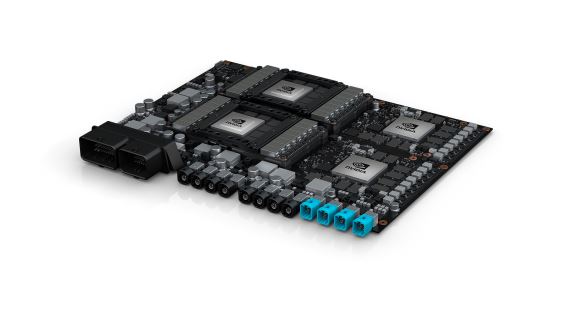
엔비디아가 뮌헨에서 (현지 시간) 10일부터 12일까지 진행되는 ‘GTC 유럽(GTC Europe)’에서 완전자율주행 로봇택시 개발을 위해 설계된 세계 최초의 인공지능 컴퓨터를 공개했다.

Comments
Related news
145 Autonomous Driving Startups Worldwide Choose NVIDIA Platform
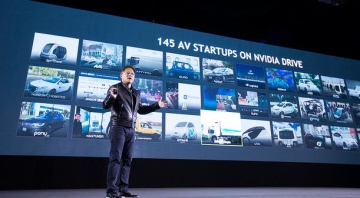
NVIDIA announced at the keynote speech by CEO Jensen Huang at the NVIDIA GPU Technology Conference (GTC) held on the 26th in Beijing, China, that numerous startups developing autonomous driving vehicle solutions are using the NVIDIA AI platform. Autonomous vehicles require artificial intelligence to explore driving scenarios that approach near-infinite possibilities. The NVIDIA AI platform provides solutions that span from cloud to vehicle. In data centers, deep neural networks are trained using the NVIDIA DGX system, while NVIDIA DRIVE PX is mounted in vehicles to implement real-time low-latency inference, enabling safe driving. NVIDIA collaborates with world-leading automotive manufacturers such as Audi, Toyota, Mercedes-Benz, Volvo, and Tesla, while also working with startups that are creating new and significant autonomous driving solutions through innovation and originality. CEO Jensen Huang stated, "The reason for the enormous investment being made in this field is simple," and added, "It is a field that has major societal impact, and the technologies necessary to achieve autonomy have been established, but because the problem is extremely complex, startup innovation can be sustained for a long time, and the industry itself is very expansive."
2017.09.27by 김지혜 기자

German delivery trucks, driver shortage prompts adoption of 'Nvidia autonomous driving'
Nvidia announced that it will collaborate with Deutsche Post DHL Group (DPDHL), a postal and logistics specialist, and ZF, an automotive parts manufacturer, to pilot autonomous delivery trucks starting in 2018. DPDHL plans to apply an artificial intelligence autonomous driving system (ZF ProAI) based on Nvidia Drive PX technology to electric small trucks to advance automation in package transportation and delivery.
2017.10.12by 김자영 기자
NVIDIA: "Vivid collaboration anytime, anywhere in VR."
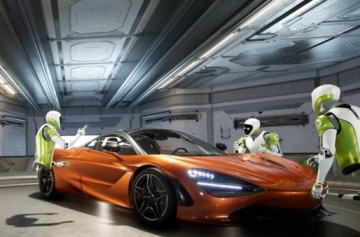
NVIDIA announced that it will provide early access to NVIDIA Holodeck, an intelligent virtual reality (VR) platform, to select designers and developers at 'GTC Europe' taking place from the 10th to 12th in Munich (local time). NVIDIA Holodeck is a platform that facilitates collaboration among designers, developers, and customers from anywhere in the world. Customers can view, build, and review creative works together in a VR environment where physical simulation takes place.
2017.10.12by 김자영 기자

[e4ds Tech Day 2026 ⑨] Sim Sang-gyu, Autocrypt CTO: "In the Physical AI Era, Automotive Security Must Extend Beyond the Vehicle"
At e4ds Tech Day 2026, Sim Sang-gyu, CTO of Autocrypt, explained automotive cybersecurity strategies in the era of Physical AI and SDV (Software-Defined Vehicle). Automobiles are evolving as part of an ecosystem connected to AI, cloud, chargers, IoT, and robots, and he emphasized that the scope of security must expand beyond the vehicle interior to the entire connected environment. In particular, AI model tampering, adversarial attacks, OTA updates, and EV charger hacking were identified as major threats. He explained that response measures require zero trust, AI model integrity protection, intrusion detection, Security by Design and Default, and full lifecycle security management, and that proactive security system establishment beyond regulatory compliance is critical for securing future mobility competitiveness.
2026.10.12by 배종인 기자

Practical HIL Construction Strategy for Automotive and Off-Highway Controller Validation
As vehicle E/E architecture transitions to zonal structures and shifts to software-defined vehicles (SDV), the number of controllers (ECUs) requiring validation and software complexity are surging dramatically. Meanwhile, real vehicle testing cannot provide repeated verification under identical conditions and entails lead time and safety concerns. This white paper explains the principles of HIL (Hardware-in-the-Loop) validation and the structure of the NI platform composed of PXI, SLSC, and VeriStand, and through two actual implementation cases—Camera Record & Replay HIL for In-Cabin Monitoring Controller (ICMU) and Forklift Controller (VCU) HILS—describes how controller-level regression testing becomes possible. Additionally, it explicitly states application boundaries and limitations, such as lack of A2B support.
2026.10.12by 편집부











