



Infosonic Delivers Payment Information via Sound
 Published2017.10.12 13:55
It is a technology that transmits information like a QR code. The difference is that it uses inaudible sound waves. It is safer and more convenient than a QR code.
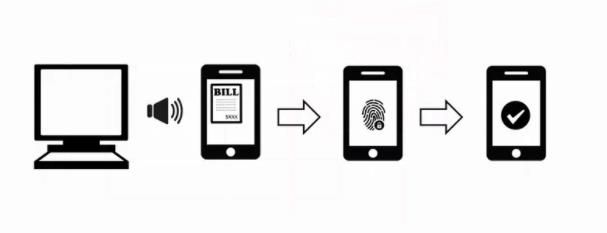
Lee Dong-ho, CTO of Infosonic, made these remarks while introducing 'Sonic Code,' a fintech technology utilizing inaudible sound waves. Sonic Code is a technology that embeds transaction request information into encrypted sound waves transmitted through a speaker, receives this data via a smartphone's microphone to authenticate the user, and enables payment.
Traditional transmission technologies used in fintech included Near Field Communication (NFC), iBeacon, and Bluetooth. Utilizing these technologies requires devices such as terminals or tags and presents security issues. Sonic Code, however, utilizes inaudible sound waves—patterns in the high-frequency band that are inaudible to the human ear—enabling implementation with only an internet connection, a speaker, and a microphone, even without dedicated terminals or the latest mobile devices.
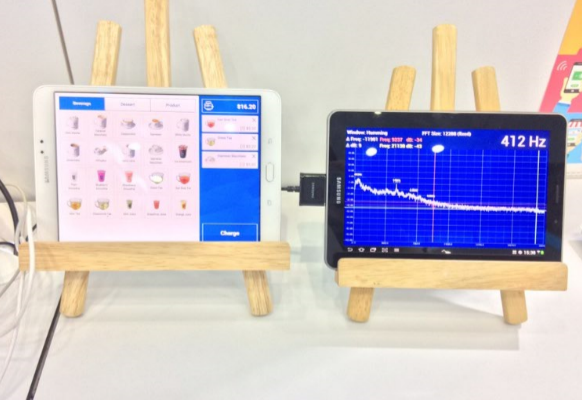
It has the advantage of being usable on all smartphones and requiring no separate device other than a speaker, making it easier to distribute and cheaper to build infrastructure than NFC or QR codes. The recognition speed of Sonic Code is approximately 0.2 seconds, and a recognition distance of around 30 cm is sufficient. QR codes require scanning with a camera, but this can be used without such a separate input action.
Users can log in to online sites without entering an ID or password, and use internet banking and make payments at online shopping malls without going through payment processes such as installing plugins or entering card numbers. Payments are also possible at offline stores with just a smartphone, without the need for a separate payment infrastructure. Furthermore, convenient money transfers between users are possible both in-person and remotely as long as they are within sound wave detection range.
"It takes about 30 seconds to log in and make a payment using existing bank certificates. Sonic Code reduces the steps from authentication to payment to make it possible in just 3 seconds," explained CTO Lee Dong-ho. "It supports 281 trillion simultaneously available codes. There is no issue with duplicate sound wave codes."
It emphasizes not only convenience but also security. Existing QR code-based mobile payments face issues such as hacking caused by screen captures or fake QR codes, as well as abnormal payments. In contrast, Sonic Code transmits payment information via sound waves, ensuring that payments operate only within the server. Focusing on the transmission of payment information, it integrates with security technologies such as PKI authentication, transaction-linked OTPs that block memory hacking, and the storage of authentication elements within a Trust Zone.
CTO Lee Dong-ho said, “Infosonic developed everything in-house, starting with the DB server. If you pay the license fee, we provide the sequence and architecture.” “We are creating and uploading new demos and making them available for customers to use,” he said. “There are long-distance and short-distance transmissions, but we are focusing on short-distance. We have achieved a short-distance transmission error detection rate of 99.999994!?”
He emphasized, “People think that superior security comes at the expense of convenience, and high convenience comes at the expense of security, but Infosonic has a strength in meeting the three goals of security, convenience, and low cost.”
Comments
Related news
Irience Develops Iris Recognition That Authentications in the Blink of an Eye
The newly unveiled 'iPhone X' features facial recognition. Samsung also equipped its Galaxy Note 7 with iris recognition capability. Now fingerprint recognition is used not only for unlocking smartphones but also for door locks. In contrast to fingerprint recognition, which has the disadvantages of being easily altered and subject to forgery, the iris is formed from the most complex and intricate fibrous tissue in the human body, making authentication forgery difficult. Since each eye also has different patterns, it can be used for identity verification. Irisense is a company that develops and manufactures products based on iris recognition technology. It has created access control systems and management programs based on iris recognition algorithms. Irisense's iris recognition algorithm features a fast frame rate for extracting iris characteristics and enables accurate 1:N matching. Iris information registration is possible regardless of iris color, and since data extracted from iris images rather than video materials is stored, it blocks authentication using photographs, videos, and artificial imitations. The company has developed a ultra-compact iris recognition module and is commercializing products based on this technology.
2017.09.13by 김지혜 기자

Olive Union helps ease hearing loss concerns with a hearing aid that connects to your phone.
In a variety show, a close-knit grandson and grandmother went out together. Their destination was an otolaryngology clinic. One of the hearing aids fitted several years ago wasn't fitting well in grandmother's ear, so the family's voices were gradually becoming louder, and they decided to get a hearing test and have the hearing aid checked. After hearing the doctor's negative opinion, the grandson tried to get a new one fitted on the other ear, but grandmother raised her voice sharply. The reason was, as expected, the high cost. While wearing both hearing aids can slow down hearing loss, many people only wear one. Into this hearing aid market with such high costs, a hearing aid in the 100,000 won range—significantly lower in price—has been launched. It is the startup 'Olive Union (http://www.oliveunion.com/ko/)'.
2017.09.22by 김자영 기자
Carssum, it's the era of mobility now, so try car sharing.
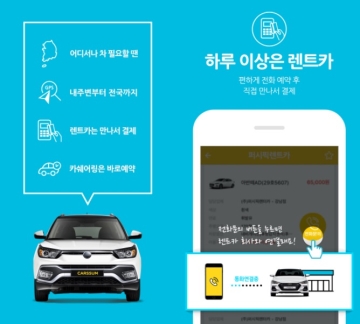
Last July, Ssoca achieved a cumulative booking milestone of 10 million reservations. Not only Ssoca but car-sharing service providers such as Green Car are also seeing increased usage rates. Ha Ho-seon, CEO of Korea Car Sharing, stated, "Car-sharing has been adopted as we enter an era of low growth and shared economy," adding, "It is not simply a car rental concept but a mobile-based converged service centered on automobiles, and an era of automobile mobility will arrive." Korea Car Sharing's Carsum is realizing e-mobility through car-sharing platform development and the activation of connected rental vehicle usage. It provides corporate fleet vehicles on a B2B basis and unmanned rental car services and integrated rental car management platform services on a B2C basis. Carsum provides unmanned brokerage services for members who are rental car users and rental car operators. Existing rental car services enabled long-term rentals and non-member usage, but were based on long-distance criteria. By introducing the car-sharing concept, it has made both long-distance and short-distance usage possible. Through unmanned rental, vehicles at sales offices or parking lots can be used without time constraints, available 24 hours a day, 365 days a year.
2017.09.29by 김지혜 기자

The financial services industry is the most active in adopting hybrid cloud.
Nutanix announced the cloud adoption status and outlook for the financial services industry through its Enterprise Cloud Index report. According to a survey of current hybrid cloud adoption rates by industry, the financial services industry's hybrid cloud adoption rate was 21%, which was higher than the industry average of 18.5%. Financial services companies are facing the challenge of providing differentiated experiences to customers through methods such as leveraging emerging technologies like blockchain, while simultaneously simplifying operations.
2019.04.02by 이수민 기자

IBM Blockchain World Wire… Real-time global financial payment network expands to over 50 countries worldwide
IBM announced on the 19th the expansion of IBM Blockchain World Wire, a real-time global financial settlement network for financial institutions. World Wire was developed to accelerate and optimize foreign exchange transactions and cross-border payment and remittance speeds. Additionally, it integrates payment message transmission, clearing, and settlement procedures into a single network while supporting network participants in selecting various types of digital assets for settlement. Starting from the 19th, the payment service area will be expanded to 72 countries, including 47 global currencies and 44 financial endpoints. Busan Bank became the first domestic bank to join World Wire.
2019.03.19by 이수민 기자











