



Western Digital Unveils HDD with MAMR Technology
 Published2017.10.18 13:23

Western Digital announced the development of an ultra-high-capacity HDD capable of meeting future big data demands, based on proven data center-grade reliability.
Western Digital held an event at its Silicon Valley headquarters under the theme "Innovating to Fuel the Next Decade of Big Data." The event featured a demonstration of the world's first HDD equipped with Microwave-Assisted Magnetic Recording (MAMR) technology, along with a presentation by Jimmy Zhu, a company executive and MAMR technology developer who is also a professor at Carnegie Mellon University. Additionally, improvements in Micro Actuation and Damascene Recording Head technologies were introduced.
Western Digital has recently been pursuing innovation in materials and processes to provide stable and predictable performance and achieve an annual average improvement of over 15% in areal density and cost in terms of manufacturing capabilities. While the existing Heat-Assisted Magnetic Recording (HAMR) method faced challenges in new materials science and reliability, the newly announced MAMR technology is not constrained by these issues and satisfies the requirements of data center operators in terms of reliability and cost. Western Digital predicted that in 2019, ultra-high capacity MAMR HDDs would be shipped and available for use in data centers supporting big data applications in various fields.
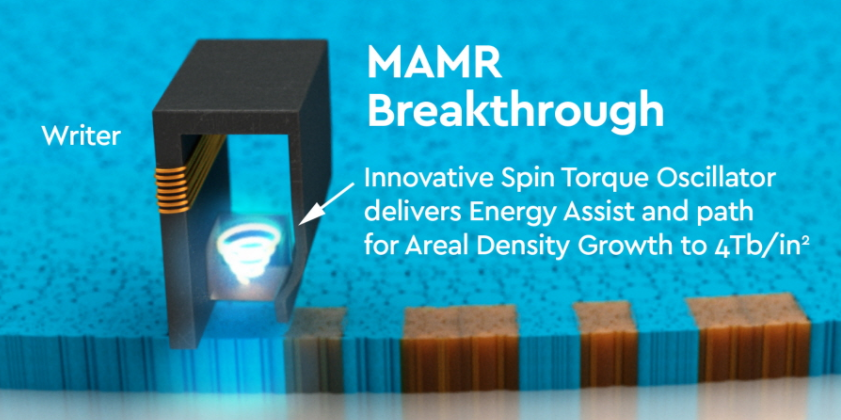
The core of this technology lies in the 'spin torque oscillator.' The spin torque oscillator is used to generate a microwave field that enhances data recording capabilities without loss of reliability, even in ultra-high-density environments. Based on this, Western Digital's MAMR technology is expected to provide a recording density of over 4 terabit (Tb) per square inch. Furthermore, it is projected that the development of HDDs with a capacity of over 40 terabytes (TB) will be possible by 2025 through the continuous improvement of recording density via MAMR technology.
Western Digital’s MAMR technology, which significantly improves areal density, was developed based on the company’s microactuation and recording head manufacturing technologies, which were also used in the development of the helium-filled drive technology, 'HelioSeal'. This enhanced microactuation technology for data center applications ensures that the hard drive’s magnetic head remains accurately and stably positioned even during read and write operations in ultra-high-density environments. Furthermore, the manufacturing of heads with precise tolerance ranges and complex structures required for stable and cost-effective recording in such ultra-high-density environments is achieved through in-house supply via the damascene process. The damascene process also enables the insertion of spin torque oscillators necessary for MAMR head manufacturing. The combination of these technologies enables Western Digital's HDDs to dramatically reduce the total cost of ownership (TCO) of cloud and enterprise data centers of all sizes.
This announcement of MAMR technology is an achievement based on the leadership Western Digital has built in the HDD field. Western Digital has achieved innovations including the acquisition of over 7,000 HDD technology-related patents, the recent launch of the world's first enterprise-grade 14TB HDD incorporating host-managed SMR technology, continuous improvements to helium-based HDD technology, and the world's first multi-disk design.
"Western Digital's MAMR technology has enabled us to approach the future of high-capacity storage by redefining HDD density and introducing a new dimension of highly stabilized, ultra-high-capacity drives," said Mike Cordano, President and COO of Western Digital. "Just as Western Digital has shipped over 20 million helium drives since introducing HelioSeal technology five years ago, our goal is to continue this leadership and innovation."
Comments
Related news
Western Digital Announces New SD Cards for Industrial and Automotive
The latest industrial and automotive SD card storage solution unveiled this time delivers exceptional durability and reliability optimized for security systems, intensive industrial Internet of Things (IIoT) applications, and connected automotive applications requiring extreme temperature specifications. Compared to existing products, read speeds are improved up to 4 times and write speeds are enhanced more than 2 times, enabling OEM manufacturers to utilize applications without constraints. The solution can be widely applied ranging from smart security systems requiring rapid CCTV analysis, to capturing high-definition video in commercial drones and black boxes, as well as improving responsiveness in automotive 3D mapping navigation systems.
2017.09.29by 김자영 기자
Western Digital Launches 14TB HDD with Stilt-Back Magnetic Recording Technology
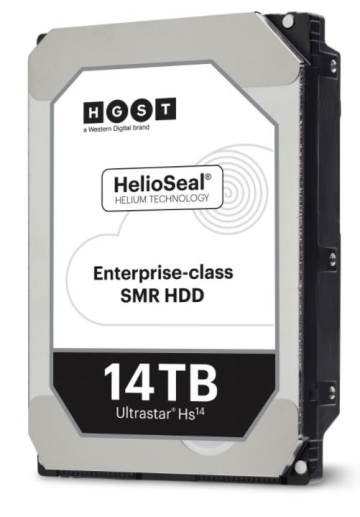
Western Digital launches the 14TB enterprise-class HDD 'Ultrastar Hs14'. The new product applies Shingled Magnetic Recording (SMR) technology, which stacks data tracks like roof tiles, providing storage space for big data applications required in cloud and hyperscale data centers. The Ultrastar Hs14, which Western Digital launches under the HGST brand, delivers over 40% improved capacity compared to the company's previous SMR-based products and sequential write performance more than twice as fast. This enables more economical and efficient storage of increasingly vast and diverse data in the big data era.
2017.10.13by 김지혜 기자
Western Digital Launches HDDs Optimized for Enterprise Workloads
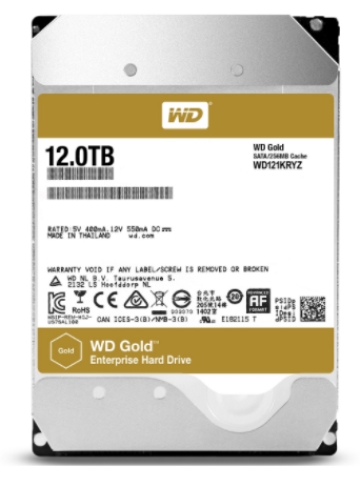
Western Digital has strengthened its WD Gold HDD lineup by launching the WD Gold 12TB, an HDD optimized for demanding enterprise workload processing. The WD Gold 12TB is a reliable and efficient storage solution for the rapidly growing data needs of enterprises across various enterprise and cloud storage applications. WD Gold provides an optimal storage solution for protecting and storing diverse enterprise data such as confidential customer information, medical records, or business intelligence. It is particularly designed with a focus on safely storing the most critical data for enterprises. The WD Gold, specially engineered for high-workload and high-vibration server environments, boasts an average mean time between failures (MTBF) of 2.5 million hours, representing the highest reliability rating in Western Digital's HDD portfolio. The drive applies Western Digital's patented fourth-generation HelioSeal process, which minimizes internal resistance by using helium at 1/7 the air density, maximizing capacity while optimizing both reliability and power efficiency.
2017.10.17by 김지혜 기자
.jpg)
SalePoint Signs Multi-Year Partnership Agreement with AWS… Promoting Identity Security that Integrates Even AI Agents
Sailpoint has entered into a multi-year strategic partnership agreement with AWS and is moving forward with establishing an integrated governance system that manages both human and non-human identities together. The plan is to consistently manage access permissions in an environment where AI agents are increasing as work execution entities, while applying the principle of least privilege and automated policy enforcement. The two companies plan to jointly expand capabilities to manage the identities of various entities, including AI agents, within a single layer in the AWS environment. This collaboration is interpreted as a move to design security and governance together in corporate environments where AI adoption is expanding.
2026.03.26by 배종인 기자
.png)
Databricks Unveils Open AI Security Monitoring 'Lakewatch'
Databricks entered the security market on March 24 by unveiling LakeWatch, an open-source agentic SIEM. The core functionality of this product is to integrate and analyze security, IT, and business data in a single environment to support AI-based threat detection and investigation. The company explained that it reduces the limitations of existing security operations centers, which have had to forgo some data due to high cost structures, and enables large-scale data analysis and automation based on open formats and ecosystems. LakeWatch is currently offered as a private preview, with Adobe and Dropbox mentioned as early customers. Databricks also announced an expanded partnership with Anthropic as well as the acquisition of Antimatter and SiftD.ai.
2026.03.26by 배종인 기자











