


LG Electronics partners with Qualcomm to secure a leading position in the autonomous vehicle parts market
 Published2017.10.20 14:44
LG Electronics is partnering with Qualcomm, a leading company in the mobile communications semiconductor sector, to secure a leading position in the autonomous vehicle parts market.
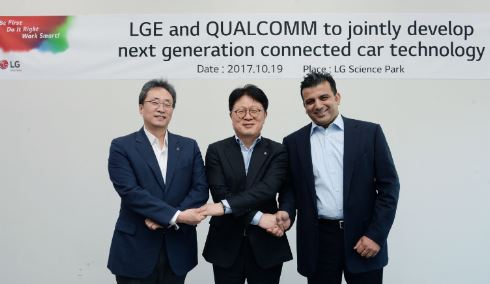
LG Electronics and Qualcomm held a signing ceremony for a "Next-Generation Connected Car Solution Joint Development Agreement" at Magok LG Science Park on the 19th. Officials from both companies attended the signing ceremony, including LG Electronics President Ahn Seung-kwon of the CTO Division, Vice President Kim Jin-yong of the Smart Business Division, and Qualcomm Vice President Nakul Duggal, Head of Automotive Business.
On this day, the two companies established and began operating a joint research center within LG Electronics' Seocho R&D Campus in Yangjae-dong, Seoul, to develop next-generation connected car solutions and future technologies, including mobile communication-based V2X (Vehicle to Everything).
In addition, LG Electronics and Qualcomm plan to establish an additional research center with a total floor area of 1,320 square meters (㎡) within the Magok Industrial Complex by the end of next year.
The two companies plan to lead the autonomous vehicle parts market by introducing advanced connected car solutions that combine LG Electronics’ capabilities in automotive communication and connected car components with Qualcomm’s latest automotive communication chipset technologies, ranging from LTE to 5G.
In particular, the automotive 5G communication technology being jointly developed by the two companies enables ultra-high-speed wireless data communication that is about 4 to 5 times faster than LTE and can reduce communication latency to one-tenth, making it an essential technology for the development of next-generation connected cars.
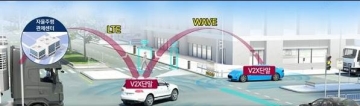
Mobile communication-based V2X technology aims to establish a safer traffic environment by connecting communication between vehicles and all entities—including Vehicle-to-Vehicle (V2V), Vehicle-to-Infrastructure (V2I), and Vehicle-to-Pedestrian (V2P)—via mobile communication technology, and is an essential foundational technology for the era of autonomous driving.
For example, if mobile communication-based V2X technology is implemented, ▲vehicles Full-scale intelligent transportation services become possible, such as detecting approach and warning of collisions between vehicles (V2V technology), exchanging real-time traffic conditions and information on unexpected situations between vehicles and base stations to notify drivers of potential hazards on the route in advance (V2I technology), and enabling vehicles to recognize pedestrians' smartphones and send pedestrian approach warnings to drivers (V2P technology).
Last year, LG Electronics was selected by the 3GPP (3rd Generation Partnership Project, a global technical cooperation organization for mobile telecommunications standardization) as the lead company for developing standards for mobile communication-based V2X technology, and is leading the industry by recording the number one global market share in the telematics sector, a vehicle communication module, for five consecutive years since 2013.
LG Electronics Vice President Kim Jin-yong said, “We will showcase next-generation connected car solutions that enable major automakers to respond to the era of autonomous driving by leveraging the technological capabilities of LG Electronics, which has led the connected car parts industry, and Qualcomm, a global telecommunications semiconductor company.”
"Based on our long-standing partnership with LG Electronics, we will continue to collaborate on the development and commercialization of automotive communication technology, a solution for safe autonomous vehicles and next-generation connected cars in the 5G era," said Qualcomm Vice President Nakul Duggal.
Comments
Related news
KT to Build Communication Infrastructure at Pangyo Autonomous Driving Demonstration Complex
KT announced on the 9th that it will participate in Gyeonggi Province's 'Pangyeo Zero City Autonomous Driving Demonstration Complex Construction Project.' KT plans to complete the construction of an autonomous driving demonstration complex by December 2019 in accordance with the Pangyeo Zero City development project, which spans a total area of 432,000 ㎡ (130,000 pyeong) divided into phases 1 and 2, with a project scale of over 20 billion won.
2017.10.10by 김자영 기자
NVIDIA AI Computer 'Supports Level 5 Driverless Autonomous Vehicles'
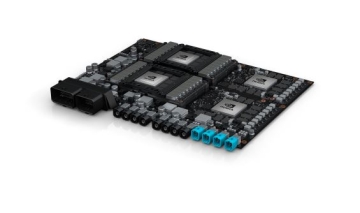
Nvidia unveiled the world's first artificial intelligence computer designed for the development of fully autonomous robot taxis at 'GTC Europe' held in Munich from the 10th to 12th (local time). This new system, which has been assigned the code name Pegasus, is an extended version of the NVIDIA DRIVE PX AI computing platform for processing Level 5 autonomous vehicles, capable of performing 320 trillion operations per second, delivering performance over 10 times superior to the previous version, NVIDIA DRIVE PX 2. Accordingly, NVIDIA DRIVE PX Pegasus does not require a driver to be on board. There is no steering wheel, pedals, or mirrors for the driver. Additionally, as it arrives at the destination according to the passenger's request, it can be used by everyone, including the elderly and people with disabilities.
2017.10.12by 김자영 기자

Intel and Mobileye Develop Mathematical Formula to Prevent Autonomous Vehicles from Causing Accidents
At the World Knowledge Forum held in Seoul, Amnon Shashua, CEO of Mobileye and Vice President of Intel, presented a method to demonstrate the safety of autonomous vehicles. He disclosed a formal mathematical formula that ensures autonomous vehicles operate in a responsible manner and do not cause accidents that could be subject to blame. Mobileye, an Intel subsidiary, is a leader in automation technology and the world's largest camera supplier for ADAS (advanced driver assistance systems). Based on years of successful experience in automotive automation and evolution from ADAS to fully autonomous driving technology, Professor Shashua and his colleague Shai Shalev-Shwartz developed a mathematical formula that can bring certainty to questions of responsibility and blame when accidents occur in unmanned autonomous vehicles. The Responsibility Sensitive Safety model (RSS model) they developed provides concrete and measurable parameters for human concepts of responsibility and care. It also defines a "Safe State" in which autonomous vehicles cannot be the cause of accidents regardless of the movements of other vehicles.
2017.10.19by 김지혜 기자
[e4ds Tech Day 2026 ⑨] Sim Sang-gyu, Autocrypt CTO: "In the Physical AI Era, Automotive Security Must Extend Beyond the Vehicle"
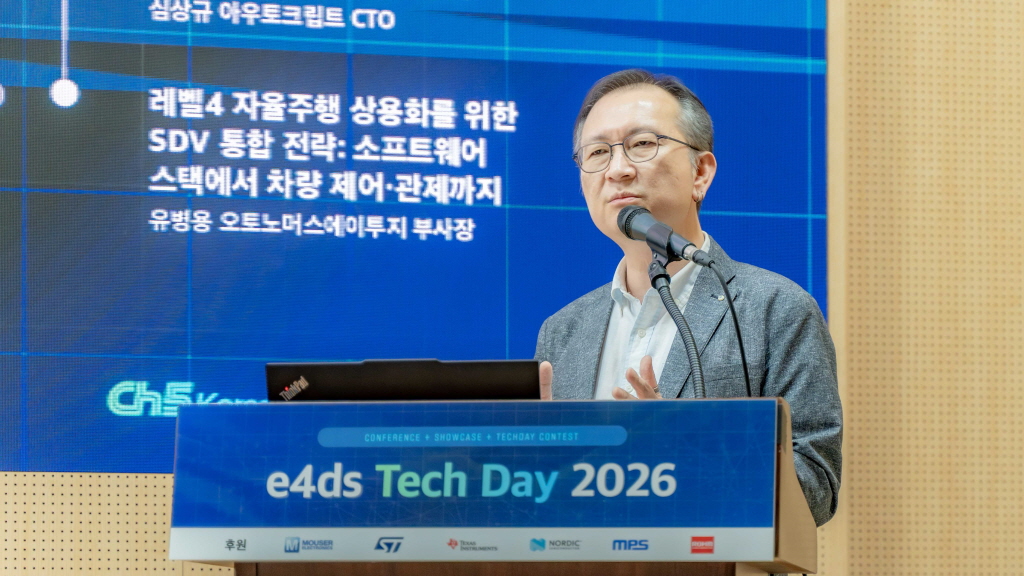
At e4ds Tech Day 2026, Sim Sang-gyu, CTO of Autocrypt, explained automotive cybersecurity strategies in the era of Physical AI and SDV (Software-Defined Vehicle). Automobiles are evolving as part of an ecosystem connected to AI, cloud, chargers, IoT, and robots, and he emphasized that the scope of security must expand beyond the vehicle interior to the entire connected environment. In particular, AI model tampering, adversarial attacks, OTA updates, and EV charger hacking were identified as major threats. He explained that response measures require zero trust, AI model integrity protection, intrusion detection, Security by Design and Default, and full lifecycle security management, and that proactive security system establishment beyond regulatory compliance is critical for securing future mobility competitiveness.
2026.10.12by 배종인 기자

Practical HIL Construction Strategy for Automotive and Off-Highway Controller Validation
As vehicle E/E architecture transitions to zonal structures and shifts to software-defined vehicles (SDV), the number of controllers (ECUs) requiring validation and software complexity are surging dramatically. Meanwhile, real vehicle testing cannot provide repeated verification under identical conditions and entails lead time and safety concerns. This white paper explains the principles of HIL (Hardware-in-the-Loop) validation and the structure of the NI platform composed of PXI, SLSC, and VeriStand, and through two actual implementation cases—Camera Record & Replay HIL for In-Cabin Monitoring Controller (ICMU) and Forklift Controller (VCU) HILS—describes how controller-level regression testing becomes possible. Additionally, it explicitly states application boundaries and limitations, such as lack of A2B support.
2026.10.12by 편집부











