


NVIDIA Leverages GPUs for KISTI's Typhoon Damage Prediction System
 Published2017.10.26 14:54
NVIDIA announced that its GPUs are being used to train GlobeNet and DeepRain, groundbreaking typhoon and heavy rain damage prediction systems from the Korea Institute of Science and Technology Information (KISTI).
Researchers at KISTI are attracting attention for developing a system to predict damage from typhoons and heavy rain using GPU-accelerated deep learning. Dr. Minsoo Cho, Director of KISTI's HPC Research Center, stated, "While it's impossible to prevent natural disasters, the risks can be minimized with the right information."
Korea is surrounded by storms like hurricanes and tropical cyclones. Hurricanes and typhoons are known by different names depending on their geographical location: hurricanes in the Atlantic and eastern North Pacific, typhoons in the western North Pacific, and cyclones in the South Pacific and Indian Ocean. Hurricanes and typhoons are phenomena that occur worldwide.
Dr. Cho Min-soo and other KISTI researchers are working to improve the speed and accuracy of typhoon forecasts by combining deep learning technology with existing forecasting methods to create numerical weather models using GPU-accelerated supercomputers. More accurately determining a typhoon's path and intensity will help authorities issue more accurate and timely evacuation orders to residents in areas expected to be affected.
Currently, meteorologists utilize various numerical models to predict wind speed, precipitation, atmospheric pressure, and other factors that determine the path and intensity of a typhoon from its formation to its dissipation. However, KISTI researchers are using satellite and radar observation data to train two deep learning systems: GlobeNet, which predicts typhoon paths, and DeepRain, which predicts heavy rainfall. Additionally, data from numerical models are being used to train DeepTC, a tropical cyclone prediction system.
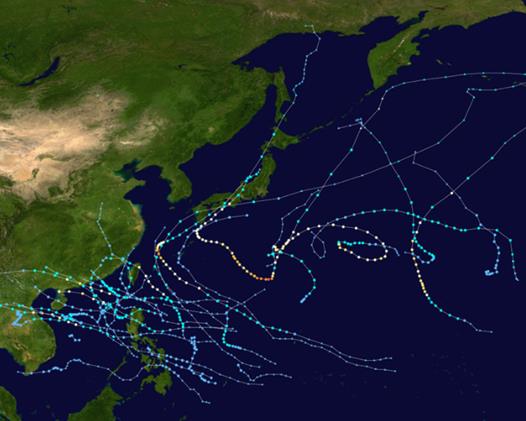
“Although these three models are still in the research phase, they have achieved significant improvements in accuracy compared to existing methods,” said Dr. Song Sa-kwang, a senior scientist in charge of developing deep learning systems at KISTI.
The KISTI research team trained these models using cuDNN with the Keras toolkit and TensorFlow deep learning framework based on NVIDIA GPUs, and deployed the trained models using GPUs in the Amazon Web Services cloud.
The system developed at KISTI has so far enabled predictions of typhoons and resulting rainfall 1-2 hours in advance. The research team plans to increase the forecasting window to six hours by next year, ultimately reaching three days, a timeframe where effective countermeasures can be implemented.
The KISTI research team's work will be utilized for flood prediction in the Seoul metropolitan area, home to approximately 30% of the nation's population, along the Imjin River, and surrounding areas. Furthermore, KISTI's system is currently undergoing technology transfer to the Air Force Meteorological Agency.
While KISTI's research was designed for domestic use in Korea, the same approach can be applied anywhere in the world. Dr. Cho Min-soo stated, "As long as sufficient satellite and radar data are available, DeepRain and GlobeNet can be applied to North America as well."
Comments
Related news
NVIDIA AI Computer 'Supports Level 5 Driverless Autonomous Vehicles'
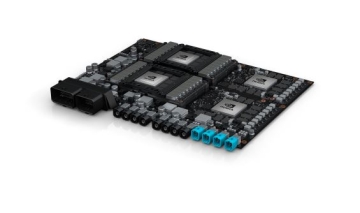
Nvidia unveiled the world's first artificial intelligence computer designed for the development of fully autonomous robot taxis at 'GTC Europe' held in Munich from the 10th to 12th (local time). This new system, which has been assigned the code name Pegasus, is an extended version of the NVIDIA DRIVE PX AI computing platform for processing Level 5 autonomous vehicles, capable of performing 320 trillion operations per second, delivering performance over 10 times superior to the previous version, NVIDIA DRIVE PX 2. Accordingly, NVIDIA DRIVE PX Pegasus does not require a driver to be on board. There is no steering wheel, pedals, or mirrors for the driver. Additionally, as it arrives at the destination according to the passenger's request, it can be used by everyone, including the elderly and people with disabilities.
2017.10.12by 김자영 기자

NVIDIA Hosts 'Deep Learning Day 2017' for AI Developers and Industry Professionals
Nvidia announced that it will hold 'Deep Learning Day 2017,' showcasing the latest artificial intelligence technology, for a total of three days from October 31st to November 2nd at InterContinental Seoul COEX. Deep Learning Day 2017 is part of the 'GPU Technology Conference (GTC) 2017,' which is being held in major cities worldwide this year. The event is composed of conference sessions where the most important technological developments and cases in the AI field today will be presented, and the Deep Learning Institute, which provides practical hands-on sessions.
2017.10.13by 김자영 기자
Nvidia Demonstrates Deep Learning Application That Transforms Any Drawing Into Artwork
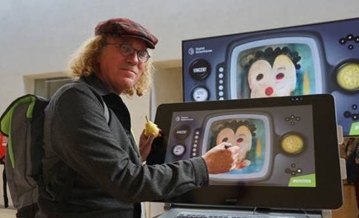
Nvidia held a public demonstration of "Vincent AI," a deep learning-based application developed by Cambridge Consultants, at the GTC Europe event held in Munich, Germany. The Vincent application allows users to complete simple sketches drawn with a stylus in real-time as artwork in seven different styles, including oil paintings by J.M.W. Turner, a 19th-century English landscape painter, and neon-colored pop art. The public demonstration, which took place during Nvidia founder and CEO Jensen Huang's keynote address, drew gasps of amazement from over 3,000 attendees. CEO Jensen Huang came down from the stage during the keynote and personally drew the Nvidia logo and a human face with a stylus. When the sketch was transformed in real-time into a Picasso-style painting, the audience burst into applause.
2017.10.17by 김지혜 기자
.jpg)
SalePoint Signs Multi-Year Partnership Agreement with AWS… Promoting Identity Security that Integrates Even AI Agents
Sailpoint has entered into a multi-year strategic partnership agreement with AWS and is moving forward with establishing an integrated governance system that manages both human and non-human identities together. The plan is to consistently manage access permissions in an environment where AI agents are increasing as work execution entities, while applying the principle of least privilege and automated policy enforcement. The two companies plan to jointly expand capabilities to manage the identities of various entities, including AI agents, within a single layer in the AWS environment. This collaboration is interpreted as a move to design security and governance together in corporate environments where AI adoption is expanding.
2026.03.26by 배종인 기자
.png)
Databricks Unveils Open AI Security Monitoring 'Lakewatch'
Databricks entered the security market on March 24 by unveiling LakeWatch, an open-source agentic SIEM. The core functionality of this product is to integrate and analyze security, IT, and business data in a single environment to support AI-based threat detection and investigation. The company explained that it reduces the limitations of existing security operations centers, which have had to forgo some data due to high cost structures, and enables large-scale data analysis and automation based on open formats and ecosystems. LakeWatch is currently offered as a private preview, with Adobe and Dropbox mentioned as early customers. Databricks also announced an expanded partnership with Anthropic as well as the acquisition of Antimatter and SiftD.ai.
2026.03.26by 배종인 기자











