



NVIDIA Enhances Autonomous Driving Safety with GPU-Powered Road Driving Simulation
 Published2017.10.31 16:03
NVIDIA announced that it is enhancing the safety of self-driving cars by testing various driving environments through simulations using its GPUs.
During the development of autonomous vehicles, simulation testing can be more effective than real-world testing in testing hazardous or unusual driving conditions due to its greater flexibility and adaptability.
Simulation also allows for testing multiple scenarios in a short period of time. In his opening keynote at GTC Europe in Munich, NVIDIA CEO Jensen Huang announced that real-time simulations powered by NVIDIA DGX and the new TensorRT 3 allowed engineers to simulate driving 300,000 miles (approximately 480,000 kilometers) in just five hours. This means that every road in the United States could be simulated in just two days.
Once a simulation is built, it needs to be connected to the autonomous driving system. NVIDIA's integrated GPU architecture supports the movement of autonomous driving technology between simulation environments in the lab or data center and NVIDIA DRIVE PX in the vehicle.
Drive PX is an artificial intelligence vehicle computer that collects data from various automotive sensors, runs complex software algorithms required for autonomous driving, and transmits autonomous driving methods to the vehicle.
Additionally, it can be configured to input simulated sensor data and output simulated driving commands. At GTC Europe, several companies also had the opportunity to explain and demonstrate how they can leverage Drive PX in this way.
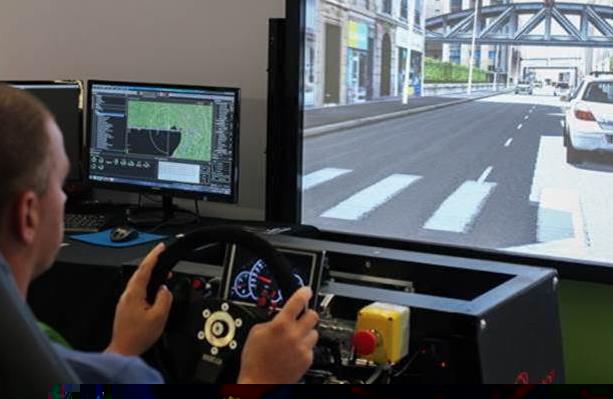
Dominik Dörr of IPG Automotive presented virtual prototypes and sensor models. IPG's automated driving solutions provide autonomous driving engineers with a holistic testing approach that integrates various development efforts. According to IPG, this allows for early testing of individual functions or networks before a complete prototype is completed.
These virtual prototypes run on DRIVE PX, which is configured to navigate in a simulated environment. DRIVE PX evaluates the simulated environment in the same way it would in a real-world environment, determining driving directions accordingly. This process allows engineers to assess whether newly developed autonomous driving solutions are functioning properly.
Roberto De Vecchi of VI-grade, along with Enrico Busto of partner AddFor, discussed the accuracy of software while driving and its impact on humans in the vehicle. To achieve this, Roberto De Vecchi and Enrico Busto use a driving simulator that combines driver inputs, such as when the vehicle guides the driver to take over driving control, with autonomous driving software running on Drive PX.
These tests allow companies to verify that their software is working properly and evaluate the driving experience for passengers inside the vehicle.
Rodolphe Tchalekian presented how ESI Group's simulation software Pro-SiVIC creates physically realistic, real-time 3D virtual environments for testing and training machine learning algorithms.
When developing new machine learning algorithms for autonomous driving, large amounts of training data are required. Data collected from real-world environments requires repetitive labeling to enable autonomous driving algorithms to process and learn from it. In contrast, simulated data is already automatically labeled, saving significant time at this stage.
After training a new algorithm using the synthetic data set, ESI uses Drive PX to verify that the system is functioning properly. The trained machine learning algorithm then drives in a simulated environment using Pro-SiVIC.
In a session at 'GTC Europe', Martijn Tideman of TASS International presented TASS' PreScan simulation platform. PreScan is a physics-based simulation platform for evaluating autonomous driving and other vehicle applications.
Tyman shared the results of a joint project with the German Research Center for Artificial Intelligence and Siemens that demonstrated the value of simulated data in deep learning. The project showed that adding synthetic data to training deep learning driving algorithms was more effective than using only real-world data.
NVIDIA also hosted its first-ever GPU Technology Conference in Israel, following its Munich event. Simulation startup Cognata presented its business strategy to a panel of five judges and won first place in the Inception Award competition for promising AI startups.
Cognata leverages patented algorithms to create simulated cities with realistic vehicle and pedestrian movements. It also replicates sensor inputs from the simulated environment and applies deep learning to ensure the simulated sensors behave accurately as they would in a real-world environment.
Comments
Related news

Nvidia Announces AI Cloud Container Registry Service for Deep Learning Acceleration
Nvidia has announced the launch of the NVIDIA GPU Cloud (NGC) container registry service for AI developers worldwide. Developers can immediately access a fully optimized comprehensive deep learning software stack through NGC at no cost through a simple process. In particular, users of Amazon Elastic Compute Cloud (EC2) P3 instances equipped with the recently announced NVIDIA Tesla V100 GPU can immediately use this cloud-based service. Nvidia plans to expand support to other cloud platforms in the near future.
2017.10.27by 김지혜 기자
NVIDIA and the Taiwanese government are working together to accelerate AI development.
Nvidia announced that it will accelerate artificial intelligence development in Taiwan's commercial sector together with Taiwan's Ministry of Science and Technology (MOST). This initiative is being undertaken in support of the Ministry of Science and Technology's recently announced "Grand Plan for AI Industry Development."
2017.10.30by 명세환 기자
NVIDIA Launches Pascal-Based GPU Line 'GTX 1070 Ti'
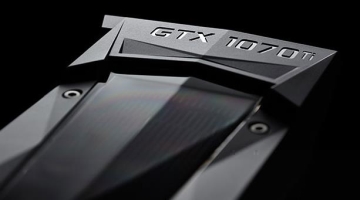
Nvidia has announced the launch of the GeForce GTX 1070 Ti, adding it to its Pascal-based gaming GPU lineup. The GeForce GTX 1070 Ti, which will be positioned between the GeForce GTX 1080 and 1070 GPUs that have garnered high praise among gamers, will launch globally on November 2nd and is currently available for pre-order. The estimated consumer price for the GeForce GTX 1070 Ti is $449 USD. Based on the Pascal GPU architecture recognized for its excellence through numerous awards, the GeForce GTX 1070 Ti is equipped with 2,432 cores and 8GB of memory, delivering speeds of 8Gbps (gigabits per second), with total memory bandwidth reaching 256GB per second. This represents roughly twice the performance of the legendary GeForce GTX 970.
2017.10.30by 김지혜 기자

[e4ds Tech Day 2026 ⑨] Sim Sang-gyu, Autocrypt CTO: "In the Physical AI Era, Automotive Security Must Extend Beyond the Vehicle"
At e4ds Tech Day 2026, Sim Sang-gyu, CTO of Autocrypt, explained automotive cybersecurity strategies in the era of Physical AI and SDV (Software-Defined Vehicle). Automobiles are evolving as part of an ecosystem connected to AI, cloud, chargers, IoT, and robots, and he emphasized that the scope of security must expand beyond the vehicle interior to the entire connected environment. In particular, AI model tampering, adversarial attacks, OTA updates, and EV charger hacking were identified as major threats. He explained that response measures require zero trust, AI model integrity protection, intrusion detection, Security by Design and Default, and full lifecycle security management, and that proactive security system establishment beyond regulatory compliance is critical for securing future mobility competitiveness.
2026.10.12by 배종인 기자

Practical HIL Construction Strategy for Automotive and Off-Highway Controller Validation
As vehicle E/E architecture transitions to zonal structures and shifts to software-defined vehicles (SDV), the number of controllers (ECUs) requiring validation and software complexity are surging dramatically. Meanwhile, real vehicle testing cannot provide repeated verification under identical conditions and entails lead time and safety concerns. This white paper explains the principles of HIL (Hardware-in-the-Loop) validation and the structure of the NI platform composed of PXI, SLSC, and VeriStand, and through two actual implementation cases—Camera Record & Replay HIL for In-Cabin Monitoring Controller (ICMU) and Forklift Controller (VCU) HILS—describes how controller-level regression testing becomes possible. Additionally, it explicitly states application boundaries and limitations, such as lack of A2B support.
2026.10.12by 편집부











