


SKT to use high-capacity data transmission as an IoT network
 Published2017.11.13 10:47
SK Telecom announced that it has completed the development of 'LTE Cat.M1' technology, the latest LTE-based IoT network technology.
'LTE Cat.M1' is a technology standardized by the international standardization organization 3GPP last March that provides speeds of up to 1 Mbps. It is a technology that is significantly advanced compared to the existing high-capacity IoT network technology, LTE-M, in terms of battery life and data transmission efficiency. By utilizing this, services requiring the transmission of medium to high-capacity data, such as voice and photos, become possible, which is expected to greatly expand the scope of customers' use of IoT networks.
SK Telecom developed 'LTE Cat.M1' technology last December and completed technical verification at its Bundang R&D Center test network early this year. In particular, since August of this year, it has been advancing the technology through application and field testing at commercial LTE base stations for the first time in Korea, in collaboration with Ericsson and Qualcomm.
'LTE Cat.M1' can significantly reduce the manufacturing cost of IoT devices due to the lower price of communication modules compared to existing LTE-M. As a result, various companies are expected to be able to participate in the IoT ecosystem. In addition, as production costs decrease, the burden of usage fees for customers purchasing products will also be reduced, which is expected to revitalize the IoT ecosystem.
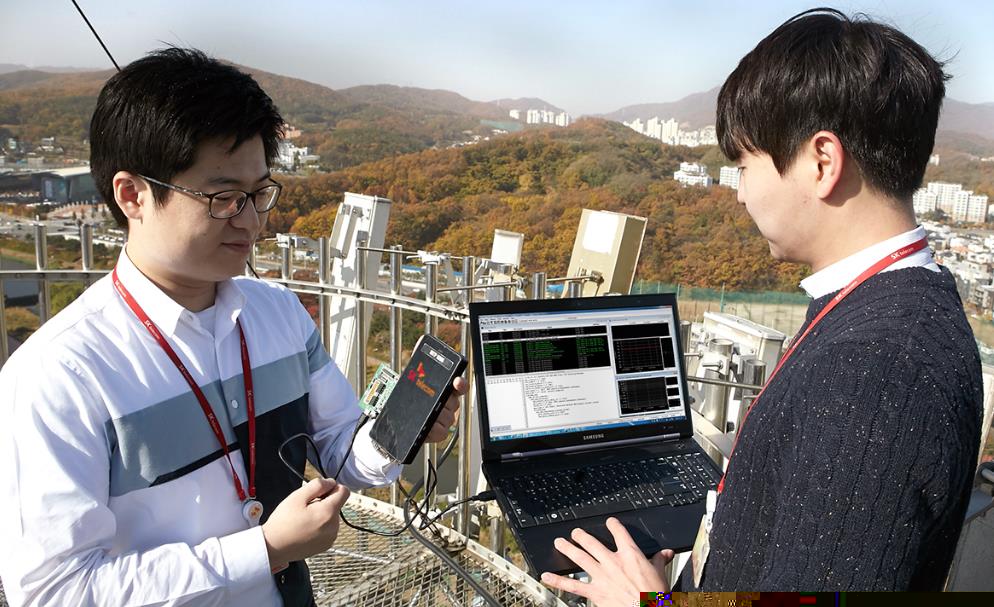
SK Telecom provides IoT services using LoRa networks for services requiring low-power, low-capacity data transmission, and LTE-M networks for services requiring high-capacity data transmission. With the acquisition of 'LTE Cat.M1' technology, the evolution of LTE-M can now be anticipated.
SK Telecom has also successfully integrated its 'LTE Cat.M1' with a commercial LoRa network. Relatively large data, such as voice collected from IoT devices, can be transmitted via 'LTE Cat.M1', while low-volume data, such as device location or numerical information, can be transmitted via the LoRa network and analyzed and managed on a single server.
For example, in a theft and fire monitoring system, sensor information such as intrusion detection, smoke, and temperature is collected through a LoRa network, and the transmission of photos from the scene, alarms, and device control can be done through an LTE Cat.M1 network.
Park Jin-hyo, Head of the Network Technology Institute at SK Telecom, stated, “The development of ‘LTE Cat.M1’ technology is highly significant in that it secures an important foundation for the evolution of IoT networks,” adding, “In particular, the competitiveness of hybrid IoT networks has been strengthened by securing optimal network technologies tailored to different types of IoT services.”
Comments
Related news
SKT, don't develop IoT-based technology, just borrow it.
'How should we leverage T map technology to maximize the efficiency of our company's transportation services?', 'Where can we obtain the technology needed to create IoT services using inter-device communication?' These days, when open technologies and developers' unique ideas come together to create various services, the telecommunications sector—which had previously been noted for its difficulty in accessing technical information compared to other industries—has now opened a marketplace where new services can be developed by borrowing verified foundational technologies from a single location. SK Telecom announced the opening of the 'SK Telecom API Portal,' which consolidates its foundational technologies (APIs, application program interfaces) including T map and IoT services in one place.
2017.10.25by 김지혜 기자

SKT T Roaming Korea-China-Japan Pass Users Surpass 100,000
SK Telecom announced on the 26th that its 'T Roaming Korea-China-Japan Pass' plan, launched for customers visiting China and Japan, surpassed 100,000 users just 50 days after its launch. The 'T Roaming Korea-China-Japan Pass' is a region-specialized roaming plan that SK Telecom launched in early September, reflecting the fact that approximately 51% of Korean outbound travelers visit China and Japan. The plan provides 1GB of data and affordable calling and text messaging services for 5 days at 25,000 won (approximately 5,000 won per day), tailored to customers' usage patterns.
2017.10.26by 김자영 기자
SKT Establishes Autonomous Driving Joint Research Alliance
SK Telecom announced the launch of AROUND Alliance, an industry-academia-research autonomous driving joint research consortium, on October 31st with Seoul National University, Yonsei University, and Daegu Gyeongbuk Institute of Science and Technology (DGIST). AROUND Alliance was established with the purpose of sharing capabilities and infrastructure among leading companies, universities, and research institutes in the domestic autonomous driving industry to develop foundational technologies and accelerate commercialization of autonomous driving in Korea. The alliance plans to focus on ▲advancing artificial intelligence and driving perception and decision-making software for accident-free autonomous driving ▲establishing a general-purpose autonomous driving platform ▲providing major software as open source ▲talent cultivation and other initiatives.
2017.10.31by 김자영 기자
European Patent Applications Surpass 200,000 for the First Time… South Korea Maintains 5th Place, Led by Batteries and Telecommunications
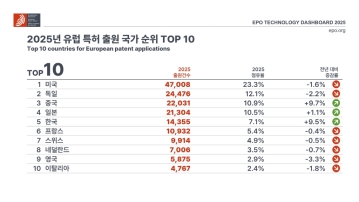
According to the European Patent Office (EPO)'s 'Technology Dashboard 2025', European patent applications last year reached 201,974, surpassing 200,000 for the first time. Korean companies and inventors filed 14,355 applications, representing a 9.5% increase from the previous year and maintaining 5th place by country. Battery, digital communication, and semiconductor technologies led the growth, with Samsung ranking as the top EPO applicant for the second consecutive year and LG reaching 3rd place. The presence of major domestic cities such as Seoul, Suwon, and Yongin was also confirmed. It was also revealed that Korea's European patent strategy is expanding beyond individual technologies to span the entire industry.
2026.03.24by 명세환 기자

SK Telecom First Applies AI-Based Network Operations at Gwanghwamun K-Pop Concert
SK Telecom announced that it applied an AI-based network operation system for the first time at a large-scale K-pop concert held in the Gwanghwamun area of Seoul on March 21st, managing communication quality throughout the event. Mobile data usage during the three hours before and after the concert reached 12.15TB, approximately doubling compared to the same time slot the previous weekend. SK Telecom monitored traffic using the AI system 'A-One' in five-minute and 50-meter units to respond to potential overload situations, while also operating temporary communication facilities and on-site personnel in parallel. This case is interpreted as confirmation of the practical applicability of AI-based autonomous network operation in an environment where demand from dense events and foreign users increases simultaneously.
2026.03.23by 명세환 기자











