


ST Adopts Arm's PSA to Implement Cybersecurity
 Published2017.11.14 09:24
STMicroelectronics (ST) announced that it has adopted Arm’s Platform Security Architecture (PSA), which enables best-in-class ubiquitous cybersecurity.
ST's STM32H7 high-performance MCU is designed with the same security concepts as the PSA framework, combining these principles with the advanced security features and services of the STM32 family.
As IoT applications expand, public safety and national security issues may also be exposed to risk. Manufacturers, who must constantly innovate to counter new and innovative hacking attacks, can cost-effectively implement cutting-edge security features in small, resource-constrained devices through PSA.
Michel Buffa, Head of the Microcontroller Business Unit at ST, stated, “Security is a priority for the success of IoT. To increase security payload, it is crucial to gain the trust of end users, ranging from individual consumers to enterprises and government agencies,” and added, “Arm’s PSA enables key security features such as more cost-effective and scalable device identification and Over-The-Air (OTA) updates on small, autonomous IoT devices.” “These PSAs can operate with existing security features of STM32 microcontrollers, including our high-performance STM32H7 series,” they stated.
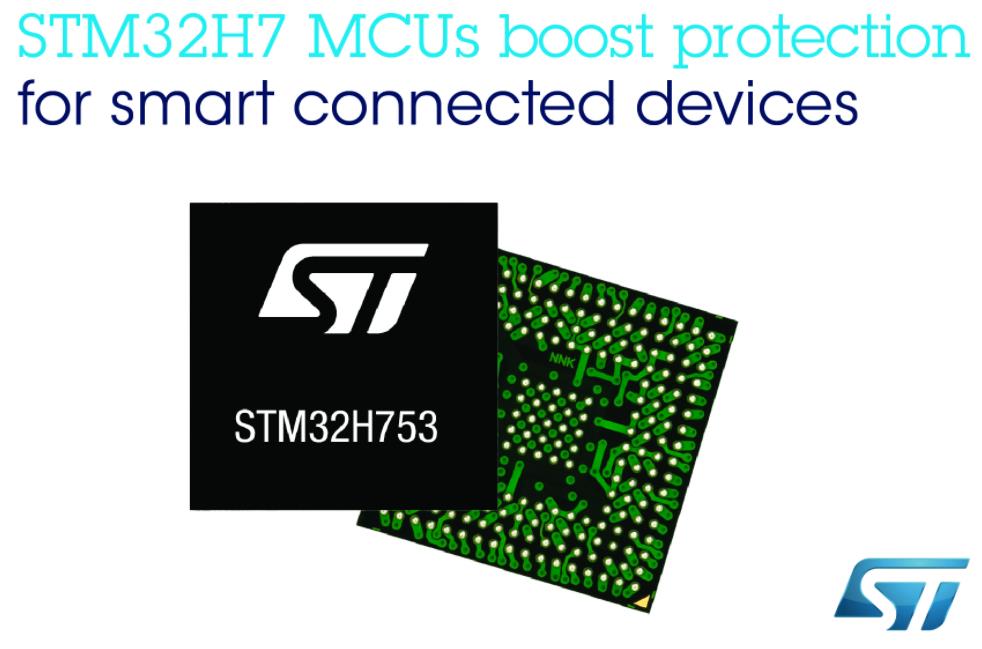
ST's STM32H7 MCU device integrates hardware-based security features, including a True Random-Number Generator (TRNG) and a state-of-the-art dedicated cryptographic processor, which simplifies the protection of embedded applications and global IoT systems against attacks such as eavesdropping, spoofing, and Man-in-the-Middle (MITM) intrusions. In addition, it features secure firmware loading capabilities, allowing OEMs to securely program not only within their own facilities but also externally, such as contract manufacturers or programming firms.
Because security keys and software services are pre-embedded in the MCU for secure loading, OEMs provide manufacturing partners with already encrypted firmware. Therefore, it is impossible to intercept, copy, or manipulate the code. This enables programming and authentication tasks to establish a root-of-trust (RoT) mechanism for devices that require security patch application and feature upgrades throughout their lifespan by connecting to the end user's network or via remote OTA updates.
Paul Williamson, Vice President and General Manager of Arm’s IoT Device IP, said, “Arm is transforming the economics of security by collaborating with its ecosystem to introduce PSA as a common industry framework for securing the next trillion connected devices,” adding, “The Cortex-M-based STM32H7 series, with built-in security hardware blocks and firmware-loading services, is driving security innovation in various applications, such as communication gateways and connected things, by leveraging Arm’s PSA principles.”
Comments
Related news
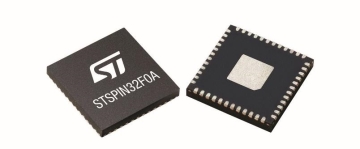
ST releases motor controller with 32-bit MCU suitable for miniaturization
STMicroelectronics has launched the programmable motor controller STSPIN32F0A. This device integrates an STM32F0 microcontroller (MCU) and gate drivers for 3 external MOSFET half-bridges, and features a 3.3V DC/DC switching converter with an added 12V LDO, provided in a lightweight/compact 7 x 7mm form factor to offer flexible motor control options during design. The 48MHz microcontroller with 32Kbyte on-chip flash enables not only motor control algorithms such as 6-step sensorless, field-oriented control, and position-sensing control, but also user application execution.
2017.10.30by 김지혜 기자
ST Launches IoT Solution in Collaboration with Alibaba Cloud
ST Microelectronics announced a collaboration with Alibaba Cloud, the cloud computing equipment and business division of Alibaba Group, to launch a cloud-to-node IoT solution. Through this collaboration, developers can easily develop nodes and gateways using ST's semiconductor building blocks for the Internet of Things, and by running AliOS, Alibaba's IoT operating system, on the nodes, seamlessly connect to Alibaba Cloud. This enables rapid market introduction of numerous IoT applications. In conjunction with the official launch of AliOS, ST completed support for running AliOS on its STM32 microcontroller platform, which is preferred by Chinese IoT design engineers and boasts the industry's largest portfolio based on ARM Cortex-M. This makes available ST's comprehensive portfolio that includes all building blocks necessary for the Internet of Things, encompassing not only processing but also connectivity, security, sensors, power management, and signal processing.
2017.11.01by 김지혜 기자
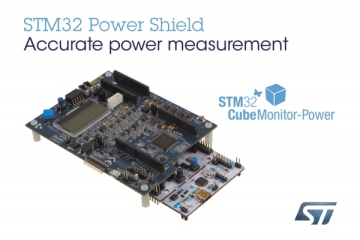
ST Launches Power Shield Kit for Low-Power IoT Devices
ST has released the STM32 Power Shield (STM32Power Shield), which enables precise monitoring of power consumption during embedded device design.
2017.11.02by 명세환 기자

Intel Unveils Next-Generation 'Core Ultra Series 3' and vPro Platform for Enterprise PCs
Intel has officially unveiled the "Intel Core Ultra Series 3" for next-generation enterprise PCs and the latest vPro platform, addressing a wide range of demands from enterprise notebooks to high-performance workstations.
2026.03.26by 배종인 기자

ROHM Launches ESD Protection Diode Compatible with High-Speed Interfaces of 10Gbps or Higher
Semiconductor specialist ROHM has developed the 'RESDxVx series' of ESD (electrostatic discharge) protection diodes capable of responding to next-generation high-speed data communication environments exceeding 10Gbps, simultaneously enhancing both signal quality maintenance required in high-speed interfaces and IC protection performance.
2026.03.26by 배종인 기자











