


Wind River to Provide Simulation Software for Fujitsu Laboratories' Software-Defined SSD Design
 Published2017.11.17 16:49
Wind River announced that Fujitsu Laboratories has developed a software-defined SSD that is three times faster than a standard SSD using its simulation software, Wind River Simics.
As IoT technology evolves and the volume of data generated continues to increase, Fujitsu Laboratories has embarked on the development of a software-defined SSD to provide high-speed processing technology capable of handling big data analysis tasks. This product features a Flash Translation Layer (FTL) embedded in the software layer, enabling direct software access to NAND flash memory.
Data placement and access patterns for NAND flash memory can be optimized according to workload, maximizing performance, and users can utilize the high-speed performance of this device as an expansion device for main memory.

Fujitsu Laboratories' software-defined SSD is a groundbreaking technology, requiring testing and evaluating the overall system's performance immediately after hardware prototypes were produced. To maximize system performance, hardware design parameters had to be optimized based on workload, while system performance had to be estimated before hardware was built to work seamlessly with the software.
Fujitsu Laboratories was able to solve this process through Wind River Simics. By designing and testing scenarios on a virtual system based on Simics, we were able to adopt new development techniques that would have been impossible with physical hardware. For example, we secured the right balance of channels and chips to deploy in the system to optimize performance while controlling costs.
Furthermore, using Simics, Fujitsu Laboratories was able to simulate workloads on virtual hardware, repeat tests using numerous channel and chip combinations, and evaluate the execution speed of each scenario, enabling them to confidently determine the optimal combination. In particular, Simics offers extensive debugging capabilities, enabling them to debug software before evaluating actual hardware, pinpointing performance bottlenecks and potential optimizations. By implementing Simics, Fujitsu Laboratories was able to innovate critical aspects of its design, development, and testing processes.
After developing a software-defined SSD, Fujitsu Laboratories verified the most effective number of channels and chips on actual hardware, confirming that the results matched Simics' simulation scenarios. Fujitsu, having experienced the utility of a full-system simulation solution through the validated results and data insights gained during the software-defined SSD development process, announced plans to actively incorporate it into future projects. Wind River will also continue its collaboration with Fujitsu Laboratories to leverage cutting-edge technologies to overcome various social and technological challenges.
Comments
Related news

Wind River, "Will Lead IoT Market Based on Virtualization Solutions"
"We have been able to lead the industry with Network Function Virtualization (NFV) cloud solutions. Due to market changes such as the Internet of Things, we believe we can also drive changes in similar business sectors."
2017.08.24by 김자영 기자
Wind River Launches Device Lifecycle Management Platform with Enhanced Security Features
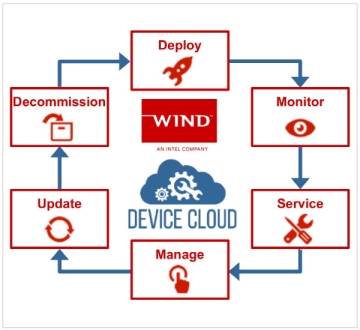
Wind River has released the latest version of "Wind River Helix Device Cloud," a device lifecycle management platform with enhanced security features, to meet market demands. Most devices in the industrial market have been in use for a considerable time and were not designed to support IoT, so in the process of connecting these legacy devices, vulnerabilities to attacks are exposed, creating risks that compromise enterprise security and personal information. The latest version of the device cloud introduced by Wind River to address these issues provides the following new features and capabilities: Through Intel's technology, the zero touch onboarding feature enables immediate connectivity and management while providing strengthened security capabilities, significantly reducing security attack risks to devices. Additionally, through the application of Telit's IoT technology, it provides remote monitoring, over-the-air (OTA)/firmware wireless updates, alert functionality, rules, campaign updates, and data management and monitoring capabilities.
2017.10.13by 김지혜 기자
Wind River Launches Analytics Software for Processing Data on Devices Without the Cloud
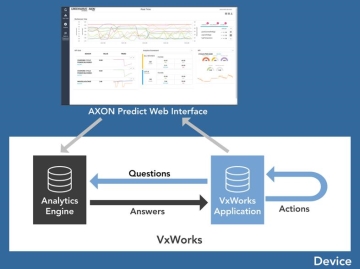
Wind River announced the expansion of its real-time operating system (RTOS) VxWorks IoT portfolio optimized to meet market demands by launching 'AXON Predict Analytics for VxWorks,' a real-time analytics solution that provides device analytics capabilities. Through this new product that can be applied alongside Wind River's RTOS (real-time embedded OS) VxWorks, developers can embed analytics functionality deployed on devices into applications, extracting high-volume streaming data on processes and products and processing that data in real-time to enhance process efficiency. Additionally, it provides methods to leverage predictive analytics, machine learning, and artificial intelligence. Since AXON Predict Analytics solution processes data directly on the device without cloud connectivity, a path has now opened to manage critical data at the network edge through visual edge analytics software, enabling real-time automatic responses.
2017.10.19by 김지혜 기자
.jpg)
SalePoint Signs Multi-Year Partnership Agreement with AWS… Promoting Identity Security that Integrates Even AI Agents
Sailpoint has entered into a multi-year strategic partnership agreement with AWS and is moving forward with establishing an integrated governance system that manages both human and non-human identities together. The plan is to consistently manage access permissions in an environment where AI agents are increasing as work execution entities, while applying the principle of least privilege and automated policy enforcement. The two companies plan to jointly expand capabilities to manage the identities of various entities, including AI agents, within a single layer in the AWS environment. This collaboration is interpreted as a move to design security and governance together in corporate environments where AI adoption is expanding.
2026.03.26by 배종인 기자
.png)
Databricks Unveils Open AI Security Monitoring 'Lakewatch'
Databricks entered the security market on March 24 by unveiling LakeWatch, an open-source agentic SIEM. The core functionality of this product is to integrate and analyze security, IT, and business data in a single environment to support AI-based threat detection and investigation. The company explained that it reduces the limitations of existing security operations centers, which have had to forgo some data due to high cost structures, and enables large-scale data analysis and automation based on open formats and ecosystems. LakeWatch is currently offered as a private preview, with Adobe and Dropbox mentioned as early customers. Databricks also announced an expanded partnership with Anthropic as well as the acquisition of Antimatter and SiftD.ai.
2026.03.26by 배종인 기자











