



Maxim Solves Fast In-Vehicle Data Transmission with Serial Links
 Published2017.11.20 17:24
The trend of introducing serial links to quickly transmit large amounts of data
The 'Autonomous Driving Motor Show' held in Pangyo concluded last week. It showcased the progress of autonomous driving technology through events ranging from test drives to synchronized driving and obstacle races against human drivers. Many applicants flocked to the test drives and obstacle races, which were conducted via pre-registration.
What is the reason for such widespread interest in self-driving cars? It is said that 94% of traffic accidents are caused by human negligence. Consequently, there is an expectation that the introduction of autonomous driving will help reduce traffic accidents. Furthermore, being freed from the burden of driving allows people to use their travel time for other tasks, enabling more efficient use of time.
Advanced Driver Assistance Systems (ADAS), which provide parking assistance, automatic braking, pedestrian detection, and collision avoidance functions, are being installed ahead of Level 5 fully autonomous vehicles. In Korea, a law came into effect this January mandating the installation of Automatic Emergency Braking (AEB) on newly released passenger vans over 11 meters in length and large commercial vehicles exceeding 20 tons. The adoption of ADAS is becoming a widespread trend.
The key to an ADAS system is the rapid reception and processing of information from multiple cameras and sensors. This is because the vehicle's response must be determined in real time. In-vehicle camera systems generally boast very high data rates. In the case of a surround view system, each camera has a video stream with a resolution of 1280 x 800 pixels and a frame refresh rate of 30 f/s.
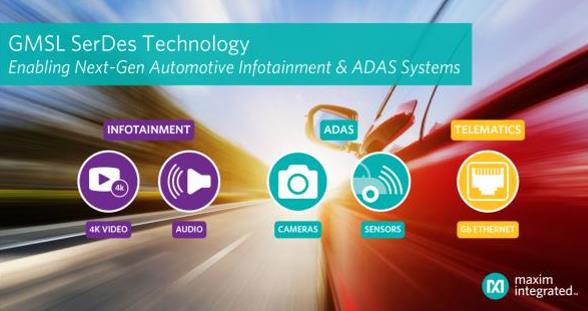
Infotainment systems that need to process high-resolution video/audio data also cannot be without cameras. Future cars will require at least 19 serial links to transmit data from more than 12 cameras and multiple UHD displays.
Accordingly, Maxim Integrated supports the bandwidth, complex interconnectivity, and data integrity issues required by ADAS and infotainment systems with next-generation Gigabit Multimedia Serial Link (GMSL) Parallel-to-Serial Transmitter (SerDes) technology.
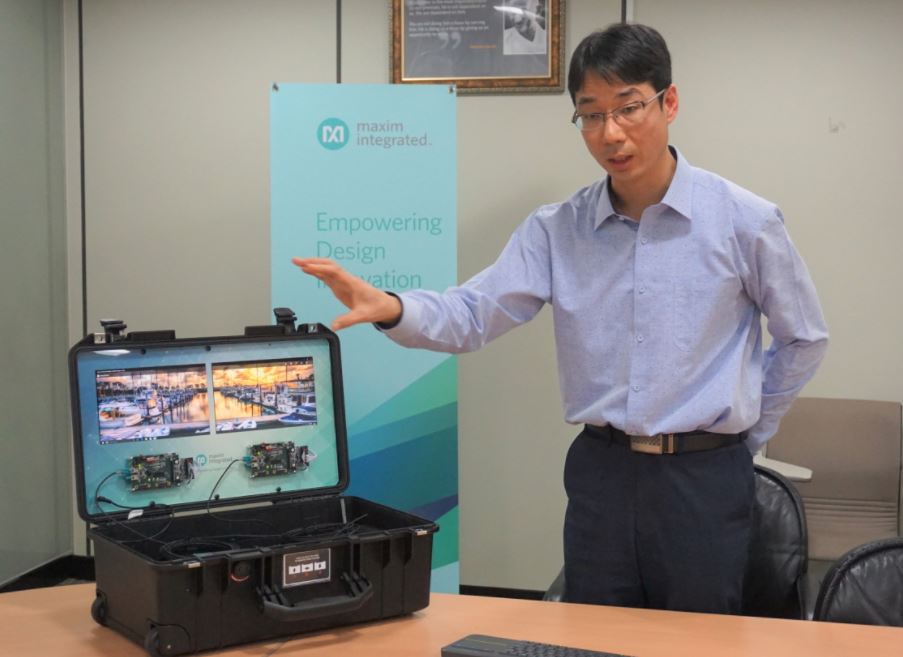
"Increasing bandwidth is the key to transmitting data quickly and securely," said Director Jaehoon Ahn of Maxim. "Currently, we have increased it to 6GHz to meet market needs. We will increase it to 9GHz and 12GHz in the future."
It was explained that not only bandwidth but also the number of cables must be reduced. GMSL SerDes technology simultaneously transmits HD video, audio, control information, integrated sensor data, and Gigabit Ethernet through a single 15m coaxial cable or a 10m to 15m Shielded-Twisted Pair (STP) cable.
GMSL technology supports machine vision technologies, such as object or pedestrian detection, quickly without compression. It is possible to transmit up to 4K video without additional contacts or ground wires.
Director Ahn emphasized, “Providing 15m as a single cable means it is highly resistant to noise. We provide the designed serial link so that it can be evaluated during the development phase. Customers can also test the voltage margin,” adding, “They say that if feed issues cannot be resolved with Maxim’s product, they won’t work with competitors’ either. That shows just how far ahead we are in reliability and EMC.”
Comments
Related news
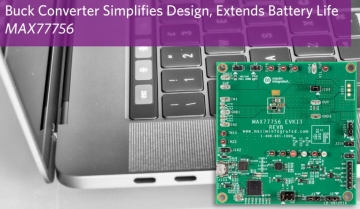
Maxim Launches Buck Converter Providing Low Standby Current for USB Type-C Devices
Maxim Integrated Korea has launched the MAX77756, a buck converter that provides flexible options with 24V, 500mA, and low standby current for multi-cell USB Type-C products requiring high current, dual input, and I2C support. USB Type-C products detect USB insertion by generating a constant 3.3V power rail. Utilizing a power supply in the 5-20V voltage range, the MAX77756 uses a step-down converter to generate always-on power (1.8V/3.3V/5.0V) digital supply rails for port controllers. The MAX77756 reduces standby power consumption while operating continuously through its low standby current of 20μA. The MAX77756 features an ideal dual-input diode ORing circuit that allows external USB power to be supplied to the input stage to drive the chip when the battery has no remaining charge, which simplifies system design.
2017.08.11by 김지혜 기자
Simplifying the head unit can solve signal loss and power issues.
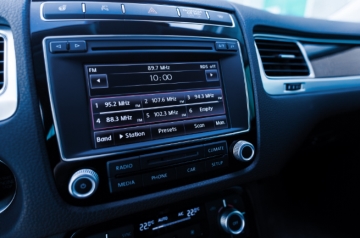
The practice of listening to music or radio in cars has continued from the past until now, but the form of the head unit has gradually changed. From cassette tapes to CDs and MP3s, as audio sources transitioned from physical media formats, head units became simplified. To support such systems in automobiles, cables weighing tens of kilograms are required. Cable routing is often done manually, which is time-consuming and costly. Automotive radios have up to 6 cables connected depending on the car model and the band functions supported. As head units become simplified, the amount of cable required can be reduced, thereby saving space and reducing heat dissipation. To reduce the amount of cabling, Maxim Integrated has proposed a "remote tuner solution." The remote tuner architecture serializes the output of a radio tuner located near the antenna using GMSL (Gigabit Multimedia Serial Link) through a single cable. The single cable transmits not only the desired channel but also control signals (I2C) through the back channel of the GMSL link and supplies power to the remote tuner.
2017.08.24by 김지혜 기자
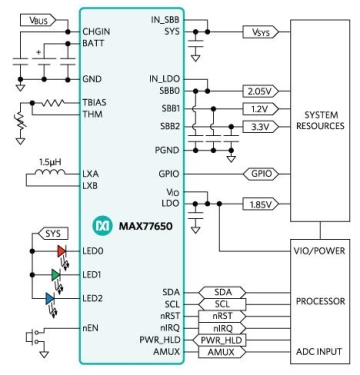
Solving wearable power issues with a compact battery-optimized solution.
Wearable devices are being used for various purposes, such as smart belts that record daily activity levels and inform users about overeating, and wearable cameras that can be attached to bags or clothing to capture everyday photos. Additionally, as 'Hearable' products—wearables in the form of earphones inserted into the ear—have emerged, devices are becoming smaller and wireless in form. Since Hearable devices must accommodate various sensors such as accelerometers and heart rate sensors in a compact size, the internal components must also be miniaturized. Most PMICs for small lithium-ion battery-powered devices require current regulators such as boost, buck, LDO, regulator chargers, and LED indicators. In response, Maxim Integrated has launched the MAX77650 and MAX77651, which can be used in compact power solutions with a size of 19.2mm² or less—half or smaller than conventional PMICs. Both products are designed to suit low-power wearables where size and efficiency are critical. Both devices feature three independently programmable power rails on a single inductor and SIMO buck-boost regulation that minimizes overall solution size.
2017.09.29by 김지혜 기자
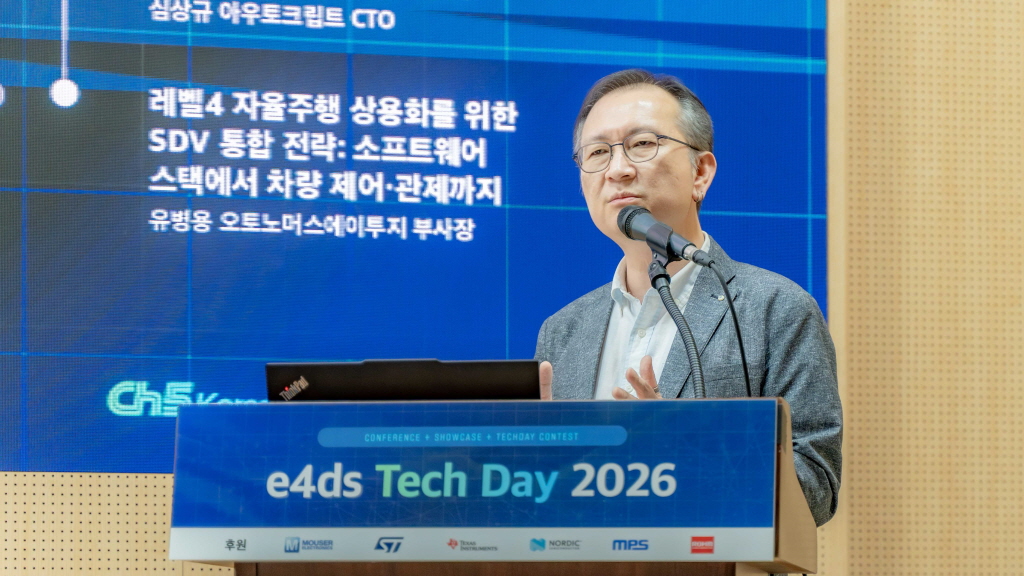
[e4ds Tech Day 2026 ⑨] Sim Sang-gyu, Autocrypt CTO: "In the Physical AI Era, Automotive Security Must Extend Beyond the Vehicle"
At e4ds Tech Day 2026, Sim Sang-gyu, CTO of Autocrypt, explained automotive cybersecurity strategies in the era of Physical AI and SDV (Software-Defined Vehicle). Automobiles are evolving as part of an ecosystem connected to AI, cloud, chargers, IoT, and robots, and he emphasized that the scope of security must expand beyond the vehicle interior to the entire connected environment. In particular, AI model tampering, adversarial attacks, OTA updates, and EV charger hacking were identified as major threats. He explained that response measures require zero trust, AI model integrity protection, intrusion detection, Security by Design and Default, and full lifecycle security management, and that proactive security system establishment beyond regulatory compliance is critical for securing future mobility competitiveness.
2026.10.12by 배종인 기자
Practical HIL Construction Strategy for Automotive and Off-Highway Controller Validation
As vehicle E/E architecture transitions to zonal structures and shifts to software-defined vehicles (SDV), the number of controllers (ECUs) requiring validation and software complexity are surging dramatically. Meanwhile, real vehicle testing cannot provide repeated verification under identical conditions and entails lead time and safety concerns. This white paper explains the principles of HIL (Hardware-in-the-Loop) validation and the structure of the NI platform composed of PXI, SLSC, and VeriStand, and through two actual implementation cases—Camera Record & Replay HIL for In-Cabin Monitoring Controller (ICMU) and Forklift Controller (VCU) HILS—describes how controller-level regression testing becomes possible. Additionally, it explicitly states application boundaries and limitations, such as lack of A2B support.
2026.10.12by 편집부











