



The core of smart factory implementation lies in 'IO-Link'.
 Published2017.11.28 12:11
Maxim lowers supply current to support communication with only 50% power
A factory equipped with technology that predicts and improves inefficiencies through the exchange of information between manufacturing facilities via the Internet of Things (IoT) and sensors is called a smart factory. Since the core of this involves the exchange of information between end-use sensors and equipment, 'connectivity' is of the utmost importance.
Generally, sensors used in factories were unidirectional, transmitting data in an analog form. Consequently, even if a single sensor failed, the failure could only be detected when a problem arose throughout the entire process. IO-Link is gaining attention as a solution to this problem.
IO-Link is an industry standard technology (IEC 61131-9) that defines how sensors and actuators in industrial systems should interact with controllers as an interface solution. IO-Link systems were developed to interact with industry-standard 3-wire sensor and actuator infrastructure and consist of 'IO-Link Master' and 'IO-Link Device' products.
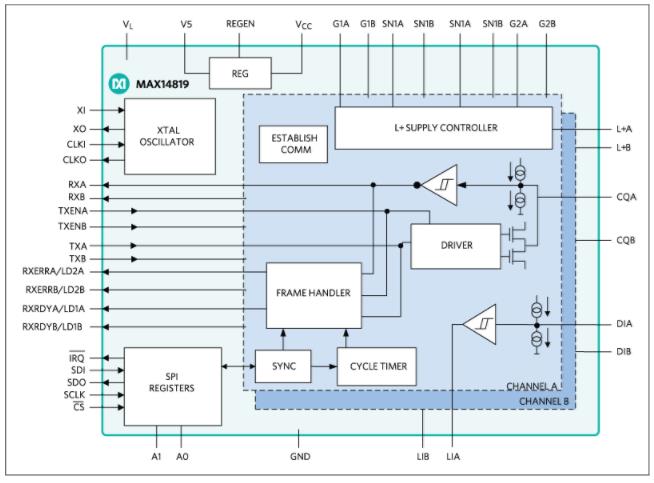
IO-Link's bidirectional protocol allows sensor parameters to be easily updated in the factory. This eliminates the need to visit the site to reprogram each sensor. Two-way communication provides real-time information on cable breakage, overheating conditions, output short circuits, diagnostics, and even sensor lifespan.
The IO-Link point-to-point communication protocol can be up to 32 bytes depending on the required cycle time. Additionally, the IO-Link master can store sensor and timing parameters, allowing it to automatically download parameters to new sensors.
Maxim Integrated has the MAX14189, which lowers on-resistance and supply current and optimizes the current limiter architecture to emit 50% less heat than other IO-Link master solutions.
Fanless programmable logic controllers (PLCs) and IO-Link gateway systems consume a significant amount of power depending on the IO configuration, such as IO-Link digital input/output and analog input/output. PLCs must achieve smart, fast, and low-power operation while complying with IO-Link and standard IO (SIO) compliance. The MAX14189’s reverse voltage/current protection complies with IO-Link and SIO compliance and supports NPN type sensors.
The L+ power supply controller allows for current limiting and features voltage and current protection to support application communication at the lowest power. The integrated Framer/Universal Asynchronous Transmitter/Receiver (UART) maximizes scalability with just a single microcontroller (MCU). It can provide up to 400 microsecond cycles, reduce latency, and eliminate the dependency of the UART on the MCU, thereby minimizing component costs.
Timothy Leung, Senior Business Manager for Industry and Healthcare at Maxim Integrated, stated, “As a member of the IO-Link Consortium, Maxim plans to provide high-performance, ultra-low-power solutions for the industrial market through IO-Link transceivers. The MAX14819 enhances IO-Link technology to create a flexible manufacturing environment and improves both factory output and operational efficiency.”
Comments
Related news
Solving wearable power issues with a compact battery-optimized solution.
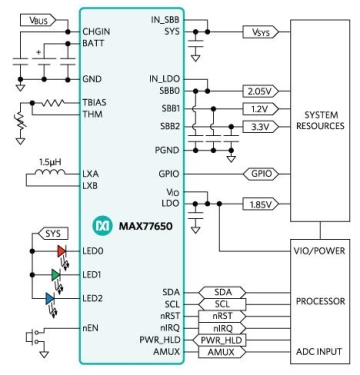
Wearable devices are being used for various purposes, such as smart belts that record daily activity levels and inform users about overeating, and wearable cameras that can be attached to bags or clothing to capture everyday photos. Additionally, as 'Hearable' products—wearables in the form of earphones inserted into the ear—have emerged, devices are becoming smaller and wireless in form. Since Hearable devices must accommodate various sensors such as accelerometers and heart rate sensors in a compact size, the internal components must also be miniaturized. Most PMICs for small lithium-ion battery-powered devices require current regulators such as boost, buck, LDO, regulator chargers, and LED indicators. In response, Maxim Integrated has launched the MAX77650 and MAX77651, which can be used in compact power solutions with a size of 19.2mm² or less—half or smaller than conventional PMICs. Both products are designed to suit low-power wearables where size and efficiency are critical. Both devices feature three independently programmable power rails on a single inductor and SIMO buck-boost regulation that minimizes overall solution size.
2017.09.29by 김지혜 기자

Maxim Launches Low-Power Sensors for Fitness and Disease Prevention
Maxim Integrated Korea has launched wearable solutions 'MAX86140', 'MAX86141', and 'MAX30001' for disease prevention and fitness. MAX86140/41 are optical pulse oximetry/heart rate sensors, while MAX30001 is an analog front-end (AFE) product that measures electrocardiography (ECG) and bioimpedance (BioZ). Through Maxim's ultra-compact, low-power solutions, consumers can accurately monitor their health status continuously and prevent diseases. Maxim's wearable sensor portfolio for healthcare and fitness supports accurate monitoring of various vital biosignals. The ultra-compact, low-power solutions take into account both extended battery life and user convenience.
2017.11.28by 김지혜 기자

Intel Unveils Next-Generation 'Core Ultra Series 3' and vPro Platform for Enterprise PCs
Intel has officially unveiled the "Intel Core Ultra Series 3" for next-generation enterprise PCs and the latest vPro platform, addressing a wide range of demands from enterprise notebooks to high-performance workstations.
2026.03.26by 배종인 기자

ROHM Launches ESD Protection Diode Compatible with High-Speed Interfaces of 10Gbps or Higher
Semiconductor specialist ROHM has developed the 'RESDxVx series' of ESD (electrostatic discharge) protection diodes capable of responding to next-generation high-speed data communication environments exceeding 10Gbps, simultaneously enhancing both signal quality maintenance required in high-speed interfaces and IC protection performance.
2026.03.26by 배종인 기자
ST Launches 75V Drive IC Targeting 48V Industrial Motor Driving
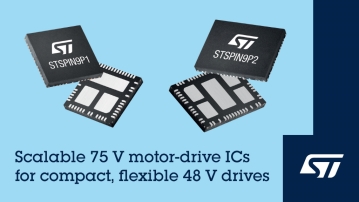
ST Microelectronics has unveiled the 'STSPIN9P' series of 75V motor drive ICs tailored for 48V-class industrial drive system design. The new product family is characterized by half-bridge and full-bridge configurations that enable design scalability according to motor type and output conditions. Power supply circuits, protection functions, and current sensing circuits are integrated on-chip to simplify system configuration, and the devices are designed to support applications up to 500W maximum. The company plans to provide reference designs and demo boards to support development and evaluation in industrial automation, robotics, pumps, fans, lighting, and textile machinery.
2026.03.26by 배종인 기자











