

Ansys Leads Ferrari to WEC Victory with CFD Solutions
 Published2017.12.06 13:22
ANSYS announced that Italian supercar brand Ferrari used its computational fluid dynamics (CFD) solutions to win the GTE-Pro class, winning both the manufacturer and driver titles in the FIA World Endurance Championship (WEC).
At the 2017 WEC, Ferrari claimed its fifth WEC title and its 24th Constructors' Championship in FIA-sanctioned competition. To maintain class-leading aerodynamic performance, Ferrari utilized ANSYS' computational fluid dynamics (CFD) solutions. This maximized downforce, which enhances the car's high-speed stability, and minimized tire damage. Furthermore, by optimizing airflow around the car, Ferrari achieved superior performance compared to its competitors.

“In the WEC, where races can last anywhere from six to 24 hours without stopping, car speed and stability are crucial factors that determine the outcome,” said Ferdinando Cannizzo, technical coordinator for Ferrari Competizioni GT. “ANSYS allows the Ferrari team to rapidly test different configurations on each section of the WEC racetrack. “It also helps us improve speed and stability in real time by providing accurate insights,” he said.
“We have been collaborating with Ferrari for more than 20 years and are continually inspired by their drive for innovation and excellence,” said Sandeep Sovani, director of industry marketing at ANSYS. “With ANSYS providing industry-leading simulation solutions and Ferrari boasting world-class cars and drivers, we are confident that our collaboration will continue to produce dazzling results in the future.”
Comments
Related news

Ansys Expands Support Program to Help Startups Enter the Market
ANSYS launches the "ANSYS Startup Program" in collaboration with Rescale and Amazon Web Services (AWS) to provide startups with cloud simulation and computing resources at reasonable costs. The ANSYS Startup Program addresses the challenges startups face in developing innovative products and enables them to enter the market more economically. It allows access to various simulation software in a network-based cloud environment without requiring on-premise installation of software on separate servers or high-performance computing support. Through this, startups can conduct simulation tests on a scale comparable to large enterprises. Companies participating in the startup program can immediately leverage ANSYS solutions to build virtual prototypes of their products. This enables hundreds of simulation tests to be performed in the time it would take to manufacture and test a single prototype, dramatically reducing the time and cost required to complete product development. Users can access the complete multiphysics simulation product portfolio through the program, including ANSYS structural, fluid, electromagnetic, and embedded software bundles.
2017.10.27by 김지혜 기자

Ansys Korea Hosts Electronics Simulation Expo
ANSYS Korea held the 2017 ANSYS Electronics Simulation EXPO (AESE), which addressed methods for improving electronic system design and the latest technologies and cases by industry sector. The expo, held at the COEX Grand Ballroom, opened with a keynote speech by Sudhir Sharma, ANSYS High Tech Industry Marketing Director, attended by ANSYS customers and experts from various fields. Sudhir Sharma explained, over approximately 50 minutes, methods for developing smart connected products and improving quality through engineering simulation. Following this, Kim Tae-jin, Director at ANSYS Korea, presented simulation cases utilizing artificial intelligence and machine learning, which are technologies receiving recent attention, and future prospects. He stated, "Through technological advancement, it has become possible to realize functions similar to human learning capabilities through computers. Therefore, computers can learn from past failures on their own and recognize problems before errors occur, making it possible to derive more accurate simulation values and reduce maintenance costs."
2017.11.17by 김지혜 기자
Ansys Acquires Additive Manufacturing Simulation Technology Developer
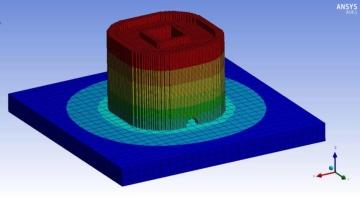
ANSYS has announced that it has acquired 3DSIM, an additive manufacturing (AM) simulation technology development company, enabling it to provide customers with the world's only complete additive manufacturing simulation workflow. 3DSIM is a company that develops high-performance simulation software for metal additive manufacturing. 3DSIM supports manufacturers, designers, and engineers in achieving optimal objectives through simulation without having to go through prototype testing. Its primary customers include aerospace and automotive OEMs (Original Equipment Manufacturing), metal 3D printer manufacturers, and universities and major research institutes. Additive manufacturing, a technology attracting attention in the 3D printing field, has primarily been used in prototype fabrication, but recently it is being directly applied to mass production of products. Various materials are being produced through additive manufacturing technology, and metal materials in particular are challenging to handle. In metal additive manufacturing processes, the lasers used can optimize metal density but can simultaneously melt the metal and cause errors. Furthermore, rapid heating and cooling during the process can induce stresses, creating a high likelihood of product deformation.
2017.11.21by 김지혜 기자
.jpg)
SalePoint Signs Multi-Year Partnership Agreement with AWS… Promoting Identity Security that Integrates Even AI Agents
Sailpoint has entered into a multi-year strategic partnership agreement with AWS and is moving forward with establishing an integrated governance system that manages both human and non-human identities together. The plan is to consistently manage access permissions in an environment where AI agents are increasing as work execution entities, while applying the principle of least privilege and automated policy enforcement. The two companies plan to jointly expand capabilities to manage the identities of various entities, including AI agents, within a single layer in the AWS environment. This collaboration is interpreted as a move to design security and governance together in corporate environments where AI adoption is expanding.
2026.03.26by 배종인 기자
.png)
Databricks Unveils Open AI Security Monitoring 'Lakewatch'
Databricks entered the security market on March 24 by unveiling LakeWatch, an open-source agentic SIEM. The core functionality of this product is to integrate and analyze security, IT, and business data in a single environment to support AI-based threat detection and investigation. The company explained that it reduces the limitations of existing security operations centers, which have had to forgo some data due to high cost structures, and enables large-scale data analysis and automation based on open formats and ecosystems. LakeWatch is currently offered as a private preview, with Adobe and Dropbox mentioned as early customers. Databricks also announced an expanded partnership with Anthropic as well as the acquisition of Antimatter and SiftD.ai.
2026.03.26by 배종인 기자