



IBM Announces Power Systems Server Specialized for AI
 Published2017.12.06 14:11
IBM announced today next-generation Power System servers equipped with the newly designed POWER9 processor.
The new Power9 system, specialized for artificial intelligence (AI) workloads requiring large-scale computation, can improve deep learning framework training times by up to approximately four times compared to existing x86 servers, enabling enterprises to rapidly develop more accurate AI applications.
The new Power9-based AC922 Power System is the industry's first to feature built-in PCI-Express 4.0, next-generation NVIDIA NVLink 2.0, and OpenCAPI, which transmits data 9.5 times faster than x86 system-based PCI-E 3.0.
This system is designed to provide enhanced performance in accelerated databases such as Kinetica, as well as popular AI frameworks such as Chainer, TensorFlow, and Caffe. Therefore, data scientists can develop applications such as deep learning in scientific research, real-time fraud detection, and credit risk analysis more quickly.
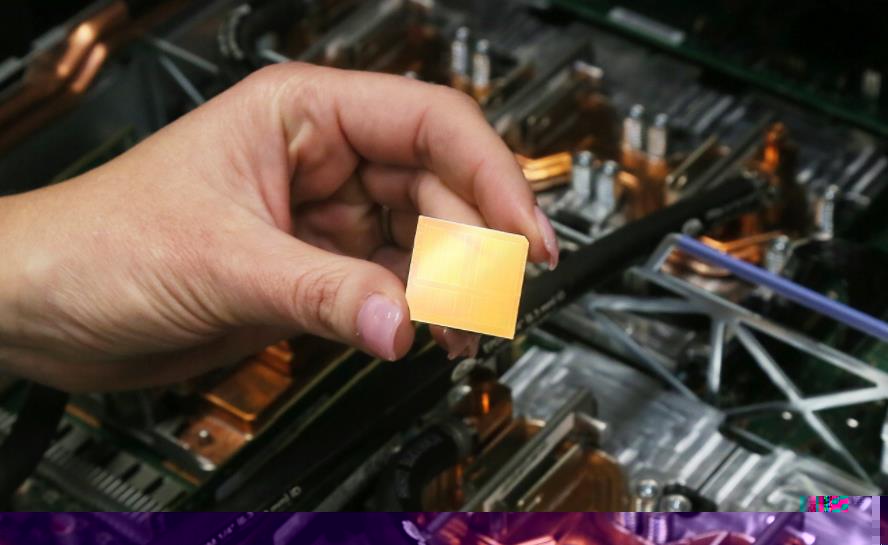
Power9 is installed on the U.S. Department of Energy’s Summit and Sierra, which are expected to become the world’s most powerful supercomputers, playing a role in supporting the world-leading performance of these two computers, and is already being utilized by numerous organizations such as Google.
Bart Sano, Google’s Vice President of Platform, stated, “Google is paying attention to the achievements IBM has made in developing the latest Power technology,” adding, “The Power 9 processor, OpenCAPI bus, and high-capacity memory will provide opportunities for innovation in Google’s data centers.”
Bob Picciano, Senior Vice President of IBM Cognitive Systems, stated, “IBM has built a game-changing, innovative system for AI and cognitive workloads. The IBM Power9 system not only powers the world’s highest-performing supercomputers but also enables companies worldwide to gain superior insights, generating scientific discoveries and innovative business outcomes across all industries.”
Comments
Related news

ON Semi, having acquired IBM radar technology, accelerates efforts to secure autonomous vehicle solutions
ON Semiconductor announced the acquisition and licensing of mmWave technology for automotive radar applications developed by IBM's Haifa Research team. Through this acquisition, ON Semiconductor has become a leader in the automotive sensing market across various domains with its automotive image sensors. Radar is essential for next-generation autonomous driving. It excels at measuring distance and object velocity even in poor visibility conditions, and can be used as a complementary tool to sensing cameras. By combining these technologies, ON Semiconductor is now able to respond to the sensor fusion trend, where sensing technologies necessary for improving accuracy and automotive safety are increasingly being deployed.
2017.03.08by 김지혜 기자
Nutanix-IBM Global Partnership and Hyper-Converged Strategy Announced
Nutanix has established a multi-year global partnership with IBM in the hyper-converged infrastructure field. The two companies plan to combine Nutanix's enterprise cloud platform software with IBM's Power Systems to deliver a turnkey hyper-converged solution that supports critical workloads for large enterprises. The approach is to provide a full stack with built-in AHV virtualization, delivering a more streamlined experience in the data center. Today, enterprises are focusing on combining technologies such as analytics, insights, and machine learning to rapidly aggregate large volumes of data, quickly process it, and anticipate the next steps. An "insight economy" era has begun. To realize this, stable storage, fast networking, and scalability are required. This is based on powerful computing, which is difficult to implement with private data centers. This is because both the technology and architectural design philosophy of private data centers are not suited for this purpose.
2017.05.29by 김자영 기자
Xilinx and IBM Improve Connection Performance Between Accelerators and CPUs with PCI Express Gen4
Xilinx announced achievements in PCI Express® Gen4 functionality. Xilinx, in collaboration with IBM, has doubled the interconnect performance between accelerators and CPUs through PCI Express Gen4 compared to the previously widely-used PCI Express Gen3 standard. Gen4 accelerates performance in data center applications such as artificial intelligence and data analytics by increasing bandwidth between CPUs and accelerators to 16Gbps per lane. IBM and Xilinx implemented Gen4 interoperability between Xilinx® 16nm UltraScale+™ devices and IBM POWER9 processors, demonstrating PCIe Gen4 functionality for the first time in a programmable device.
2017.06.29by 김지혜 기자
.jpg)
SalePoint Signs Multi-Year Partnership Agreement with AWS… Promoting Identity Security that Integrates Even AI Agents
Sailpoint has entered into a multi-year strategic partnership agreement with AWS and is moving forward with establishing an integrated governance system that manages both human and non-human identities together. The plan is to consistently manage access permissions in an environment where AI agents are increasing as work execution entities, while applying the principle of least privilege and automated policy enforcement. The two companies plan to jointly expand capabilities to manage the identities of various entities, including AI agents, within a single layer in the AWS environment. This collaboration is interpreted as a move to design security and governance together in corporate environments where AI adoption is expanding.
2026.03.26by 배종인 기자
.png)
Databricks Unveils Open AI Security Monitoring 'Lakewatch'
Databricks entered the security market on March 24 by unveiling LakeWatch, an open-source agentic SIEM. The core functionality of this product is to integrate and analyze security, IT, and business data in a single environment to support AI-based threat detection and investigation. The company explained that it reduces the limitations of existing security operations centers, which have had to forgo some data due to high cost structures, and enables large-scale data analysis and automation based on open formats and ecosystems. LakeWatch is currently offered as a private preview, with Adobe and Dropbox mentioned as early customers. Databricks also announced an expanded partnership with Anthropic as well as the acquisition of Antimatter and SiftD.ai.
2026.03.26by 배종인 기자











