


"Extreme environment sensors made of SiC and the visual sensor market will open in 2025"
 Published2017.12.14 18:01
It is predicted that future sensors will have to operate in extreme environments, perceive the external environment, and implement desired functions using less power.
Kim Young-hoon, a senior researcher at POSCO Research Institute, said, “2020 will be a year of rapid market change. As autonomous vehicles become fully operational, demand for sensors will increase.” He also predicted that a new market will open, saying, “After 2025, as urbanization accelerates, the agricultural sector, which previously did not use sensors, will become smart based on sensors.”
The sensor market has grown rapidly as smartphones have become widespread. While smartphones have led to the spread of ultra-small, low-cost sensors, the market is expected to evolve from small-batch, multi-variety production to mass-production of multi-variety products due to the influence of smart homes, smart cars, and wearables. In addition, in 2025, as the IoT environment, such as factories, energy, and infrastructure, accelerates, the demand for sensors used in extreme environments is expected to increase.
In the current multi-variety, small-quantity production market, there are more than a thousand basic materials for sensors. For example, in the case of gas sensors, there are ceramics that react only to specific gases at high temperatures. In many cases, specific materials must be used for specific detection, so the market is fragmented.

Researcher Kim said, “As IoT spreads, the proportion of semiconductor sensors is increasing. “It is currently 40%, but as IoT sensors increase and their prices drop, it will increase to over 50%,” he said. IoT sensors are integrated into a single chip with modules such as memory and information processing, and since semiconductor and process technologies are similar, mutual growth between components is important.
Pure silicon materials are vulnerable to physical properties under high temperature/high pressure/high power conditions. It is difficult to operate normally at temperatures above 300℃. However, in order to be used in extreme environments such as gas turbines and aircraft engines, it must be able to withstand temperatures of up to 600℃. Therefore, whether to change the silicon-based packaging or the material is becoming an issue.
Silicon carbide (SiC), a material for power semiconductors, is more expensive than pure silicon and has technical difficulties, but it is suitable as a material for extreme environment sensors because of its high hardness and high temperature resistance. Although the market has not yet opened, it can be used in fields such as engines, aerospace, and steel mills where sensors were not used before.
“The market share of smartphones has reached 10% and sensor prices have fallen,” said Researcher Kim. “It is expected that the market share of electric vehicles using power semiconductors will reach 6-7% in 2025. The price of SiC will also fall around that time.”
Focus on visual sensors capable of obtaining complex information
Since sensors play a role in recognizing the external environment, they are developing in a direction that complements the five senses. Among these, it seems that the development of image/video sensors that focus on vision and implement high resolution and precision will continue in the future.
Visual sensors are forming a high value-added market with an average price of about $10 per unit. Motion sensors cost about $1 per unit, and environmental sensors cost about $1 to $2. Environmental sensors are important for integration, adding hearing and smell or pressure and sound, but visual sensors are trending toward strengthening single functions rather than integration. High resolution is required, especially as the ADAS market is expected to grow to $37 billion by 2021.
In addition, there are increasing cases of visually observing and judging instead of using vibration sensors and pressure sensors that were commonly used to detect micro-vibrations and changes in appearance in steel mills. There is also a trend in the service industry to introduce visual sensors for smartening. For example, they are used in on-site damage assessment work for insurance companies and immigration control.
If simple payment and product recognition were important for Amazon Go, an unmanned market, they would have used only RFID technology. However, they installed visual and acoustic sensors on the ceiling. When footsteps are heard, the visual sensor is activated. It even interprets the consumption patterns of customers who hesitate to make a choice. Visual sensors are in the spotlight because they are easy to obtain complex information like this.
The sensor market is fragmented, with a few companies dominating most of the market by sensor type. As demand increases but prices fall, it is difficult for new companies to enter the sensor hardware sector. As market demands move toward friendliness and implementing functions with fewer sensors and power, new markets are opening up for sensor software and solutions.
A representative example is GE. GE is developing 33 sensors on its own. Among them, the core sensor, the SiC flame sensor, continues to be manufactured. In addition, it provides aircraft engine maintenance services, as technology development must come first before materials development or solution construction is possible.
Researcher Kim said, “There is a strong perception that sensors are a domain of small and medium-sized enterprises. We need to continue to talk about building an ecosystem in which large and small businesses, hardware companies, and software companies all participate,” and “We need to start preparing now for packaging extreme environment sensors and visual sensors to gain an advantage in the competition.”
Comments 1
1 Comments:
Related news

ON Semiconductor Unveils Sensor Capable of Delivering Clear Images Even Under Difficult Lighting Conditions
ON Semiconductor has unveiled a new 1/2.7-inch 2.3 megapixel (Mp) CMOS digital image sensor featuring a 1936H x 1188V active pixel array. The AR0239 delivers exceptionally clean and sharp digital images under challenging lighting conditions, both bright and dark. This device is an ideal solution for various applications including security and surveillance systems, body cameras, and automotive DVRs (dashboard cameras), with the capability to capture continuous video and single frames. Key features of the AR0239 include excellent low-light performance, robust near-infrared (NIR) quantum efficiency (QE), and high dynamic range scene capture capability. The high-sensitivity 3 micrometer (μm) x 3 μm backside-illuminated (BSI) pixel employing ON Semiconductor's Dr-Pix technology and enhanced NIR process demonstrates 21% improved response speed compared to previous devices, and also achieves 10% improved QE.
2017.10.27by 김지혜 기자
Advanced sensors will become a crucial technology in the Fourth Industrial Revolution.
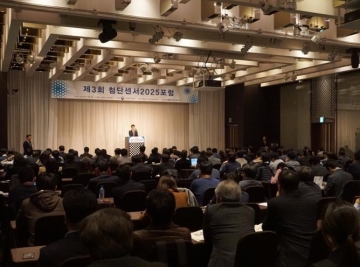
"Advanced sensors serve as peripheral nerves for industries related to the Fourth Industrial Revolution, including artificial intelligence, autonomous vehicles, and IoT." Ha Sang-tae, head of the Industrial Convergence Technology Division at the Korea Institute of Industrial Technology Evaluation and Planning (KEIT), made this statement at the '3rd Advanced Sensor 2025 Forum' held at El Tower in Yangjae on the 8th. This event is designed to foster the sensor industry by strengthening network formation and cooperation among academia, industry, and research institutions. The Advanced Sensor 2025 Forum, established in 2015, is organized into four divisions centered on public-private joint operating chairs: △smart devices, △automobiles, △healthcare, and △smart factories. Advanced sensors are a collective term for next-generation intelligent sensors that integrate sensing, information processing, and communication functions into a single semiconductor chip, serving as an elemental technology applied across industries.
2017.11.09by 김지혜 기자
In what direction will future sensors be developed?
Sensors form the foundation of technologies expected to lead the Fourth Industrial Revolution, such as big data, artificial intelligence (AI), Internet of Things (IoT), and autonomous vehicles. This is because sensors selectively collect information from specific targets. Interest in advanced sensors—intelligent sensors that integrate not only sensing but also information processing and communication functions into a single unit—is growing. According to the POSRI report, the sensor market is expected to see increased demand across all sectors, primarily driven by smart cars and smartphones. While conventional mobile phones used only two types of sensors—image and audio sensors—smartphones now use more than 20 sensors per device. Accordingly, it is projected that the era of 1 trillion sensors will arrive around 2025. The advanced sensor market share is also expected to increase from 19% in 2010 to 49% in 2020. Kwang-Jun Sohn, PD at the Korea Institute of Industrial Technology Evaluation and Planning, explained, "Whereas semiconductors and MEMS sensors were primarily used in the information and communication or automotive industries in the past, with the advent of the era of intelligent advanced sensors, the markets in which they are applied—such as robotics, automobiles, medical, environmental, and energy industries—will expand significantly," and described the development direction of sensors by key sector of the Fourth Industrial Revolution.
2017.11.13by 김지혜 기자

Intel Unveils Next-Generation 'Core Ultra Series 3' and vPro Platform for Enterprise PCs
Intel has officially unveiled the "Intel Core Ultra Series 3" for next-generation enterprise PCs and the latest vPro platform, addressing a wide range of demands from enterprise notebooks to high-performance workstations.
2026.03.26by 배종인 기자

ROHM Launches ESD Protection Diode Compatible with High-Speed Interfaces of 10Gbps or Higher
Semiconductor specialist ROHM has developed the 'RESDxVx series' of ESD (electrostatic discharge) protection diodes capable of responding to next-generation high-speed data communication environments exceeding 10Gbps, simultaneously enhancing both signal quality maintenance required in high-speed interfaces and IC protection performance.
2026.03.26by 배종인 기자












센서시장이 대세죠...기대됩니다