



SK Telecom-Korea Transportation Safety Authority to Build 5G in Autonomous Driving Experimental City
 Published2017.12.28 10:46
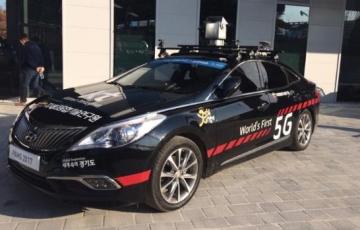
SK Telecom and the Korea Transportation Safety Authority announced that they have built 5G infrastructure in the main test sections of the autonomous driving experimental city 'K-City'. This is the first time in the world that 5G infrastructure has been built in an autonomous driving experimental city.
SK Telecom and the Korea Transportation Safety Authority worked closely together to establish 5G infrastructure in K-City, including a 20Gbps 5G test network capable of transmitting a 1GB movie in just 0.4 seconds, a 5G communication control center that exchanges data with test vehicles in just 0.001 seconds, and a 3D HD map with a precision of less than 20cm. These results were achieved in just three months since groundbreaking.
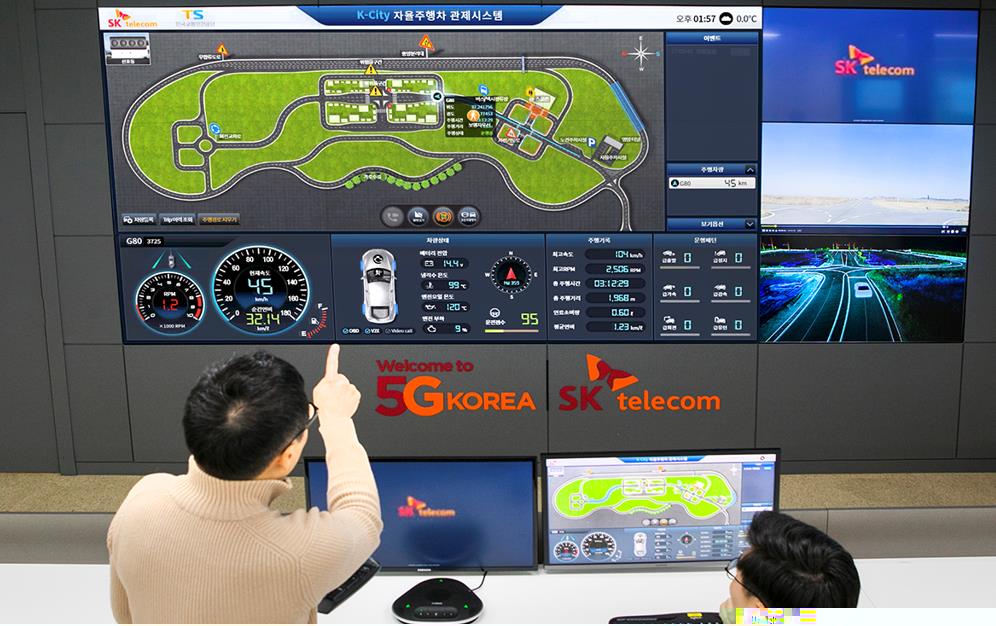
K-City 5G infrastructure is a system that applies the latest 5G technologies such as beamforming, beam tracking, and network virtualization to all sections including wireless and switchboard.
SK Telecom and the Korea Transportation Safety Authority have established a '5G autonomous driving outpost' in Korea to verify convergence technologies by building a 5G infrastructure in K-City. While there are no experimental cities overseas where 5G autonomous driving technologies can be verified, Korean companies can verify related technologies at K-City on a regular basis and speed up their development.
SK Telecom and the Korea Transportation Safety Authority plan to open 5G infrastructure to domestic companies and organizations and support the development of autonomous driving technology. In the midst of fierce global competition in autonomous driving technology, an opportunity has opened for Korea to lead the competition based on its strength in ‘5G+autonomous driving.’
5G is a key infrastructure for implementing V2X (Vehicle to Everything) technology, such as vehicle-to-vehicle communication, vehicle-to-IoT/control center communication, etc. Autonomous vehicles can exchange comprehensive surrounding environment data, such as vehicle driving information in blind spots, through 5G infrastructure to predict accident risks in advance.
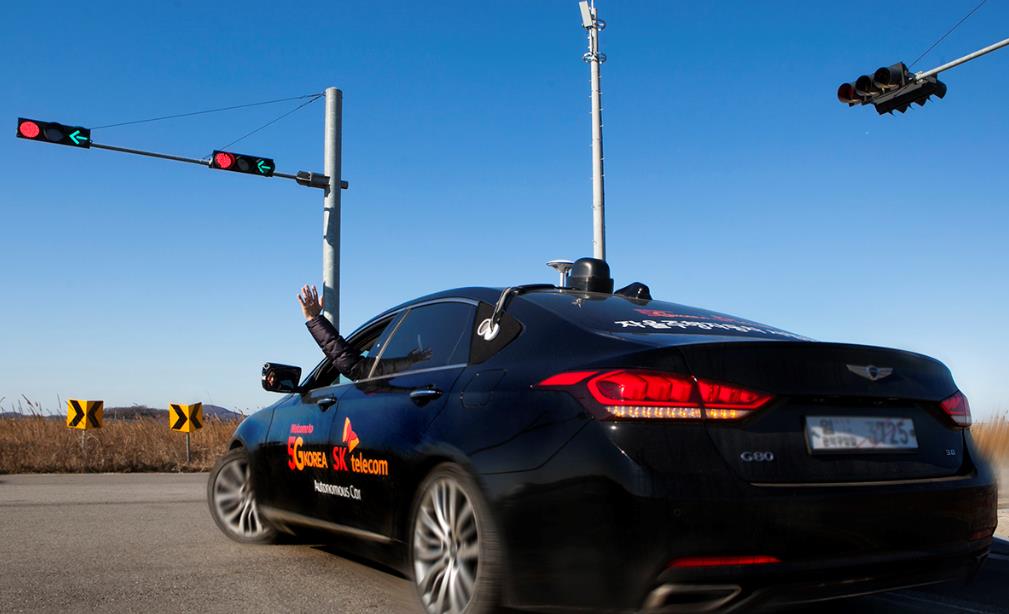
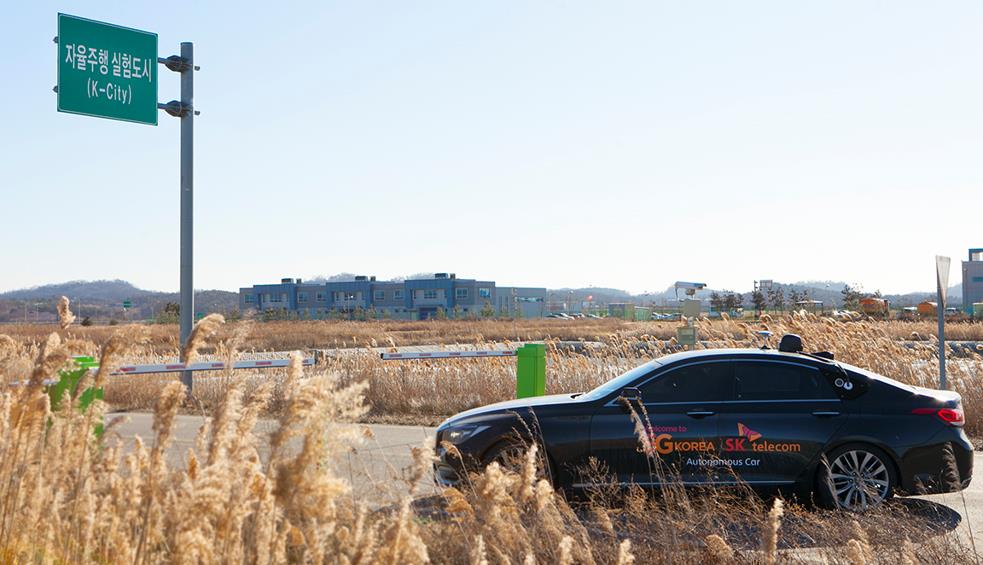
For example, if a child suddenly runs into the road, a camera/sensor mounted on a streetlight detects the danger and transmits it to the control center and surrounding autonomous vehicles via 5G within 0.1 second. The 5G infrastructure also transmits intersection signals, construction ahead, and accident situations. K-City has the infrastructure to experiment with the latest 5G autonomous driving technology in various other scenarios.
“K-City has an environment that is more advanced than other countries’ autonomous driving test cities, including 5G infrastructure, cutting-edge testing facilities, and various driving tracks,” said Kwon Byung-yoon, CEO of the Korea Transportation Safety Authority. “We will spare no support so that various domestic companies and organizations can lead the global autonomous driving technology competition.”
SK Telecom ICT Technology Center Director Park Jin-hyo said, “We will always expand the 5G K-City infrastructure with the latest technology so that K-City can become the center of the 5G autonomous driving ecosystem.”
Meanwhile, K-City is an autonomous driving experimental city with a total area of 363,000㎡ (approximately 110,000 pyeong) being developed by the Korea Transportation Safety Authority under the Ministry of Land, Infrastructure and Transport in Hwaseong-si, Gyeonggi-do. It consists of various experimental spaces that reflect actual road environments, such as △downtown △automobile-only zone △suburban zone.
Comments
Related news
K-City, a self-driving car testing facility, breaks ground, aiming for completion in 2018.
The Ministry of Land, Infrastructure and Transport will establish 'K-City', a test facility for autonomous vehicles. On August 30, the Ministry of Land, Infrastructure and Transport will hold a groundbreaking ceremony for 'K-City', an autonomous vehicle test track, at the Korea Transportation Safety Authority's Automotive Safety Research Institute located in Hwaseong-si, Gyeonggi-do. A test bed where experiments can be conducted in environments similar to real-world conditions is essential for autonomous vehicle technology development. Accordingly, the Ministry of Land, Infrastructure and Transport will invest approximately 11 billion won to construct 'K-City', a virtual city for autonomous vehicle testing, within the driving test track of the Korea Transportation Safety Authority's Automotive Safety Research Institute on a scale of 320,000 m² (110,000 pyeong).
2017.08.29by 김지혜 기자
“We will make Pangyo Zero City an international standard platform”
A venue has been set up to take a comprehensive look at how far domestic autonomous driving technology has advanced. The "2017 Pangyo Autonomous Driving Motor Show," the world's first motor show dedicated to autonomous vehicles, opened on the 16th at the Enterprise Support Hub in Pangyo Zero City, Gyeonggi Province. In the autonomous driving demonstration complex being developed in Pangyo Zero City, a future-oriented innovative city free from carbon emissions, environmental pollution, accidents, and hazards, autonomous driving traffic infrastructure including an autonomous driving control center, integrated control platform, IoT system, and big data system will be established by the end of 2019. The "Zero Shuttle," a symbol of Pangyo Zero City, was unveiled on the first day of the event. The Zero Shuttle is an autonomous vehicle developed under the leadership of Gyeonggi Province's Next-Generation Convergence Technology Research Institute and operates through V2X communication technology to exchange information with the control center and road conditions in real-world road environments where regular vehicles run. Beginning in December, it will operate in a pilot program on regular roads spanning 5.5 km between Pangyo Zero City and Pangyo Station.
2017.11.16by 김지혜 기자
[e4ds Tech Day 2026 ⑨] Sim Sang-gyu, Autocrypt CTO: "In the Physical AI Era, Automotive Security Must Extend Beyond the Vehicle"
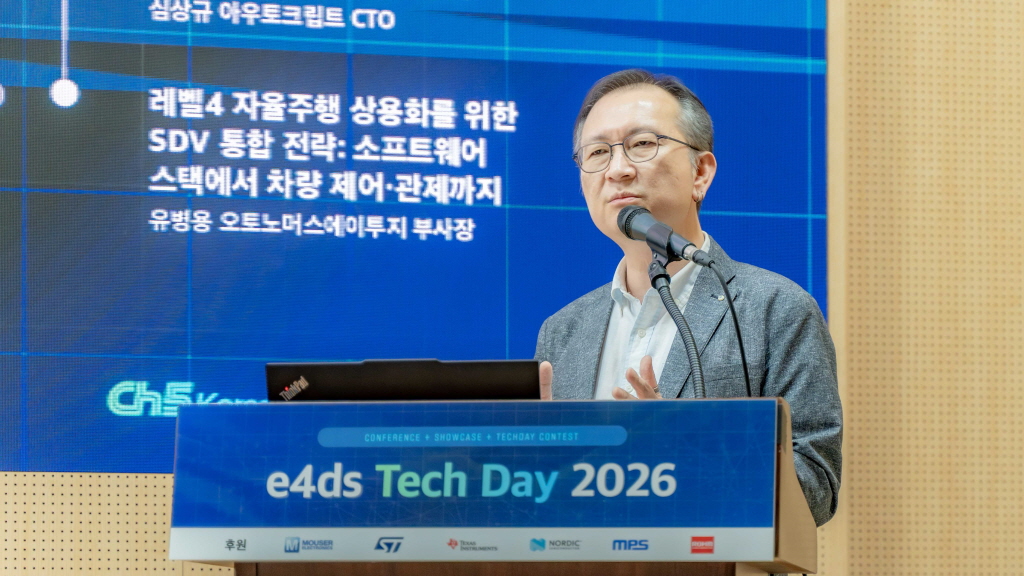
At e4ds Tech Day 2026, Sim Sang-gyu, CTO of Autocrypt, explained automotive cybersecurity strategies in the era of Physical AI and SDV (Software-Defined Vehicle). Automobiles are evolving as part of an ecosystem connected to AI, cloud, chargers, IoT, and robots, and he emphasized that the scope of security must expand beyond the vehicle interior to the entire connected environment. In particular, AI model tampering, adversarial attacks, OTA updates, and EV charger hacking were identified as major threats. He explained that response measures require zero trust, AI model integrity protection, intrusion detection, Security by Design and Default, and full lifecycle security management, and that proactive security system establishment beyond regulatory compliance is critical for securing future mobility competitiveness.
2026.10.12by 배종인 기자

Practical HIL Construction Strategy for Automotive and Off-Highway Controller Validation
As vehicle E/E architecture transitions to zonal structures and shifts to software-defined vehicles (SDV), the number of controllers (ECUs) requiring validation and software complexity are surging dramatically. Meanwhile, real vehicle testing cannot provide repeated verification under identical conditions and entails lead time and safety concerns. This white paper explains the principles of HIL (Hardware-in-the-Loop) validation and the structure of the NI platform composed of PXI, SLSC, and VeriStand, and through two actual implementation cases—Camera Record & Replay HIL for In-Cabin Monitoring Controller (ICMU) and Forklift Controller (VCU) HILS—describes how controller-level regression testing becomes possible. Additionally, it explicitly states application boundaries and limitations, such as lack of A2B support.
2026.10.12by 편집부
Korea Automotive Research Institute Signs MOU with Italy National Institute for Wireless Communications
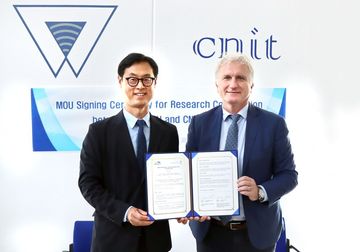
The Korea Automotive Research Institute will sign an MOU with Italy's National Institute for Wireless Communications and launch joint research on next-generation mobility technologies based on 6G, V2X, and connected vehicles. The two organizations will conduct research to apply advanced wireless communication technologies to vehicles and discover international joint projects to advance next-generation connected vehicle technology development.
2026.10.12by 배종인 기자











