



Development of core quantum cryptography components to block hacking and eavesdropping
 Published2018.01.04 17:11
Success in modularization into integrated chips and component miniaturization through semiconductor processes
Core technology for wireless quantum cryptography communication has been developed in Korea for the first time.
The Electronics and Telecommunications Research Institute (ETRI) has developed core component technology necessary for wirelessly transmitting encryption keys in quantum cryptographic communication. While bulk optical components occupying a meter-sized area have been used until now, ETRI has succeeded in miniaturizing the components to a centimeter-sized or smaller, which is 1/100th the size of the existing ones, by applying a new integration method.
Quantum cryptography generates an encryption key by reducing the intensity of photons emitted from a laser source to the level of a single photon and transmitting them to a recipient. The principle involves generating, transmitting, and detecting the polarization and phase quantum states of the photons to create an encrypted key for both the sender and the receiver. Therefore, if hacking or eavesdropping occurs during transit, the quantum state changes, making hacking or eavesdropping impossible in principle.
The research team succeeded in developing core transmitting and receiving components that create, transmit, and detect polarized quantum states using light sources and polarizing components. As core transmitting and receiving components for wireless quantum cryptography communication, they implemented component modules including a 4-channel light source, a 4-channel polarization coupling/separation module, and a 4-channel single-photon detector.
In conventional quantum cryptography, individual components and devices such as polarization couplers, beam couplers, and half-wave plates that combine polarization states were included in the transmitting and receiving units, and the volume was large in the meter (m) range. However, ETRI modularized the functions of large components by implementing them into an integrated chip for the first time through semiconductor processes.
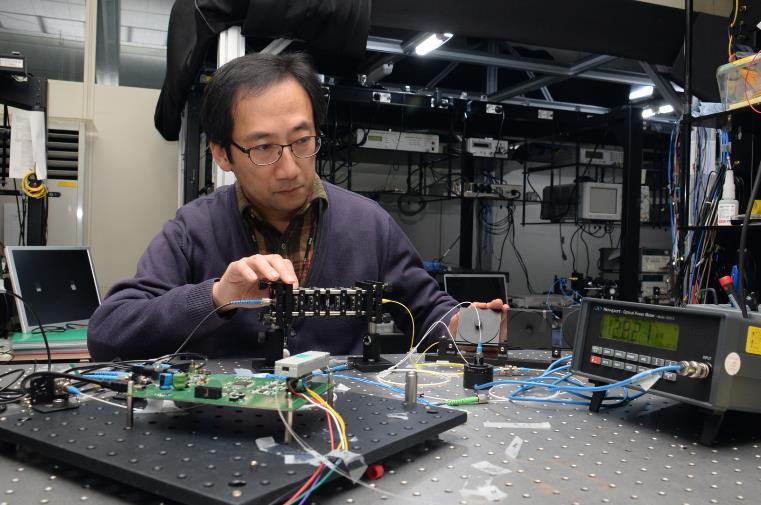
The core polarization coupling chip of the transmitter, successfully developed by the research team, measures 40mm x 2mm, significantly miniaturizing the four components that previously constituted the transmitter. ETRI created an integrated polarization module capable of generating multiple polarization states as a chip with one output for four inputs.
The system operating speed of the transmitting and receiving components created by the research team is currently 100 MHz, which is world-class.
In addition, existing transmitting and receiving components were expensive because they required combining multiple high-cost bulk individual components. There were also difficulties in aligning these individual components, but the component developed by this research team has resolved these issues. Therefore, it is expected to contribute significantly to the commercialization of quantum communication by enabling stability, mass production, and cost reduction.
Moving forward, the research team plans to demonstrate wireless quantum communication in a real-world environment early next year using the developed core transmitter and receiver components. Through this, the plan is to verify encryption key transmission rates of several hundred kbps and reduce the quantum bit error rate to within 5%, exceeding global standards.
ETRI plans to focus on further miniaturizing and integrating modules in the future, as well as improving the speed of quantum cryptographic key generation and transmission distance.
Yoon Cheon-ju, Project Leader of the Optical Communication Components Research Group at ETRI, stated, “In the era of the Internet of Things (IoT), where various devices such as mobile terminals and secure in-vehicle and inter-vehicle communication will be connected to communication networks, the transmission and reception of sensitive information will be made possible through quantum cryptography communication that guarantees perfect security.”
The wireless quantum cryptography components developed by ETRI are expected to be embedded in communication equipment and utilized as encryption devices in the future. In particular, they are projected to be useful for national administrative security networks, secure financial networks, encrypted transmission of military secrets, data center confidentiality, personal medical and information security services, and prevention of vehicle hacking.
Comments
Related news
ETRI Creates Smart Factories with NB-IoT
Domestic researchers have successfully applied mobile communication technology to smart factories, and this is expected to open the way for wireless remote control of factories in the future. The Electronics and Telecommunications Research Institute (ETRI) has successfully demonstrated industrial Internet of Things (IIoT) services by applying mobile communication technology to a smart factory production automation system for the first time in Korea. Until now, industrial sites such as factories have independently applied IT. Wired communication technology, which is widely used in factory operations, has higher reliability compared to wireless communication; however, it is not suitable for mobile operations, leaving room for improvement in wiring and safety. Therefore, there has been the inconvenience of having to completely reinstall the factory's wired communication infrastructure when rearranging the factory layout or moving machinery and robots in response to process changes.
2017.12.06by 김지혜 기자
ETRI, Chollian Satellite Communication Payload Achieves World-Class Level
The Electronics and Telecommunications Research Institute (ETRI) announced that it has developed a communication payload—the core component of the Chollian satellite—and verified world-class technical excellence in performance through satellite control and other operations. The research team has conducted satellite communication public services, satellite signal measurement, ground terminal testing, and satellite control over the past seven years. The communication payload developed by ETRI operates in the Ka band, a high-frequency band of 20–30 GHz (gigahertz). The team developed three relay channels for communication and installed them on the satellite to provide satellite communication services.
2017.12.14by 김지혜 기자
ETRI Develops Corrosion-Free Flexible Neural Electrode In Vivo
Successfully developed a flexible neural electrode that does not corrode in vivo, can measure neural signals over extended periods, and efficiently deliver electrical stimulation to cells. The Electronics and Telecommunications Research Institute (ETRI) announced the successful development of a neural electrode composed solely of biocompatible gold (Au) and fluorine (F)-based polymers with excellent chemical durability, no water absorption or permeation. The results were published in ACS Applied Materials & Interfaces (ACSAMI), a journal published by the American Chemical Society. The developed neural electrode has no chemical corrosion factors, enabling long-term stability when implanted in bodily fluids composed of various substances. Therefore, stable detection of brain neural signals and continuous stimulation of neural tissue are possible.
2017.12.22by 김지혜 기자
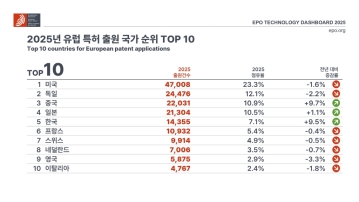
European Patent Applications Surpass 200,000 for the First Time… South Korea Maintains 5th Place, Led by Batteries and Telecommunications
According to the European Patent Office (EPO)'s 'Technology Dashboard 2025', European patent applications last year reached 201,974, surpassing 200,000 for the first time. Korean companies and inventors filed 14,355 applications, representing a 9.5% increase from the previous year and maintaining 5th place by country. Battery, digital communication, and semiconductor technologies led the growth, with Samsung ranking as the top EPO applicant for the second consecutive year and LG reaching 3rd place. The presence of major domestic cities such as Seoul, Suwon, and Yongin was also confirmed. It was also revealed that Korea's European patent strategy is expanding beyond individual technologies to span the entire industry.
2026.03.24by 명세환 기자

SK Telecom First Applies AI-Based Network Operations at Gwanghwamun K-Pop Concert
SK Telecom announced that it applied an AI-based network operation system for the first time at a large-scale K-pop concert held in the Gwanghwamun area of Seoul on March 21st, managing communication quality throughout the event. Mobile data usage during the three hours before and after the concert reached 12.15TB, approximately doubling compared to the same time slot the previous weekend. SK Telecom monitored traffic using the AI system 'A-One' in five-minute and 50-meter units to respond to potential overload situations, while also operating temporary communication facilities and on-site personnel in parallel. This case is interpreted as confirmation of the practical applicability of AI-based autonomous network operation in an environment where demand from dense events and foreign users increases simultaneously.
2026.03.23by 명세환 기자











