


Smart technologies like IoT and drones are improving railway safety.
 Published2018.01.17 16:40
Established to improve safety management methods using cutting-edge technology
The Internet of Things (IoT) is used to check train status in real time, prevent train breakdowns in advance, and manage facilities in dangerous sections such as bridges and transmission towers using drones.
The Ministry of Land, Infrastructure and Transport has established the "Basic Plan for Establishing a SMART Railway Safety Management System (2018-2027)" to proactively introduce Fourth Industrial Revolution technologies to the railway safety sector and improve railway safety standards.
The number of accidents and fatalities in the railway safety field has been decreasing, but the rate of decrease has reached its limit, making it difficult to improve safety using only existing safety management methods. Accordingly, this plan was established to improve safety management methods by utilizing cutting-edge technologies.
This plan is a mid- to long-term plan that contains 24 tasks in 6 major areas, including vehicles, facilities, and operations, to present a blueprint for future railway safety management. It was prepared through a public contest and continuous discussion and research by experts in the 4th Industrial Revolution, railway operators, and research institutes.
① Vehicle management field
By utilizing the Internet of Things (IoT) and sensors, the status of vehicle parts will be monitored in real time, warnings will be issued in real time when abnormalities occur, and automatic maintenance will be performed through smart factories such as 3D printing and robot control equipment.
This year, we will install sensors on major railway vehicle components and tracks to conduct a pilot project to monitor real-time abnormalities such as cracks, wear, and overheating in vehicle components. We will gradually expand the scope of management by installing sensors on each major component.
Starting in the second half of the year, when a vehicle enters a maintenance facility, we plan to use sensing and artificial intelligence technology to determine in real time what items need to be maintained or replaced, and automatically perform maintenance and parts replacement. We also plan to apply automatic manufacturing technology for maintenance parts using 3D printing technology.
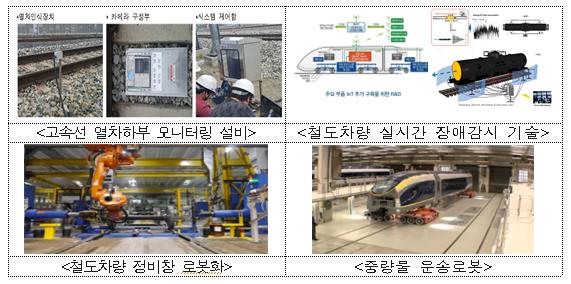
In addition, we plan to establish an information system this year and build it in stages, recording and managing failure history by vehicle and component unit, analyzing the data to establish optimized inspection and replacement cycles and methods, and utilizing this to improve product performance.
② Facility management field
By utilizing the Internet of Things and drones, the status of facilities is monitored in real time, and maintenance is performed using cutting-edge equipment. Preventive facility management is implemented by analyzing big data collected from various sensors.
We plan to continue expanding our drone-based facility inspection activities, currently under pilot operation, through 2022, and to also consider conducting research and development on facility condition inspections* using the Internet of Things this year. Through future pilot projects, we plan to improve preventative maintenance by proactively detecting abnormal conditions.
Starting this year, people will be directly deployed to the tracks where trains are running, and repairs to the tracks, which have been causing rear-end collisions, will gradually introduce small compaction equipment and other repair equipment, and old equipment will be modernized to reduce accidents. Additionally, a facility history management system that manages information such as facility maintenance/improvement history and inspection results, and supports decision-making such as establishing maintenance plans, will be designed this year and implemented by 2020.
③ Human resources management field
Through artificial intelligence sensors, it detects driver drowsiness and fatigue, and provides real-time warnings of danger. It also strengthens the disaster response capabilities of railway workers through emergency response training using virtual reality (VR) and augmented reality (AR).
.jpg)
Starting this year, we will conduct a pilot project to compare and analyze big data related to the speed limits for each section of the railway and the actual operating speed of the trains of the engineers to identify dangerous sections and dangerous habits of the engineers and make improvements in advance. We also plan to gradually develop technology that recognizes the driver's vital signs and checks and warns of risks such as drowsiness and fatigue in real time.
Additionally, in the second half of this year, we will develop an experiential education infrastructure utilizing virtual reality (VR) and augmented reality (AR), and through pilot projects, utilize it for training and education of workers, thereby strengthening the emergency response capabilities and collaboration skills of field workers.
④ Risk management field
Through big data analysis of accident cases, maintenance information, and other data, we predict accident risks and provide optimal solutions for accident prevention, enabling the most effective decision-making for safety.
This year, a system that predicts risk factors that may cause accidents will be established by collecting and analyzing accident and failure statistics and maintenance history information of vehicles, parts, and facilities. We will gradually develop a system that can propose effective preventive measures through pilot application and big data analysis.
From the production of vehicles, parts, and equipment to maintenance, improvement, and disposal, we will develop a system that supports improvement and maintenance methods and procedures by utilizing and analyzing data at all stages based on scientific techniques such as RAMS* by the end of 2018, thereby making maintenance management more scientific.
⑤ Operation management field
In control, the status of tracks, vehicles, and equipment is detected in real time based on the Internet of Things and LTE, supporting decision-making such as emergency recovery and route change, and minimizing risks to drivers and workers through real-time information sharing.
By 2022, IoT-based sensors will be used to transmit abnormal situations such as train overheating, train dragging, earthquakes, and unauthorized tunnel intrusions from various devices, including major vehicle components, tracks, and signaling devices, to the control center, enabling real-time management of emergency maintenance and train operation suspensions. To this end, we plan to implement a pilot project starting this year and expand it through performance evaluation.
Starting this year, we plan to minimize the risks to track workers by implementing a system that prevents risks in advance by sharing train operation and work information in real time with controllers, engineers, and workers through smartphone app services.
Additionally, to enable rapid and systematic response in the event of an accident, we will pilot and expand a disaster broadcasting system that utilizes LTE wireless communication to enable emergency communication among air traffic controllers, engineers, crew members, and passengers.
⑥ Security management field
A smart railway security system utilizing intelligent CCTV, artificial intelligence, etc. will be established to detect and respond to threats such as terrorism in advance.
We will establish a system to proactively respond to dangerous individuals and abnormal behavior by identifying them through intelligent CCTV that combines CCTV capable of tracking people while rotating 360 degrees with intelligent software, and we will also introduce an artificial intelligence (AI)-based automatic reading system that automatically searches for dangerous objects.
In the second half of this year, we will create a 3D map of the spatial information of major railway stations, displaying the locations of security personnel, detection dogs, and other personnel. This will be monitored comprehensively by the Railway Security Information Center, supporting decision-making. This will also establish a foundation for real-time response to terrorist attacks, crimes, and other incidents.
In order to effectively implement the Smart Railway Safety Management Basic Plan, the Ministry of Land, Infrastructure and Transport will form a task force (TF) team led by the Ministry of Land, Infrastructure and Transport's Director General for Railway Safety Policy, including railway operating agencies, railway-related academic and research institutions, and a group of experts from the Fourth Industrial Revolution. The team will manage implementation performance through periodic meetings.
Comments
Related news
Moving CCTV, replaced by drones
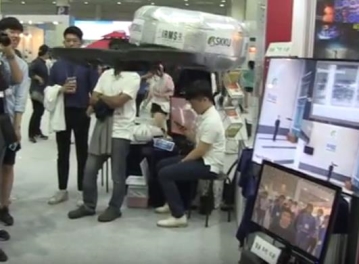
The World IT Show also held an exhibition of excellent research achievements from university ICT Research Centers (ITRC). The ITRC project is a field-oriented ICT workforce development initiative in which participating researchers from universities conduct research and development jointly with industry to develop technologies applicable in industrial settings. Divided into six areas—future society safety/security, future society contents/media, industrial ICT convergence, intelligent ICT convergence, smart life, and smart infrastructure—38 centers from 30 universities participated. Sungkyunkwan University's Intelligent ICT Convergence Research Center was selected for the Ministry of Science, ICT and Future Planning's 'Grand ICT Research Center' project and has established and operates the Pangyo SW Convergence Graduate School on the startup campus within Pangyo Techno Valley. Research is being conducted on four themes: interaction design, big data intelligence, and smart/cloud component ICT convergence platforms. Among these, the 'real-time face tracking drone' technology tracks a person's face and currently follows only the frontal view of the face. It maintains a fixed distance while tracking the person while keeping that distance constant. The product demonstrated in the demonstration had a distance set to 0.7m, but the distance can be changed depending on camera performance. The face captured by the camera can be output and viewed on a monitor as video. Through intelligent video detection, it can be applied to the security market.
2017.05.29by 김지혜 기자
SKT, Now Even Railway Detection is in the IoT Era
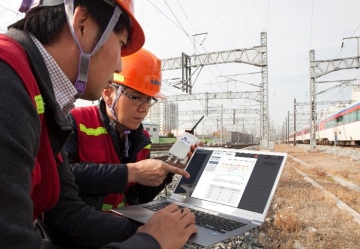
SK Telecom announced that it has developed an IoT system for safe railway operation in collaboration with Korail and Navel Communications. This system is the result of a joint research agreement on 'IoT-based Infrastructure Monitoring System' concluded in May, and its core focus is to manage railways more efficiently by utilizing LoRa and LTE. The development of railway IoT was conducted on the Gyeongbu Line between Seoul and Busan in the following areas directly related to the safety of users and employees: ▲rail temperature measurement ▲vehicle battery voltage measurement ▲vehicle reducer temperature measurement ▲vehicle vibration measurement ▲automatic tension adjustment device power gauge measurement.
2017.11.13by 김지혜 기자
LG Uplus Commercializes NB-IoT-Based City Gas Pipeline Management System
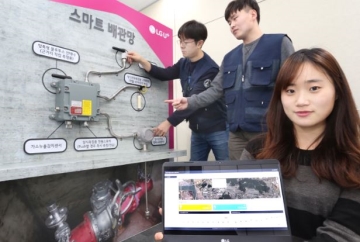
LG Uplus announced that it has established a smart pipeline management system based on NB-IoT with Samcheonri, a comprehensive energy company, and has commenced commercial service. The establishment of an industrial management service utilizing NB-IoT technology had undergone pilot operation for three months from August of last year in some areas of Samcheonri's city gas supply zone. The smart pipeline management system is a solution that enables remote monitoring of pipeline conditions and analyzes collected data to supply city gas more efficiently and reliably.
2018.01.16by 김학준 기자
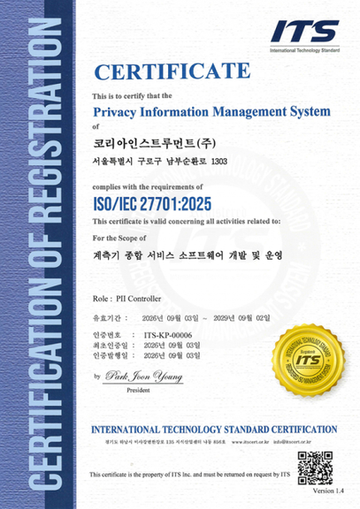
Korea Instrument, KOLAS Accredited Calibration Agency First to Simultaneously Acquire ISO/IEC 27,001·27,701
Korea Instrument has become the first among KOLAS accredited calibration agencies to simultaneously acquire ISO/IEC 27,001 and ISO/IEC 27,701 certifications. Through its proprietary platforms CWIZ Enterprise and CWIZ Partners, the company has embedded information security and personal data protection requirements across all business processes including customer information, equipment data, and calibration reports, with plans to continuously advance its management system through regular audits and security inspections.
2026.10.12by 배종인 기자
TeamViewer One, IT Incident Automation Workflow and Resolution Center Enhanced
TeamViewer has added IT incident automation capabilities and an advanced Resolution Center to its integrated digital workplace management platform 'TeamViewer ONE'. Recurrent service disruptions, configuration errors, and capacity shortages are automatically handled according to preset policies, and device status verification through script deployment can be managed in a unified interface, significantly reducing repetitive tasks for IT teams.
2026.10.12by 배종인 기자











