



How will the semiconductor market change this year?
 Published2018.01.22 14:52
ON Semiconductor presented its 2018 semiconductor market outlook.
Phil DeMarie, Senior Director of Corporate Marketing at ON Semiconductor, predicted the 2018 semiconductor market trends as follows.
Demand for innovative semiconductors in the automotive industry will continue to increase
With notable growth expected across various industrial sectors starting in 2018, this growth appears likely to be driven by major technology trends attracting global attention. For instance, as the electrification of powertrains spreads and the adoption of electric vehicles (EVs) and hybrid vehicles (HEVs) expands, the demand for innovative semiconductor and electronic component solutions in the automotive sector continues to rise. Furthermore, the scale and value of electronic components across passenger vehicles are steadily increasing, driven by body and interior systems, LED lighting, and the recently most prominent Advanced Driver Assistance Systems (ADAS). Moreover, these trends are expected to have a significant impact on the realization of 'Level 4,' a highly advanced stage of autonomous driving classified by the Society of Automotive Engineers (SAE) as Level 5, within the next decade.
The Internet of Things (IoT) and Industrial Internet of Things (IIoT) will drive the growth of the semiconductor market.
Another field expected to show explosive growth is the Internet of Things (IoT) and the Industrial Internet of Things (IIoT), also known as Industry 4.0. The convergence of technologies from industry leaders and cutting-edge technologies is providing engineers across various industries with practical and integrated end-to-end solutions for IoT development, including sensing, signal processing, power management, and secure wireless connectivity. Various tools, such as IoT Development Kits (IDKs), are lowering the barriers to entry for products like ON Semiconductor's energy harvesting and battery-free Smart Passive Sensors (SPS), helping to turn ideas into actual solutions in an easier, faster, and more cost-effective manner. Furthermore, fields such as smart cities, smart homes, machine vision, robotics, mobile healthcare, and wearables are also expected to continue advancing based on the continuous innovation of semiconductor technology. These are all areas in which ON Semiconductor is actively participating.
Integration and systemization will serve as the core of semiconductor design
It is difficult to say that Moore's Law is over. However, the focus of semiconductor development is gradually shifting from increasing integration density to integrating design technologies into more efficient, energy-efficient, stable, and robust system solutions. This ultimately leads to the miniaturization of the form factor of end products. Integration and systemization are expected to serve as the core of semiconductor design, playing a crucial role in enabling industry leaders, including ON Semiconductor, to provide innovative solutions and launch new products into the market. In other words, while semiconductor integration density will continue to increase, the pace will slow down. This is because semiconductor companies can provide enhanced value and benefits to end users by focusing their efforts on other aspects of technology.
Security and connectivity of the Internet of Things (IoT) will become more important
As data increasingly moves to the cloud and the proliferation of IoT accelerates, issues surrounding security and connectivity will emerge as increasingly critical technical concerns. Companies providing end-to-end IoT solutions, such as ON Semiconductor, will play a vital role not only in demonstrating that their solutions are equipped with hardware, software, and development support elements, but also in ensuring robust, reliable, and secure connectivity between nodes and the cloud.
Furthermore, the importance of energy efficiency will continue to be raised in most technology areas, including IoT. When power loss reduction and energy conservation are realized in semiconductors within all types of devices, the overall power requirements of products and systems are reduced. In particular, with the increase in battery-powered portable applications, this not only enables device miniaturization by reducing battery size but also extends device lifespan by decreasing the demand for large battery cells. This is expected to bring significant benefits, especially to the field of wearable devices such as mHealth devices and fitness trackers, where miniaturization while increasing battery capacity is key.
We will accelerate the development of autonomous driving based on machine learning (ML) and artificial intelligence (AI).
Another field emerging as a powerful technology is machine learning (ML) and artificial intelligence (AI), and the automotive industry is one of the sectors where this trend is most prominent. As passive vision systems, such as rear-view cameras, are combined with sophisticated data processing, cars are now able to make decisions themselves that were previously performed by drivers, ultimately realizing autonomous driving. Furthermore, a process similar to the application of AI technology in the automotive sector is expected to emerge in various fields, including sub-industries related to IIoT.
ON Semiconductor is accelerating growth in high-growth sectors including ADAS, electric vehicles, silicon carbide, machine vision, and industrial power management, and the outlook for 2018 is very positive. In particular, investments in demand markets for automotive and industrial applications are entering a phase of profitability. Furthermore, profitability is expected to improve further as the adoption of ADAS, electric and hybrid vehicles, machine vision, and robotics expands. ON Semiconductor plans to continue making sustained investments based on the belief that the automotive, industrial application, and communications sectors will be the fastest-growing semiconductor demand markets.
ON Semiconductor has an extensive product portfolio supporting applications within automotive electronics. In particular, cameras are becoming increasingly important as they are widely used not only in vehicles supporting ADAS and autonomous driving, but also in consumer applications such as unmanned aerial vehicles and sports cameras, as well as in the fields of security, surveillance, and machine vision.
In addition, ON Semiconductor provides a diverse range of solutions across the entire field of power management semiconductors. There is significant demand for ON Semiconductor's power modules and power management semiconductor solutions. Leveraging its expertise in the consumer power module sector, ON Semiconductor offers system solutions that encompass various application areas. Furthermore, ON Semiconductor's sensing, power management, connectivity devices, and system solutions are used across various industries, offering innovative solutions to address application challenges and deliver differentiated, high-performance products to consumers.
Comments
Related news
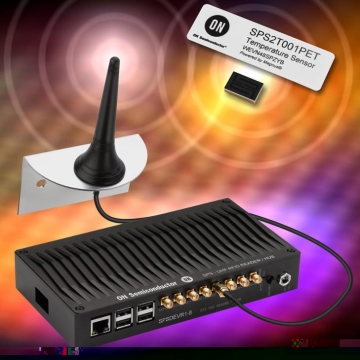
ON Semiconductor Unveils Battery-Free Wireless Sensor Kit for IoT Applications
ON Semiconductor has announced a battery-free wireless sensor solution kit (SPSDEVK1) that enables rapid integration of its innovative Smart Passive Sensors (SPS) into IoT applications. The battery-free SPS wireless sensors can monitor various parameters such as temperature, pressure, humidity, or proximity at network edges where wired connections or battery replacement are not feasible. Additionally, when receiving interrogation signals from an RF reader—specifically ON Semiconductor's TagReader—the SPS derives energy from the measurement signal to provide fast and accurate sensor readings. Moreover, the cost-effective SPS offers significant benefits compared to other technologies and possesses the potential to drive innovation in low-power IoT sensor design.
2018.01.10by 김지혜 기자

ON Semiconductor and ConvenientPower Systems Announce Strategic Partnership for Automotive Wireless Charging Technology
ON Semiconductor has announced a strategic partnership with ConvenientPower Systems (CPS). Through this collaboration, CPS will design, develop, and sell automotive wireless charging solutions using ON Semiconductor's NCV6500 application-specific power management controller. This integrated solution initiative is based on a single architecture that can scale multiple devices and coils up to 15W. The patented new technology for FOD (Foreign Object Detection) prevents overcurrent from foreign objects during charging, enabling safe operation with simple "place and charge" capability and providing users with a wide charging field.
2018.01.11by 김지혜 기자

Intel Unveils Next-Generation 'Core Ultra Series 3' and vPro Platform for Enterprise PCs
Intel has officially unveiled the "Intel Core Ultra Series 3" for next-generation enterprise PCs and the latest vPro platform, addressing a wide range of demands from enterprise notebooks to high-performance workstations.
2026.03.26by 배종인 기자

ROHM Launches ESD Protection Diode Compatible with High-Speed Interfaces of 10Gbps or Higher
Semiconductor specialist ROHM has developed the 'RESDxVx series' of ESD (electrostatic discharge) protection diodes capable of responding to next-generation high-speed data communication environments exceeding 10Gbps, simultaneously enhancing both signal quality maintenance required in high-speed interfaces and IC protection performance.
2026.03.26by 배종인 기자
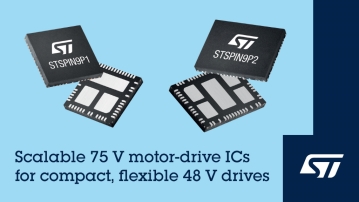
ST Launches 75V Drive IC Targeting 48V Industrial Motor Driving
ST Microelectronics has unveiled the 'STSPIN9P' series of 75V motor drive ICs tailored for 48V-class industrial drive system design. The new product family is characterized by half-bridge and full-bridge configurations that enable design scalability according to motor type and output conditions. Power supply circuits, protection functions, and current sensing circuits are integrated on-chip to simplify system configuration, and the devices are designed to support applications up to 500W maximum. The company plans to provide reference designs and demo boards to support development and evaluation in industrial automation, robotics, pumps, fans, lighting, and textile machinery.
2026.03.26by 배종인 기자











