


ETRI Announces Current Status of Domestic Mobile Traffic
 Published2018.01.25 12:08
It will reach 3.2 exabytes by the end of 2023.
The Electronics and Telecommunications Research Institute (ETRI) announced the current status of mobile traffic as a representative indicator of mobile telecommunications market growth.
This document examines domestic mobile communication subscribers, traffic trends, and traffic status by user characteristics, and introduces forecasts for mobile communication subscribers and mobile communication traffic for the next six years through 2023.
As of the third quarter of 2017, the mobile phone penetration rate in Korea exceeded 122% relative to the population. The subscription rate for 4th generation mobile communication (4G) is around 78%. Mobile communication data traffic is 305 petabytes (PB), with 4G accounting for the majority at 99.6%.
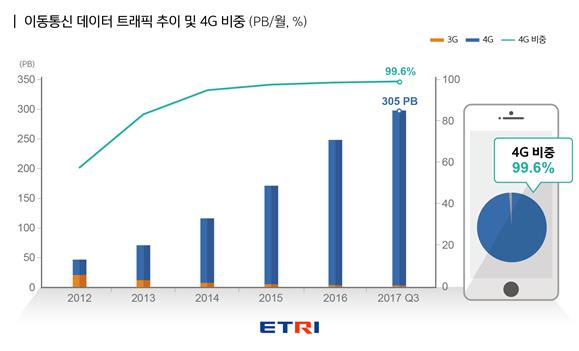
We have already experienced changes in lifestyle through 4G data services. As a result, acceptance of innovative 5th generation mobile communication (5G) services that reflect various requirements is also expected to be high.
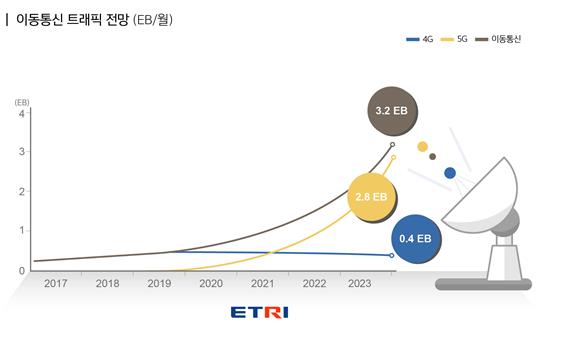
According to the results of this study, domestic mobile communication traffic is projected to surge tenfold over the next six years, reaching 3.2 exabytes (EB) by the end of 2023.
Among them, ETRI estimated that the 5G system will increase to 2.8 exabytes (EB) by the end of 2023, as the proportion of high-definition video applications such as Full HD (FHD), 4K, and 8K is expected to rise as the market grows. It is now evident that mobile communications must prepare to enter the exabyte (EB) era.
To accommodate the rapid increase in traffic, there is a growing need for the development of technologies to increase wireless network capacity and the supply of additional frequencies. In order to increase the insufficient wireless network capacity in the bands below 3 GHz, 4G has utilized spatial cell division as well as Multiple Input Multiple Output (MIMO), Carrier Aggregation, and QAM to improve frequency efficiency.
Nevertheless, when the frequency saturation capacity accommodating traffic reaches its limit, mobile communication services face Quality of Service (QoS) issues such as transmission delays, dropped calls, and the inability to watch videos.
Fortunately, 5G technical standards are nearing completion, and the supply of new frequency bands is becoming visible. As a result, it appears that South Korea will be the first in the world to embrace the 5G paradigm shift following the smartphone era, including virtual reality (VR) and augmented reality (AR), while simultaneously maintaining seamless 4G services.
Park Seung-geun, Project Leader (PL) of the Radio Resource Research Group at ETRI, stated, “Starting with this mobile traffic forecast, if annual traffic forecast reports become regular, it is expected to help establish mid-to-long-term strategies such as mobile communication technology development, frequency allocation plans, and the timing and volume of 5G frequency supply.”
Furthermore, it is expected that once traffic forecasting suitable for the domestic mobile communication service and market environment is systematized, it will be possible to establish more objective and efficient radio wave policies in conjunction with the supply and demand of mobile communication frequencies.
Comments
Related news
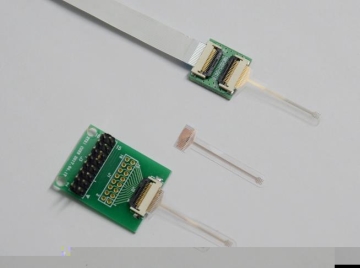
ETRI Develops Corrosion-Free Flexible Neural Electrode In Vivo
Successfully developed a flexible neural electrode that does not corrode in vivo, can measure neural signals over extended periods, and efficiently deliver electrical stimulation to cells. The Electronics and Telecommunications Research Institute (ETRI) announced the successful development of a neural electrode composed solely of biocompatible gold (Au) and fluorine (F)-based polymers with excellent chemical durability, no water absorption or permeation. The results were published in ACS Applied Materials & Interfaces (ACSAMI), a journal published by the American Chemical Society. The developed neural electrode has no chemical corrosion factors, enabling long-term stability when implanted in bodily fluids composed of various substances. Therefore, stable detection of brain neural signals and continuous stimulation of neural tissue are possible.
2017.12.22by 김지혜 기자
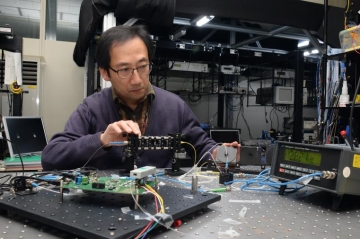
Development of core quantum cryptography components to block hacking and eavesdropping
A core technology for wireless quantum key distribution has been developed in Korea for the first time. The Electronics and Telecommunications Research Institute (ETRI) has developed key component technology required for wireless transmission of encryption keys in quantum key distribution communications. Previously, bulk optical components occupying meter-scale areas were used, but through application of a new integration method, the institute successfully miniaturized components to centimeter-scale or smaller—1/100 the size of existing systems. Quantum key distribution works by reducing the intensity of photons from a laser light source to single-photon level and transmitting them to the receiver to generate encryption keys. The principle involves generating, transmitting, and detecting the polarization and phase quantum states of photons to create encrypted keys for both sender and receiver. Therefore, if hacking or eavesdropping occurs in transit, the quantum state changes, making hacking and eavesdropping theoretically impossible.
2018.01.04by 김지혜 기자
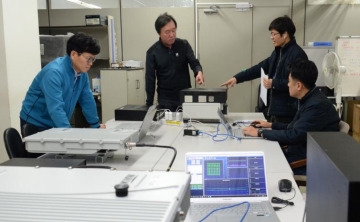
Giga Wi-Fi now works on the Seoul subway.
The Electronics and Telecommunications Research Institute (ETRI) has developed Mobile Hotspot Network (MHN) technology that enables 1Gbps-class data transmission in subway systems. This technology is a next-generation mobile communication technology that provides ultra-high-speed mobile internet service in moving subway tunnels, utilizing the broadband frequency of millimeter-wave. Through the technology development, up to approximately 550 people can simultaneously watch video content. A consortium promoting commercialization of MHN technology to provide gigabit Wi-Fi service in Seoul Metro completed final technology verification successfully, which was conducted in five subway stations on Seoul Metro Line 8 at the end of last year.
2018.01.05by 김지혜 기자
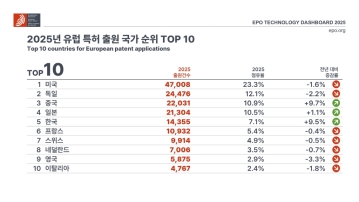
European Patent Applications Surpass 200,000 for the First Time… South Korea Maintains 5th Place, Led by Batteries and Telecommunications
According to the European Patent Office (EPO)'s 'Technology Dashboard 2025', European patent applications last year reached 201,974, surpassing 200,000 for the first time. Korean companies and inventors filed 14,355 applications, representing a 9.5% increase from the previous year and maintaining 5th place by country. Battery, digital communication, and semiconductor technologies led the growth, with Samsung ranking as the top EPO applicant for the second consecutive year and LG reaching 3rd place. The presence of major domestic cities such as Seoul, Suwon, and Yongin was also confirmed. It was also revealed that Korea's European patent strategy is expanding beyond individual technologies to span the entire industry.
2026.03.24by 명세환 기자

SK Telecom First Applies AI-Based Network Operations at Gwanghwamun K-Pop Concert
SK Telecom announced that it applied an AI-based network operation system for the first time at a large-scale K-pop concert held in the Gwanghwamun area of Seoul on March 21st, managing communication quality throughout the event. Mobile data usage during the three hours before and after the concert reached 12.15TB, approximately doubling compared to the same time slot the previous weekend. SK Telecom monitored traffic using the AI system 'A-One' in five-minute and 50-meter units to respond to potential overload situations, while also operating temporary communication facilities and on-site personnel in parallel. This case is interpreted as confirmation of the practical applicability of AI-based autonomous network operation in an environment where demand from dense events and foreign users increases simultaneously.
2026.03.23by 명세환 기자











