


Jim Handy: "Will decline starting in the second half of the year due to the semiconductor market cycle"
 Published2018.02.06 10:00
The semiconductor market follows an investment cycle. A downturn is expected to begin in the second half of this year.
Jim Handy, an analyst at Objective Analysis, stated this at a press conference for 'Semicon Korea 2018.' He explained that when companies invest excessively, oversupply leads to a drop in prices, which in turn reduces investment. As investment decreases, prices fall and stabilize. He noted that there exists a cycle where investment increases again once stabilization occurs.
The semiconductor market grew by 22% in 2017 as the memory boom continued. Jim Handy predicted that "this year will see a 10% growth rate," forecasting that DRAM would grow by 12% year-on-year and NAND flash by 9%. This represents a significant decrease compared to last year's growth forecasts (80% for DRAM and 50% for NAND flash).
The decrease in figures is due to the expectation that the market will remain strong through the second quarter following the beginning of the year, but will enter a downturn cycle starting in the second half. Regarding this, Jim Handy explained, “Demand will not change much, but since the market is product-based, there will be oversupply,” adding, “New applications using semiconductors will emerge, but this will not lead to a rapid increase in consumption immediately.”
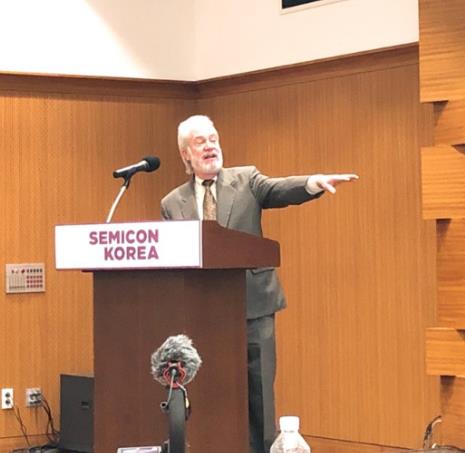
The reason for the predicted oversupply is technological stagnation. Jim Handy analyzed, “Looking at past cases, when technological stagnation occurred, supply became scarce and prices rose, but once the technological issues were resolved, prices fell. This happened when 90-nanometer process technology was introduced in 2005. Once the transition of NAND flash technology from 2D to 3D is mastered, there will be an oversupply and prices will start to fall.”
He added, “If 3D NAND prices fall, semiconductor companies will close their NAND factories or convert them into DRAM plants,” and “if this conversion leads to an oversupply of DRAM, there is a high possibility that they will close the facilities again or convert them to other uses such as foundry or SRAM.”
He predicted that new demand in the semiconductor market would come from autonomous vehicles, the Internet of Things, and artificial intelligence. He stated, “Use cases for artificial intelligence and the Internet of Things have not yet emerged. Although the technology for autonomous vehicles is advancing rapidly, it will take at least 5 to 10 years for it to be actually applied,” adding, “We must view the impact of new applications on market demand from a long-term perspective.”
China is also expected to make significant investments by 2020 under government leadership. However, many challenges remain, including intellectual property rights, wafer issues, and a shortage of fab engineers. It is anticipated that oversupply will begin once China starts full-scale mass production following the commencement of mass production by Samsung and SK Hynix. Consequently, it is predicted that intensified competition will lead to restructuring among the companies currently dominating the DRAM market.
“Currently, Samsung Electronics, SK Hynix, and Micron are making a lot of money in the DRAM market, but although it is unclear who it will be, one of the three companies will disappear and only two will remain,” he predicted.
Comments
Related news
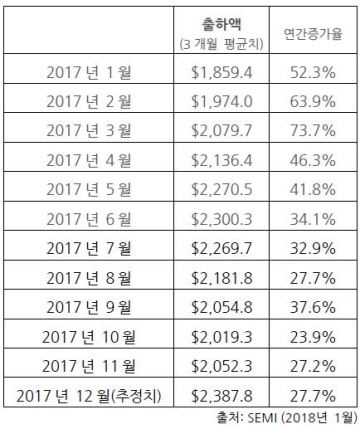
North American semiconductor equipment shipments rose 27.7% year-over-year.
The Semiconductor Equipment and Materials International (SEMI) announced that North American semiconductor equipment shipments for December totaled $2.39 billion. SEMI reports shipment figures from semiconductor equipment manufacturers in the North American region as a three-month average in its report. This represents a 16.3% increase compared to November's $2.05 billion, and a 27.7% increase compared to December of the previous year's $1.87 billion in shipments.
2018.01.25by 김지혜 기자

Samsung and Apple ranked first and second in global semiconductor purchases in 2017.
According to Gartner, Samsung Electronics and Apple held the top two positions in global semiconductor purchasing share in 2017. The combined semiconductor procurement scale of the two companies in 2017 was 81.8 billion dollars, up 2 billion dollars from the previous year, accounting for 19.5% of the total market. Masatsune Yamaji, senior research analyst at Gartner, stated: "Samsung Electronics and Apple have maintained the number one and two positions in the semiconductor purchasing index since 2011, and in 2017 their share of semiconductor purchases increased significantly. These two companies exert considerable influence over technology and pricing trends across the semiconductor industry."
2018.01.26by 김학준 기자
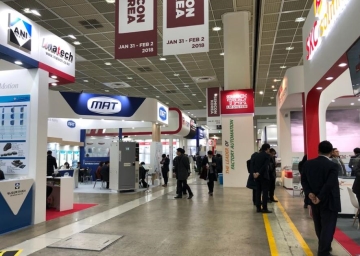
Semiconductor Equipment and Materials Industry Trends at a Glance...Semicon Korea Opens
Semicon Korea 2018, where you can see equipment and materials companies leading the global semiconductor industry all in one place, opened its doors on the 31st. Running for three days from the 31st through February 2nd at COEX, Semicon covers not only semiconductors but the entire industry including printed electronics, LED, MEMS, PV, sensors, and photonics. This year features 436 companies with 1,913 exhibition booths. Cho Hyun-dae, president of Korea SEMI, stated his aspirations at the opening ceremony, saying "Under the theme of 'CONNECT, INNOVATE, COLLABORATE,' we will provide a global supply chain for the semiconductor industry and serve as a business platform."
2018.01.31by 김지혜 기자
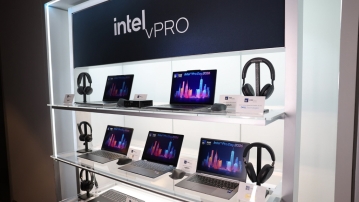
Intel Unveils Next-Generation 'Core Ultra Series 3' and vPro Platform for Enterprise PCs
Intel has officially unveiled the "Intel Core Ultra Series 3" for next-generation enterprise PCs and the latest vPro platform, addressing a wide range of demands from enterprise notebooks to high-performance workstations.
2026.03.26by 배종인 기자
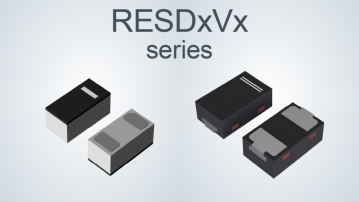
ROHM Launches ESD Protection Diode Compatible with High-Speed Interfaces of 10Gbps or Higher
Semiconductor specialist ROHM has developed the 'RESDxVx series' of ESD (electrostatic discharge) protection diodes capable of responding to next-generation high-speed data communication environments exceeding 10Gbps, simultaneously enhancing both signal quality maintenance required in high-speed interfaces and IC protection performance.
2026.03.26by 배종인 기자











