


Stop worrying about accidents and emergencies with 5G autonomous vehicles!
 Published2018.02.08 11:00
'Ultra-high Speed, Ultra-low Latency, Ultra-connectivity' to Realize V2X and HD Maps
"Through 5G technology, autonomous driving will prevent traffic accidents and create a world without accidents, improving quality of life"
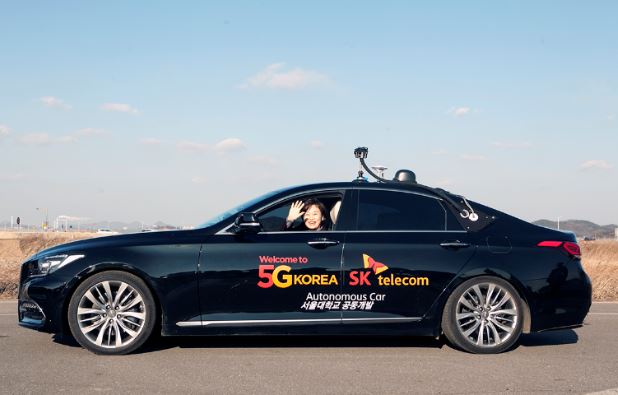
SK Telecom (hereinafter SKT) Park Jin-hyo, Head of ICT Technology, made this statement at a 5G autonomous vehicle demonstration conducted by SKT and the Korea Road Traffic Authority.
For safe and convenient autonomous vehicle operation, which SKT emphasized on this day, 5G implementation is essential. At CES 2017, Intel announced a 5G modem, signaling innovation in various fields such as wireless broadband and the Internet of Things. As a concern for mobile carriers, the automotive industry, and various companies, autonomous vehicle operation has the following characteristics.
First, ultra-high speed mobile communication. 5G supports bandwidth that is up to 1GHz wider and provides speeds of 20Gbps or higher. This is a 20-fold difference compared to 4G, which operates at 1Gbps speed. Public data such as vehicles, traffic volume, tunnels, and construction status, as well as surrounding environmental information, are transmitted and responded to at high speed. Through this data processing speed, it supports safe driving, as well as blind spot compensation and in-vehicle infotainment services.
Second, high-reliability ultra-low latency service. With 5G response latency that is one-tenth or less compared to 4G, response speed improves to 1ms (one-thousandth of a second). This enables real-time information to be processed immediately, allowing for intelligent response to various situations. This is why SKT was able to demonstrate the ability to detour and brake suddenly in road accident scenarios and school zone child jaywalking situations during the demonstration. For 4G, at a speed of 100km/h, the baseline latency is 0.03-0.05 seconds.
Finally, ultra-connectivity Internet of Things. For information transmission and processing and ultra-low latency, an ultra-connectivity network must be established first. SKT explained the characteristics of ultra-connectivity Internet of Things through a multi-collision accident scenario. When a leading vehicle detects a multi-collision accident, it transmits the accident information via 5G network to the control center and vehicles behind it. The trailing vehicle then reduces speed and changes its driving route to safely pass through the accident area. Data sharing based on connectivity makes this possible.
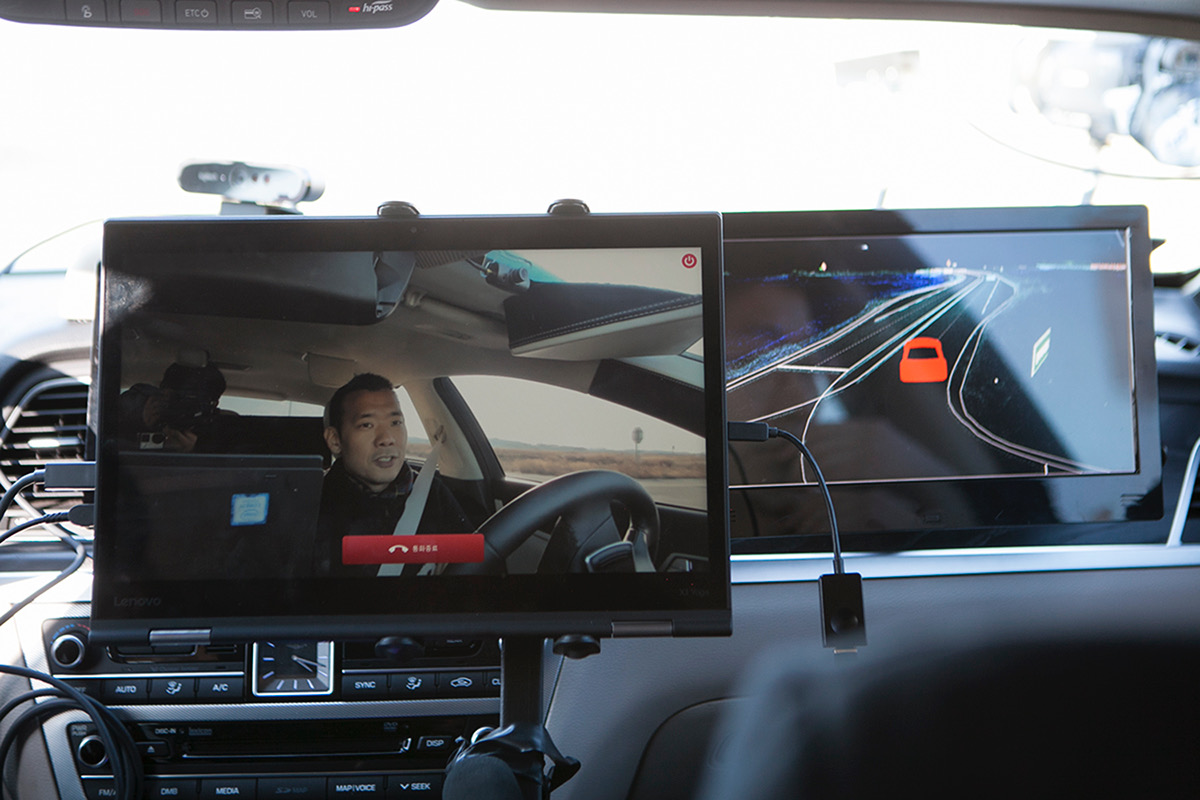
The characteristics of 5G are well-suited to the conditions for realizing Vehicle to Everything (V2X), a core element of autonomous vehicles. Along with SKT and KT's competition for 5G leadership, companies such as Samsung Electronics and Intel are putting effort into 5G-optimized services.
However, there are also problems to be solved. First, there is the security issue. SKT's Song Gwang-hyun, Head of Corporate PR Team, said, "Through quantum cryptography, we will block hacking attempts in communication between vehicles-control centers and Internet of Things," and "We plan to install security modules in autonomous vehicles soon." Unlike existing encryption methods where random number generation repeats at certain points, quantum cryptography does not cause random number repetition. However, it has the characteristic of being applied differently to each infrastructure such as transmission equipment, requiring cost-saving measures.
Additionally, regarding the HD map, which is one of SKT's autonomous vehicle strengths, legal issues may arise when collecting map data as personal information. Director Park Jin-hyo stated, "We are using the data after obtaining personal information consent and will continue to develop while actively reviewing legal concerns without privacy infringement."
Comments
Related news
SKT's AI-powered T Map app, which understands speech, is now available on iPhone.
SK Telecom announced that the downloads of its voice-activated artificial intelligence navigation service 'T map x Nugu' have exceeded 8 million, with approximately half of all T map users having experienced voice recognition-capable navigation. 'T map x Nugu' enables users to search for and change destinations using voice commands alone without touching the screen while driving, earning praise for significantly enhancing traffic safety. SK Telecom has launched an iOS version, expanding the availability of 'T map x Nugu' beyond the existing Android-only offering to iPhone users. iPhone customers can download 'T map' from the App Store and use it, while existing 'T map' users can access it immediately through an app upgrade.
2017.11.22by 김지혜 기자
SKT Notifies of Energy Production Equipment 'Failures' in Real Time
SK Telecom announced the launch of a service that enables remote real-time monitoring and control of energy production equipment through LoRa, an IoT-dedicated network. SK Telecom's energy facility management IoT service is applied to energy equipment and collects and analyzes operational and fault data from the equipment through the IoT network, enabling real-time identification of malfunctions. Unlike the existing service, which was limited to monitoring energy consumption status in various buildings to reduce energy costs, this approach enables remote management and control of facilities in real-time, making it possible to reduce maintenance costs and respond quickly when faults occur.
2017.12.04by 김지혜 기자
Leading Win-Win Cooperation Between Large and Small-Medium Enterprises in the 5G Era
The Ministry of Science and ICT held a '5G Small-Medium Enterprise Roundtable' following last week's meeting with the CEOs of the three telecommunications companies, and visited 'win-win cooperation sites between large and small-medium enterprises,' recognizing the growing importance of small-medium enterprises' role in securing a global market position in fifth-generation mobile communications (5G). This roundtable was organized to listen to voices from the 5G industry field and to fully launch win-win cooperation between large and small-medium 5G enterprises, with the participation of approximately 10 small-medium enterprises related to 5G components, equipment, and services, as well as representatives from the three telecommunications companies.
2018.01.15by 김지혜 기자
Signal-level HIL Solution for EV Power Conversion Controllers, NI ITS
EV power conversion circuits are becoming faster and more complex with SiC and GaN application and X-in-1 functional integration, and ECU verification requires the capability to simulate circuit behavior at nanosecond-level resolution in real time. This white paper organizes the position of signal-level HIL (sHIL) in the development flow and describes the hardware and software architecture, model implementation workflow, and application boundaries of NI ITS (Inverter Test System), which responds to this requirement through FPGA-based real-time simulation, based on webinar materials.
2026.10.16by 편집부
Microchip and Elektrobit Join Hands on AUTOSAR Solution
Microchip Technology and Elektrobit have unveiled a collaborative solution with pre-integrated automotive hardware and AUTOSAR software. With MCAL software based on EB tresos, the solution can reduce development effort for OEMs and Tier 1 suppliers and accelerate time-to-market. The two companies will employ an "Integration-as-Code" automation method to lower integration risk while beginning support in the Asian two-wheeler market.
2026.10.16by 배종인 기자











