


ADI Launches High-Efficiency DC/DC Controller Operating from a Single Input Voltage
 Published2018.02.13 15:21
Comments
Related news
ADI Launches DAC Controlled by DC/DC Regulator via PMBus Interface
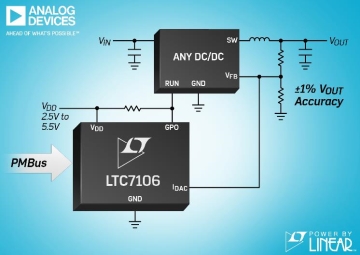
Analog Devices has announced the release of the Power by Linear LTC7106, a precision bidirectional current DAC newly designed to enable PMBus I2C interface control of output voltage on nearly all DC/DC regulators. Through a PMBus-compatible interface, the LTC7106 receives a 7-bit serial code and converts it back into bidirectional (source, sink) output current. When this output current is delivered to the regulator's feedback network, the corresponding output voltage can be dynamically programmed to optimize load power/performance or to have margin that responds to serial VID commands.
2018.01.23by 김지혜 기자
ADI Launches New Standalone Capacitor-Based Power Controller ICs
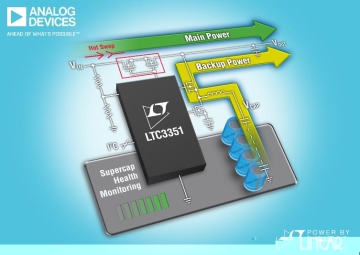
Analog Devices announced the launch of Power by Linear LTC3351, a new supercapacitor charger and backup power controller IC with all the functions needed to supply hot-swap front-end protection capabilities and a complete standalone capacitor-based backup power solution. The hot-swap controller and circuit breaker built into the LTC3351 provide a low-loss power path from input to output using N-channel MOSFETs, and together with foldback current limiting, reduce inrush current.
2018.01.25by 김지혜 기자
ADI Launches DC/DC Controller That Maintains Output Voltage Under Automotive Cold Crank Conditions
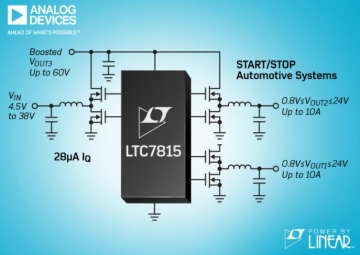
Analog Devices has announced the launch of the Power by Linear LTC7815, a new high-frequency (up to 2.25MHz) triple-output (buck, buck, boost) synchronous DC/DC controller that maintains regulation of all output voltages under automotive cold crank conditions. Since 12V automotive batteries can experience voltage droop to 4V or below during engine restart or cold crank situations, resets can occur in infotainment systems operating at 5V or higher and other vehicle electrical components.
2018.01.30by 김지혜 기자

Intel Unveils Next-Generation 'Core Ultra Series 3' and vPro Platform for Enterprise PCs
Intel has officially unveiled the "Intel Core Ultra Series 3" for next-generation enterprise PCs and the latest vPro platform, addressing a wide range of demands from enterprise notebooks to high-performance workstations.
2026.03.26by 배종인 기자

ROHM Launches ESD Protection Diode Compatible with High-Speed Interfaces of 10Gbps or Higher
Semiconductor specialist ROHM has developed the 'RESDxVx series' of ESD (electrostatic discharge) protection diodes capable of responding to next-generation high-speed data communication environments exceeding 10Gbps, simultaneously enhancing both signal quality maintenance required in high-speed interfaces and IC protection performance.
2026.03.26by 배종인 기자











