


Backpack-type base station commercialization possibility opens within a radius of several hundred meters of temporary LTE network
 Published2018.02.13 15:46
The Electronics and Telecommunications Research Institute (ETRI) is developing advanced small cell base station SW technology that can be used in buildings and sports stadiums and is preparing to commercialize it.
Following the successful development of LTE small cell base station SW in 2016, the company announced that it has succeeded in developing SW technology that supports LTE-TDD technology and dual connectivity.
The LTE-TDD technology developed by the research team is a technology that can be used by dividing the ratio of uplink and downlink by time. In LTE, the ratio of uplink and downlink can be changed in 7 ways. For example, the ratio of uplink and downlink data rates can be adjusted according to the situation for limited data.
In addition, SW technology that supports dual connectivity can be utilized in the future 5G. It is called LTE-A Pro technology, and it is a technology that allows users to simultaneously connect to two base stations to transmit and receive data. In 5G, it is also possible to connect to 4G and 5G base stations simultaneously.
In addition, the research team developed an enhanced interference control (eICI) function and an eMBMS function that additionally controls interference between base stations to increase the user's transmission speed at the edge of the cell. They also announced that they successfully developed a test environment technology to verify small cell base station SW.
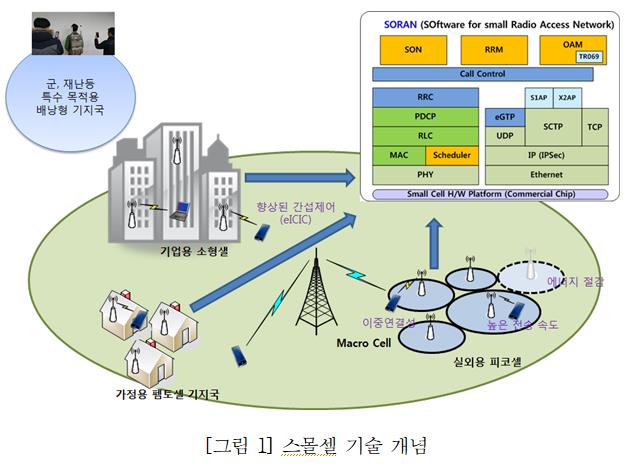
The LTE-FDD/LTE-TDD SW developed by ETRI is a model that can be exported not only domestically but also overseas, and the research team has transferred four technologies. It is also expected that it will be possible to commercialize a backpack-type base station with a radius of several hundred meters to several kilometers to form a temporary LTE network.
The research team specifically increased the number of subscribers in small cells from about 8 in the past to 64, allowing simultaneous connections. Previously, only the FDD method could be used, but this has been expanded to include the TDD method.
This technology is suitable for places with a rapid increase in traffic such as stadiums, department stores, disaster areas, and military communications where many people gather in the future, and it seems that it can be used by attaching it to indoor and outdoor building walls, utility poles, and communication antennas like a wireless LAN AP or by carrying it around in a backpack. The research team explained that the size of the small cell has been minimized to the size of a wireless LAN AP for indoor use and a shoebox for outdoor use depending on the purpose, and if made into a backpack, it will weigh about 10 kg.
Lee Jae-hak, PM of Mobile Communications at the Information and Communications Technology Promotion Center (IITP), said, “Small cell base station SW technology is expected to be localized and effectively utilized by small and medium-sized businesses. We will work to ensure that this technological prowess can lead to 5G.”
Comments
Related news
ETRI Develops Corrosion-Free Flexible Neural Electrode In Vivo
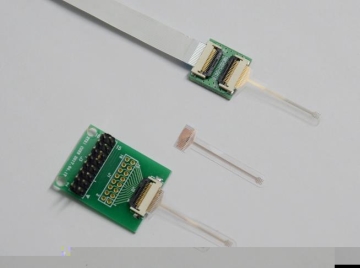
Successfully developed a flexible neural electrode that does not corrode in vivo, can measure neural signals over extended periods, and efficiently deliver electrical stimulation to cells. The Electronics and Telecommunications Research Institute (ETRI) announced the successful development of a neural electrode composed solely of biocompatible gold (Au) and fluorine (F)-based polymers with excellent chemical durability, no water absorption or permeation. The results were published in ACS Applied Materials & Interfaces (ACSAMI), a journal published by the American Chemical Society. The developed neural electrode has no chemical corrosion factors, enabling long-term stability when implanted in bodily fluids composed of various substances. Therefore, stable detection of brain neural signals and continuous stimulation of neural tissue are possible.
2017.12.22by 김지혜 기자
ETRI Announces Current Status of Domestic Mobile Traffic
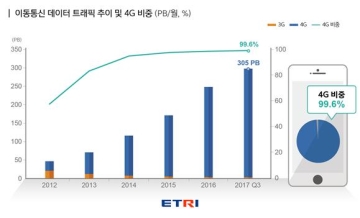
The Electronics and Telecommunications Research Institute (ETRI) released mobile traffic status as a representative indicator of growth in the mobile communication market. This content examines domestic mobile communication subscribers, traffic trends, and traffic status by user characteristics, and presents forecasts for mobile communication subscribers and mobile communication traffic over the next six years through 2023. As of the third quarter of 2017 last year, South Korea's mobile communication penetration rate exceeded 122% of the population. The fourth-generation mobile communication (4G) subscription rate relative to mobile communication stands at approximately 78%. Mobile communication data traffic reached 305 petabytes (PB), with 4G accounting for 99.6% of the total.
2018.01.25by 김지혜 기자
ETRI Develops Unidirectional Data Transmission Technology to Enhance Internal Security
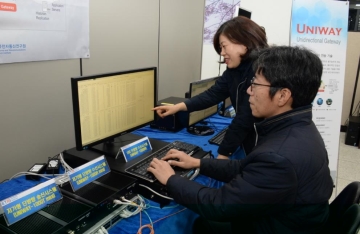
Domestic researchers have successfully developed one-way data transmission technology to strengthen internal security in control systems of critical national infrastructure such as power plants. The Electronics and Telecommunications Research Institute (ETRI) has completed the development of one-way data transmission technology in collaboration with JinTech N.G., which can fundamentally block external access to critical infrastructure where security and safety are essential. One-way data transmission refers to allowing only unidirectional communication channels between data senders and receivers, thereby blocking any pathways through which external access could occur.
2018.01.30by 김지혜 기자
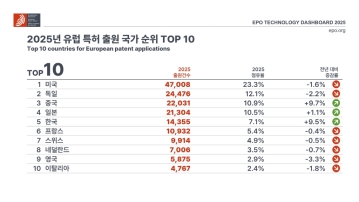
European Patent Applications Surpass 200,000 for the First Time… South Korea Maintains 5th Place, Led by Batteries and Telecommunications
According to the European Patent Office (EPO)'s 'Technology Dashboard 2025', European patent applications last year reached 201,974, surpassing 200,000 for the first time. Korean companies and inventors filed 14,355 applications, representing a 9.5% increase from the previous year and maintaining 5th place by country. Battery, digital communication, and semiconductor technologies led the growth, with Samsung ranking as the top EPO applicant for the second consecutive year and LG reaching 3rd place. The presence of major domestic cities such as Seoul, Suwon, and Yongin was also confirmed. It was also revealed that Korea's European patent strategy is expanding beyond individual technologies to span the entire industry.
2026.03.24by 명세환 기자
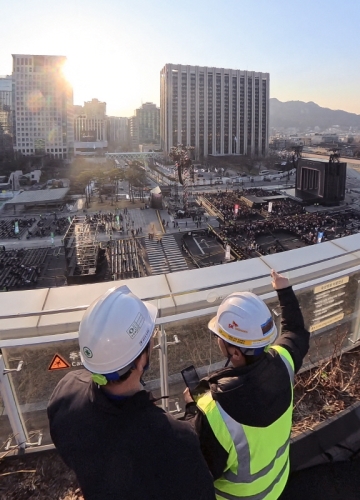
SK Telecom First Applies AI-Based Network Operations at Gwanghwamun K-Pop Concert
SK Telecom announced that it applied an AI-based network operation system for the first time at a large-scale K-pop concert held in the Gwanghwamun area of Seoul on March 21st, managing communication quality throughout the event. Mobile data usage during the three hours before and after the concert reached 12.15TB, approximately doubling compared to the same time slot the previous weekend. SK Telecom monitored traffic using the AI system 'A-One' in five-minute and 50-meter units to respond to potential overload situations, while also operating temporary communication facilities and on-site personnel in parallel. This case is interpreted as confirmation of the practical applicability of AI-based autonomous network operation in an environment where demand from dense events and foreign users increases simultaneously.
2026.03.23by 명세환 기자











