


The semiconductor industry's "Gap 5" strategy aims to bridge the five-year gap with advanced economies by 2022.
 Published2018.02.14 11:22
Our goal is to develop new materials, pico-processing technology, and neuromorphic chip technology.
The development of edge computing technology that integrates artificial intelligence into semiconductors, neuromorphic chips, and Internet of Things devices that consume 1/1000th of the existing power but have 1,000 times the performance is being promoted.
On the 8th, the Ministry of Trade, Industry and Energy reported its "Semiconductor/Display Industry Development Strategy," outlining key future policy directions for the semiconductor industry. The plan aims to commercialize new materials, such as silicon carbide (SiC), gallium nitride (GST), and potassium nitride (GaN), which are more efficient than conventional silicon, as well as pursue research into ultra-fine process technologies that transcend the nanoscale.
Son Gwang-jun, PD at the Korea Evaluation Institute of Technology (KEIT), explained, "With the advent of the Fourth Industrial Revolution, technologies that were previously focused on integration and size are evolving toward low-power, ultra-lightweight, and ultra-high-speed capabilities. The market for mass production of small items has also diversified as new demands emerge." He added, "Individualized ecosystems are also expanding in the direction of accelerated collaboration and convergence."
Currently, several countries are spurring technological innovation in the race for dominance in the semiconductor market. The United States holds a significant market share in both memory and system semiconductors and is actively developing neuromorphic chips and next-generation memory. China has declared its "semiconductor revolution" and is focusing its investments on memory semiconductors. While Japan's competitiveness has declined compared to the past, it still boasts world-class competitiveness in the materials and equipment sectors.
The domestic memory semiconductor industry dominates the global market. The DRAM market is dominated by a three-way oligopoly: Samsung Electronics, SK Hynix, and Micron. Samsung Electronics and SK Hynix also control more than half of the NAND market. However, with China expected to enter the memory semiconductor market in 2019, the possibility of oversupply is growing. Maintaining current competitiveness requires a strategy to significantly expand next-generation memory devices, processes, and equipment, while preventing the exodus of highly skilled talent.
Compared to memory, system semiconductors are generally less competitive. Producer Son stated, "Domestic companies' market share in system semiconductors is less than 3%," and added, "There is no absolute leader in any product category, including automotive semiconductors, mobile APs, and power semiconductors."
He pointed out that the lack of original technology and the small size of companies producing system semiconductors are problematic. Lack of human resources and reliance on foreign IP are also problematic.
Despite the fact that materials and equipment are key components of industrial competitiveness, the domestic market remains weak. We lack core technologies for advanced EUV materials, such as photoresist (PR), pellicles, and mask blanks. The lack of global equipment manufacturers also poses a challenge, limiting the domestic production rate.
Accordingly, the Ministry of Trade, Industry and Energy has come up with the 'Gap 5' strategy to maintain a 5-year gap with developing countries and overcome a 5-year gap with developed countries. In the semiconductor sector, the company announced its goal of achieving a 22% domestic production rate for equipment, a 70% domestic production rate for materials, a 6% market share for system semiconductors, and eight world-class equipment companies by 2022.
The '2K Project' was promoted, and key tasks were set to pioneer new convergence markets through linking demand industries, foster material and equipment memory through a win-win strategy for large and small businesses, and establish a virtuous cycle of investment, jobs, and excellent human resources.
The 2K Project aims to develop semiconductors that deliver 1,000 times the performance of conventional semiconductors at 1/1,000th the power. Its goals include research and commercialization of new materials beyond silicon, such as SiC, GST, and GaN, as well as pico-level process technology beyond the nanoscale and the development of neuromorphic computing systems. A "System Semiconductor Activation Support Center," which will support the entire semiconductor lifecycle from startup to prototype production, is also scheduled to be established in July of this year.
To pioneer new convergence markets, we will establish a permanent cooperative system across five sectors: automobiles, home appliances, energy, bio, and machinery. We will pursue joint R&D, international standards compliance, and overseas expansion. To prevent the outflow of highly skilled talent, we will identify investment challenges through public-private partnerships, including matching university technical talent, providing startup funding, and utilizing M&A funds within the Semiconductor Growth Fund. Through a "Joint Government Support Team," we will address these challenges, create quality jobs, and establish a virtuous cycle of additional domestic investment.
Park Young-sam, Director of the Electronic Components Division at the Ministry of Trade, Industry and Energy, stated, "The situation of Korea's key industries is not good. While semiconductors are doing relatively well, many point out that they lack substance." He added, "The government will work to open new avenues for the semiconductor industry. Planning is important, but execution is crucial. We will dedicate ourselves to ensuring that our strategies are effective."
Comments
Related news

How will the semiconductor market change this year?
ON Semiconductor has presented its semiconductor market outlook for 2018. Phil DeMarie, Senior Director of Corporate Marketing at ON Semiconductor, forecasted the 2018 semiconductor market trends as follows.
2018.01.22by 김지혜 기자
Jim Handy: "Will decline starting in the second half of the year due to the semiconductor market cycle"
"The semiconductor market operates in cycles driven by investment. A downturn will begin in the second half of this year." Jim Handy, researcher at Objective Analysis, stated this at a press conference for Semicorea 2018. When companies invest excessively, oversupply leads to price declines, which then reduces investment. As investment decreases, prices stabilize. Once stabilization occurs, investment increases again, creating a cyclical pattern. In 2017, the semiconductor market showed 22% growth as the memory boom continued. Jim Handy stated, "This year will see 10% growth," and forecast that DRAM would grow 12% year-over-year and NAND flash would grow 9%. This represents a significant decrease compared to last year's projected growth rates (DRAM 80%, NAND flash 50%).
2018.02.06by 김지혜 기자
January ICT Exports Reach $9.33 Billion, Driven by Continued Strong Performance in Memory Semiconductors
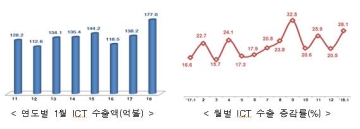
In January 2018, ICT exports were recorded at $17.70 billion and imports at $9.33 billion. This represented a 28.1% increase compared to the same month of the previous year, marking 14 consecutive months of double-digit growth since December 2016. By product category, semiconductors ($9.86 billion, up 53.8%) achieved exports in the $9 billion range for the fifth consecutive month, driven by continued strong performance in memory semiconductors ($6.85 billion, up 67.7%) and system semiconductors ($2.31 billion, up 25.3%).
2018.02.14by 김지혜 기자

Intel Unveils Next-Generation 'Core Ultra Series 3' and vPro Platform for Enterprise PCs
Intel has officially unveiled the "Intel Core Ultra Series 3" for next-generation enterprise PCs and the latest vPro platform, addressing a wide range of demands from enterprise notebooks to high-performance workstations.
2026.03.26by 배종인 기자

ROHM Launches ESD Protection Diode Compatible with High-Speed Interfaces of 10Gbps or Higher
Semiconductor specialist ROHM has developed the 'RESDxVx series' of ESD (electrostatic discharge) protection diodes capable of responding to next-generation high-speed data communication environments exceeding 10Gbps, simultaneously enhancing both signal quality maintenance required in high-speed interfaces and IC protection performance.
2026.03.26by 배종인 기자











