


SKT Upgrades Hybrid IoT Network with 'LTE cat.M1' Deployment
 Published2018.02.21 11:41
SK Telecom announced that it has upgraded its existing 'Hybrid IoT Network' by revealing plans to complete the construction of 'LTE Cat.M1,' another nationwide IoT network following the 'LoRa' network, and to commercialize it in April.
'LTE Cat.M1' is a technology standardized by the international standardization organization 3GPP, characterized by its ability to transmit low-capacity video and HD-quality photos and voice. With this commercialization, SK Telecom is now able to provide complete IoT network coverage in conjunction with the 'LoRa' network, which is suitable for low-power, low-capacity data transmission.
The power efficiency of 'LTE Cat.M1' is tens of times higher than that of the existing 'LTE-M', and the price of communication modules is more than 30% cheaper. From the perspective of manufacturers, this is expected to lower the production costs of IoT devices and reduce the price burden on customers. Furthermore, it is anticipated that the IoT ecosystem will be revitalized as it becomes easier for various manufacturers to enter the market.
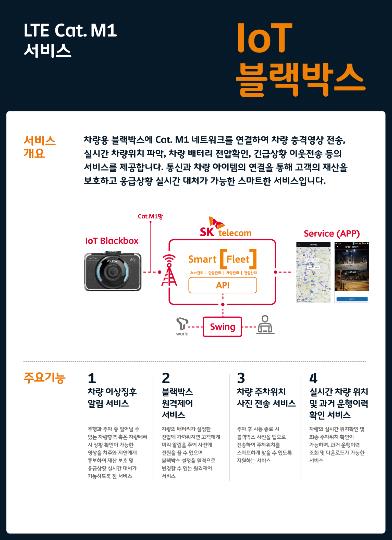
SK Telecom also unveiled an 'LTE Cat.M1'-based 'dashcam modem' and 'blood glucose monitor' on the same day, which will be showcased at MWC 2018. By utilizing 'LTE Cat.M1', video recorded by a dashcam in a parked vehicle can be viewed in real-time on a mobile device, and integrated healthcare services can also be provided. These services had difficulty utilizing LTE networks due to low power efficiency and high communication module prices, but the commercialization of 'LTE Cat.M1' has made service development easier.
SK Telecom completed the development and test network verification of 'LTE Cat.M1' technology in 2017 and has been striving to advance the technology by applying it to commercial LTE base stations and conducting field tests. SK Telecom plans to launch 'LTE Cat.M1' starting in April after completing network stabilization and optimization in March.
In the upcoming 5G era, the convergence of offline and mobile, such as autonomous driving and smart cities, is expected to increase explosively. SK Telecom predicted that the nationwide rollout of 'LTE Cat.M1' will serve as an important bridgehead for the 5G era, and that the emergence of 'LTE Cat.M1' will change the landscape of the IoT industry.
'LTE Cat.M1' Unveiled at MWC 2018
SK Telecom will showcase an 'IoT black box' and a 'blood glucose monitor' utilizing 'LTE Cat.M1' at MWC 2018.
In particular, power usage efficiency is important for vehicle dashcams as they can affect battery discharge. For this reason, it was previously difficult to incorporate communication modules for providing real-time information, but the commercialization of 'LTE Cat.M1' has made such services possible.
SK Telecom plans to launch an 'IoT Black Box' service in April in partnership with domestic telecommunications equipment manufacturer Contella, which provides accident notification and video transmission, vehicle theft detection, and battery discharge protection alerts.
The blood glucose monitoring service will also be upgraded. Since existing blood glucose meters are not always connected online, it was difficult to respond immediately to changes in the customer's situation. However, by utilizing 'LTE Cat.M1,' not only can real-time data of measurement results be accumulated, but continuous and periodic monitoring of measurement values can also be performed, enabling more efficient management of chronic diseases.
Establishing a nationwide IoT network using a hybrid network combining 'LTE Cat.M1' and ' LoRa'
SK Telecom completed the nationwide rollout of its LoRa network, a dedicated IoT network, in July 2016 and introduced a hybrid nationwide IoT network together with the 'LTE-M (LTE Cat.1)' network that was previously established in March 2016.
SK Telecom plans to utilize 'LTE Cat.M1' and 'LTE-M' for services requiring the transmission of video and photo data, and the 'LoRa' network for low-capacity, low-speed IoT services that require simple monitoring and control. Through this, it is expected that various products capable of enhancing work efficiency in industrial sectors and the convenience of daily life for the public will continue to be introduced.
SK Telecom is leading the revitalization of the domestic IoT ecosystem by developing over 150 IoT services with more than 1,200 domestic partner companies to date. In March 2017, it also opened the 'SK Telecom IoT Open House' to support ventures and startups in the IoT sector in developing and commercializing technologies and products.
“As the only company in Korea possessing a nationwide multi-IoT network, SK Telecom is accelerating the development of various IoT technologies and services for the hyper-connected era,” said Heo Il-gyu, Head of the IoT/Data Business Division at SK Telecom. “Through collaboration with various IoT partners, we will not only revitalize the IoT ecosystem but also lead the industry.”
Comments
Related news
LG Electronics Develops LTE-Based V2X Autonomous Driving Safety Technology
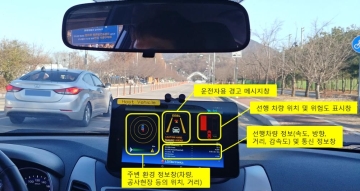
LG Electronics has successfully developed LTE-based V2X (Vehicle to Everything) terminals and autonomous driving safety technologies utilizing them, marking the first such achievement in Korea. LG Electronics recently completed successful performance verification through demonstrations of its independently developed V2X safety technology at the driving test track of the Korea Transportation Safety Authority's Automobile Safety Research Institute located in Hwaseong, Gyeonggi Province, and on regular roads in Gwacheon, Gyeonggi Province. LTE V2X is a technology that connects vehicles with all entities—including Vehicle to Vehicle (V2V), Vehicle to Infrastructure (V2I), and Vehicle to Pedestrian (V2P)—through LTE high-speed mobile communication to establish a safer and more convenient transportation environment.
2017.12.11by 김지혜 기자

SK Telecom Deploys Railway Integrated Wireless Network (LTE-R) to Gimpo Urban Railway
SK Telecom announced that it will establish the next-generation railway communication standard 'Railway Integrated Wireless Network (hereinafter LTE-R)' on the main section of the Gimpo Urban Railway together with the Korea Railroad Corporation, and will begin train test runs starting on the 20th. The two companies will conduct annual test runs of trains and verify the stability of LTE-R, and plan to commence Gimpo Urban Railway operations from November 2018. Gimpo Urban Railway is an unmanned light rail transit. This is the first time LTE-R has been applied to an unmanned light rail transit line. For unmanned light rail transit, the reliability and stability of wireless communication between the control center and trains are of paramount importance.
2017.12.20by 김지혜 기자

Nordic Semiconductor Approves LTE-M/NB-IoT Low-Power Cellular IoT Solutions for Major Mobile Operators
Nordic Semiconductor announced that it has received its first approval for low-power cellular IoT solutions on live networks from major mobile operators through its customer sampling program. Additionally, certification testing with infrastructure suppliers and operators is proceeding on schedule, with plans to launch fully certified universal solution samples by mid-2018. Svein-Egil Nielsen, CTO of Nordic Semiconductor, stated, "This will be a very significant milestone for us," and added, "We are very pleased to be able to support the nRF91 series, our low-power cellular IoT solution, enabling market-leading key customers to begin development work on cellular IoT applications. For everyone at Nordic Semiconductor who participated in this innovative technology development, this is a proud moment. We all have high expectations for this solution we are bringing to market, and we believe we will share these expectations with our customers."
2017.12.22by 김지혜 기자
Korea Instrument, KOLAS Accredited Calibration Agency First to Simultaneously Acquire ISO/IEC 27,001·27,701
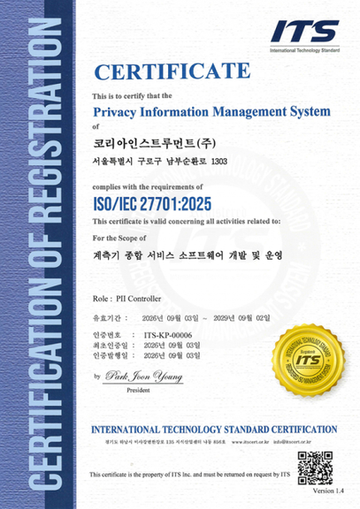
Korea Instrument has become the first among KOLAS accredited calibration agencies to simultaneously acquire ISO/IEC 27,001 and ISO/IEC 27,701 certifications. Through its proprietary platforms CWIZ Enterprise and CWIZ Partners, the company has embedded information security and personal data protection requirements across all business processes including customer information, equipment data, and calibration reports, with plans to continuously advance its management system through regular audits and security inspections.
2026.10.12by 배종인 기자
TeamViewer One, IT Incident Automation Workflow and Resolution Center Enhanced
TeamViewer has added IT incident automation capabilities and an advanced Resolution Center to its integrated digital workplace management platform 'TeamViewer ONE'. Recurrent service disruptions, configuration errors, and capacity shortages are automatically handled according to preset policies, and device status verification through script deployment can be managed in a unified interface, significantly reducing repetitive tasks for IT teams.
2026.10.12by 배종인 기자











