



Drone Education “It’s time to move beyond pilot licenses and prepare for systematic education”
 Published2018.02.28 07:46
We need to find a market with new perspectives such as entertainment and education.
The drone light show that lit up the night sky during the opening and closing ceremonies of the PyeongChang Winter Olympics drew attention. The show, which featured 1,218 Intel Shooting Star drones, broke the Guinness World Record for the “most unmanned aerial vehicles simultaneously in the air.”
The 1,218 drone aircraft used in the show were controlled by just one computer and one pilot.
When we talk about drone education, it is easy to think of the process of obtaining an 'ultralight aircraft pilot license'. This is because the current domestic drone education market is centered around licenses. The government said it would raise drone technology competitiveness to the world's top 5, but basic elements such as original technology and related personnel are not in place. Accordingly, voices are growing louder that systematic education is needed from drone hardware to software.
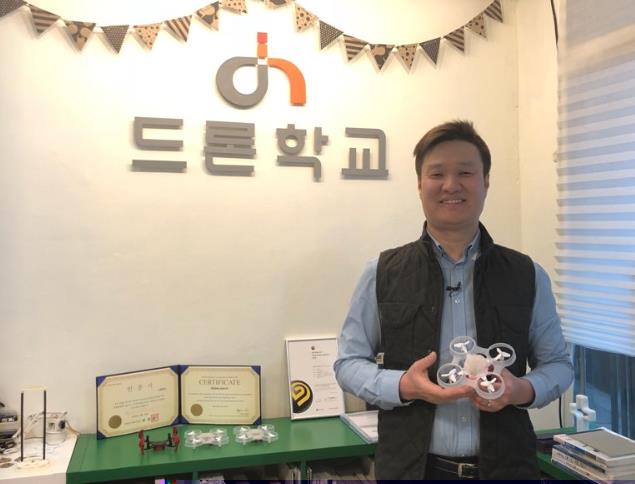
There is a place in Korea where you can learn everything from drone design to coding, assembly, and even making a control app. The Drone School, founded by CEO Oh Sang-eun, teaches the entire process of making a finished product, including 3D modeling classes using drones, Arduino-based coding, and smartphone apps.
CEO Oh Sang-eun said, “Just for the drone performances shown at the Olympic opening and closing ceremonies, only one pilot is needed. “It’s not something that can be done simply by controlling it, but rather by creating and operating movements with software,” he said. “Focusing on obtaining a pilot’s license is not useful in terms of utility. Systematic education that can support the drone industry is needed,” he explained.
The drone school classes are conducted using an assembly kit called KITRONE. The classes, which were initially conducted for college students and the general public, were expanded to include elementary school students starting this year in line with the mandatory middle school coding education.
Mr. Oh said, “As you go through the process of making a drone, you can develop interest and learn simple coding so that you can apply it. If you learn these three things: drone modeling, coding, and control apps, you can apply them in various ways.” He added, “The direction that coding education should pursue is to teach you how to actually put your thoughts into form, not just stop at ideas.”
Drones are suitable for use in fields that can replace labor.
DJI, which has 70% of the global commercial drone market, started out as a small hobby drone. In Korea, the hobby drone market was not formed due to regulations such as visual flight, night flight, and flight zone restrictions, and it moved to commercial use. The government's policy is also focused on industrial use.
Accordingly, CEO Oh chose the agricultural sector as the most suitable industrial market for drone use. “I think it is appropriate to use drones in a way that can replace labor. Demand for filming and hobby use is already limited, and it seems that agriculture is the most effective field for industrial use,” he answered.
Other fields that were seen as having potential include entertainment and education. “I think there will be a market demand for drone shows like the Olympics,” he said. “The global drone market is not yet fully open. Still, there is a big wall called China. Ultimately, we have to go to the industrial market, but rather than going beyond China, looking at it from a different perspective and focusing on the education market could be another alternative.”
Comments
Related news
[Reporter's Notebook] Will the 10-Year Drone Policy Plan Succeed in Popularizing Drones Without Leaving Hobby Drones Behind?
At major exhibitions like 'World IT Show' and 'K Drone Summit', drones are consistently featured. While agricultural and industrial drone exhibitions are also present, the greatest interest is drawn by consumer drones such as 'drone battles', 'drone racing', and 'drone soccer'. This interest in drones continued at the public hearing on the Basic Plan for Drone Industry Development hosted by the Ministry of Land, Infrastructure and Transport and the 2017 Republic of Korea Drone Policy Forum. Kim, who operates a hobby/leisure drone enthusiast club, stated, "At the last public hearing, I proposed that hobby/leisure drones be considered as well. However, at the policy forum, hobby/leisure drones were excluded again." He expressed curiosity about why the medium to long-term plan for Korea's domestic drone industry is unilaterally focused solely on industrial applications. Drones, identified as a core task and key topic of the Fourth Industrial Revolution, initially started with military applications. They are expected to expand beyond the civilian market for hobbies and filming to include applications in safety inspections, surveillance/surveying, and cargo transportation. The domestic market is also showing a trend of increasing private demand, centered on filming and agricultural uses.
2017.09.01by 김지혜 기자
[Discussion] I was wondering what business models there are for making money with drones.
Drones, recognized as a core task of the Fourth Industrial Revolution. When drones are discussed domestically, market activation is an inevitable topic. The Ministry of Land, Infrastructure and Transport has decided to place greater emphasis on industrial drones rather than hobbyist drones. So what kind of business should small and medium enterprises and startups pursue using drones? Under the theme of "Drones Emerging as a New Business," a discussion session was held at the Seoul Industrial Promotion Agency in Sangam to explore what kind of business can actually be conducted using drones and what issues need to be addressed to revitalize the industry. First, experts discussed recommended sectors that small and medium enterprises should consider challenging. Lee Hyun-jong, CEO of RoboLink, stated, "Ten years ago, we focused on developing our own products. Now we operate in integration with domestic and international drone partner companies," and advised, "The focus is burning on hardware development, but it is difficult to compete with China in the hardware sector. Rather than asking what kind of drone to build, shift your attention toward the software side."
2017.09.19by 김지혜 기자
.png)
PyeongChang Olympics, Intel's Drone Simultaneous Control Technology, 1,218 Drones Launched
Intel took flight with 1,218 drones at the 2018 PyeongChang Winter Olympics, making the opening ceremony even more spectacular. Intel's Shooting Star drone, which began in 2016, is based on Intel's own sensor technology, RealSense, and drone simultaneous control technology. After simultaneously flying 100 drones in Germany in 2015 and 500 drones in 2017, Intel launched 1,218 drones at this year's PyeongChang Olympics, breaking the existing Guinness record.
2018.02.10by 명세환 기자

Korea Instrument, KOLAS Accredited Calibration Agency First to Simultaneously Acquire ISO/IEC 27,001·27,701
Korea Instrument has become the first among KOLAS accredited calibration agencies to simultaneously acquire ISO/IEC 27,001 and ISO/IEC 27,701 certifications. Through its proprietary platforms CWIZ Enterprise and CWIZ Partners, the company has embedded information security and personal data protection requirements across all business processes including customer information, equipment data, and calibration reports, with plans to continuously advance its management system through regular audits and security inspections.
2026.10.12by 배종인 기자
TeamViewer One, IT Incident Automation Workflow and Resolution Center Enhanced
TeamViewer has added IT incident automation capabilities and an advanced Resolution Center to its integrated digital workplace management platform 'TeamViewer ONE'. Recurrent service disruptions, configuration errors, and capacity shortages are automatically handled according to preset policies, and device status verification through script deployment can be managed in a unified interface, significantly reducing repetitive tasks for IT teams.
2026.10.12by 배종인 기자











