


Graphene-coated fabrics develop bendable sensors
 Published2018.03.02 11:21
A sensor has been developed that is waterproof and has high conductivity even when bent or pressed repeatedly.
The Electronics and Telecommunications Research Institute (ETRI) announced that it has succeeded in developing a fabric-type composite sensor capable of simultaneously measuring pressure and strain by immersing fabrics such as cotton fibers in a solution containing graphene and carbon nanotubes, then removing them and drying them.
The research team successfully created a motion sensor that detects movement according to finger movements by grafting the sensor they created onto a cotton glove.
Until now, sensors have primarily utilized conductive metals that conduct electricity well. However, metals have been difficult to bend and break easily with repeated bending, hindering their commercialization due to their poor flexibility and durability.
The research team developed a sensor that is thin yet strong, and chemically stable against sweat, chemicals, and other substances. It is also water-resistant, meaning it can be washed without any issues, and requires no additional functional modifications.
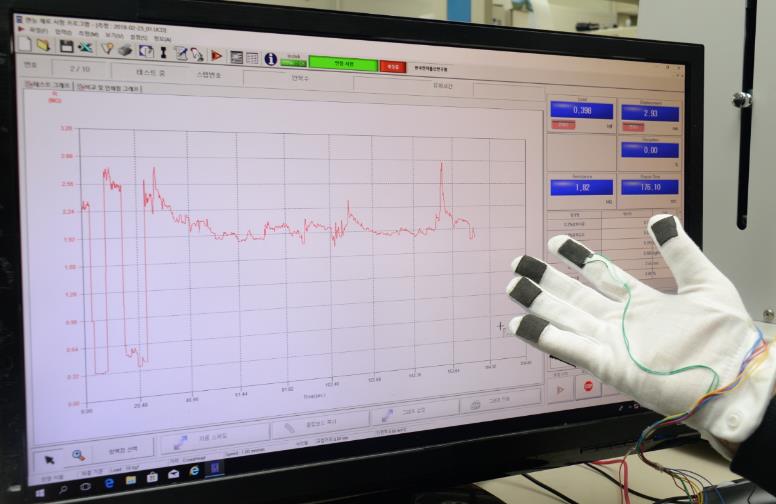
The key to this research and development achievement lies in the combination of reduced graphene and carbon nanotubes. This resulted in the realization of a fabric-type composite sensor capable of measuring pressure and strain. The sensor measures approximately 1 x 3 cm. It can be manufactured on a large area, up to several tens of centimeters, with no design or size restrictions. It can also be applied directly to fabric without any problems.
Since the material itself is a sensor, this technology is similar to coating fabric. It coats conductive graphene like a dye. Therefore, you can cut it as much as you want and use it as a sensor.
"Reduced graphene" is made by chemically reducing graphene oxide, which is made by oxidizing graphite, the material used in pencil lead. Because graphene oxide is an insulator, oxygen (O2) must be removed from the graphene oxide to make it conductive.
Graphene-based fabric sensors created through this process can be mass-produced and exhibit a variety of properties, including excellent electrical conductivity, hydrophobicity, excellent flexibility, and large-area applications. In this study, the process for manufacturing a high-quality reduced graphene solution was conducted by Dr. Ki-Seok Ahn's team at the Korea Research Institute of Chemical Technology.
Meanwhile, 'carbon nanotubes' have excellent thermal conductivity and mechanical and electrical properties, so they are used as additives in various structural materials.
The ETRI research team took advantage of the strengths of the two materials and increased electrical conductivity by grafting carbon nanotubes onto graphene-coated fabric. They also explained that the complex network structure of the carbon nanotubes ensured durability even after being bent or pressed more than 100,000 times.
The research team announced that they plan to apply the developed sensor to a wearable material, gloves, and distribute it to robot hands or patients who have difficulty using their hands or feet and wear prosthetic arms and legs.
Dr. Choi Chun-ki of the New Device Research Group at the ETRI ICT Components and Materials Research Institute said, “We also confirmed the superiority of the sensing performance, such as the composite sensor maintaining linearity as the measurement range changes and the measurement process being completed within a few seconds.”
Comments
Related news
Samsung Electronics Develops Amorphous Graphene Technology Grown on Semiconductors
Professor Hwang Dong-mok from the Division of Materials Science and Engineering at Sungkyunkwan University's College of Engineering, Dr. Lee Jae-hyun, Executive Vice President Hwang Sung-woo from Samsung Electronics' Advanced Institute of Technology, and Dr. Ju Won-je, among others, jointly announced that they have developed the world's first groundbreaking technology for synthesizing large-area single-atomic-layer amorphous graphene on semiconductor wafers.
2017.02.13by 김지혜 기자

Can Graphene Overcome the Limitations of Flexible Displays?
While there are ongoing discussions about foldable and flexible displays, what is the reason for the slow development of flexible displays? At a seminar on flexible display technology trends and issues held at KINTEX in Ilsan on the 17th, Dr. Kim Myeong-jong of the Korea Institute of Science and Technology (KIST), who gave a keynote presentation, stated, "Going forward, displays will be based on OLED and will move toward larger sizes, transparency, and flatness," and added, "Large-area CVD graphene is being applied in various fields, and since it is also used as a transparent electrode, it can be utilized in flexible and transparent displays as well."
2017.02.27by 김지혜 기자
ETRI to Use Graphene Instead of ITO in Displays
ETRI (Electronics and Telecommunications Research Institute) has successfully developed a display by creating electrodes using graphene, referred to as a dream material, instead of indium tin oxide (ITO), which has been widely used as electrodes for conventional OLED displays. The display substrate developed by the research team measures 370mm x 470mm, which is approximately the size of a 19-inch monitor. The graphene electrode thickness is 5 nanometers (nm) or less. ETRI anticipates that combining graphene with a flexible substrate will enable the implementation of thin and flexible displays. If realized, this could serve as a core technology applicable to the manufacturing of wearable devices that can be applied to clothing and skin.
2017.04.17by 김지혜 기자

Intel Unveils Next-Generation 'Core Ultra Series 3' and vPro Platform for Enterprise PCs
Intel has officially unveiled the "Intel Core Ultra Series 3" for next-generation enterprise PCs and the latest vPro platform, addressing a wide range of demands from enterprise notebooks to high-performance workstations.
2026.03.26by 배종인 기자
ROHM Launches ESD Protection Diode Compatible with High-Speed Interfaces of 10Gbps or Higher
Semiconductor specialist ROHM has developed the 'RESDxVx series' of ESD (electrostatic discharge) protection diodes capable of responding to next-generation high-speed data communication environments exceeding 10Gbps, simultaneously enhancing both signal quality maintenance required in high-speed interfaces and IC protection performance.
2026.03.26by 배종인 기자











