


Development of 'optical synapse mimicking device' that mimics the human brain
 Published2018.03.02 11:38
An 'optical synapse-mimicking device' that artificially reproduces neurons and synapses has been developed. This has laid the foundation for the development of a neuro-mimicking optical computing technology that can store and think like the human brain.
The Electronics and Telecommunications Research Institute (ETRI) has succeeded in developing a core technology for an optical synapse-mimetic device that combines graphene, one of the two-dimensional (2D) semiconductor materials that is attracting great attention as a new material in the form of an ultra-thin film with nano-thickness, and optical communication technology.
The human brain is a form in which the storage part and the calculation part coexist. However, the computer has the storage part and the calculation part separated. If the computer has the storage and calculation part coexisting like the human brain, it can send information quickly while calculating it. This is the principle that makes optical computing that imitates the human brain nerves possible.
By changing the resistance in an electrical way, it was made possible to recognize and calculate the resistance when a signal is given. However, as the circuit became more complex, interference occurred, which limited the ability to increase integration.
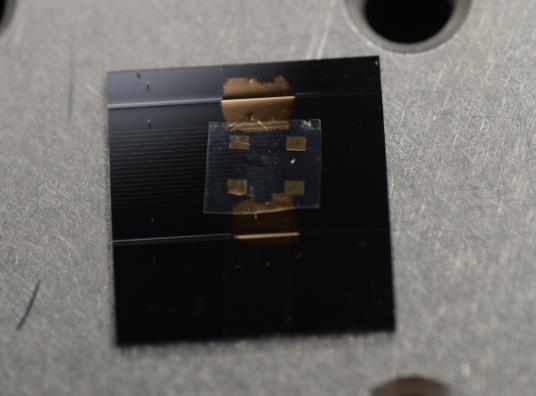
So the research team took an optical approach. They changed the electrical circuit to an optical circuit. This created a photoresistive memory. They also made it possible to perform calculations using various wavelengths of light by utilizing the hysteresis phenomenon. The optical memory device created by the research team is about 20㎛ x 20㎜. In the future, we plan to develop it at the hundreds of nanometer (nm) level and highly integrate it into a chip form.
It is expected that the developed device will be embedded in a chip form for optical communication for the purpose of information transmission in the future, enabling calculations and information transmission at the same time. This will make so-called optical synaptic computing and neuro-mimetic optical computing possible.
ETRI explained that if this technology is commercialized, the time it takes for a person to see and recognize an object is usually around 0.06 seconds, but if optical computing is made possible, not only will power be reduced, but the recognition speed will also be much faster.
ETRI stated that in the future, if the original technology is applied to optical communications, an optical computing device can be created. Optical computing will soon become possible.
ETRI Biomedical IT Research Center Director Seung-Hwan Kim said, “We plan to develop a neuro-mimetic optical computing technology that mimics biological brain functions using artificial optical technology by combining the developed optical synapse-mimetic device with existing ultra-high-speed optical communication technology.”
Comments
Related news
AI chip that replicates the structure of the human brain is coming out
"In the era of artificial intelligence, what matters is the chip. There is no longer any place for research based solely on software." At the 'Artificial Intelligence New Industry Convergence Forum' hosted by the Korea Institute of Industrial Technology, Nefes Chairman Lee Byung-gu stated this as a method for democratization, noting that artificial intelligence is drawing closer to our daily lives. Subsequently, Nefes Executive Director Ahn Jeong-ho introduced the artificial intelligence chip 'NM500,' which will be launched next month, saying "there are many advantages when approaching artificial intelligence from a hardware perspective." Nefes is a semiconductor packaging company that designed a system-on-chip (SoC) implementing artificial intelligence by entering into a neuromorphic architecture license agreement with General Vision (GV), a U.S. semiconductor technology company.
2017.06.23by 김지혜 기자
.jpg)
Developing AI semiconductors with four times the energy efficiency of Google's TPU
An artificial intelligence semiconductor that processes deep learning more efficiently by applying technologies such as variable artificial neural networks has been developed. A research team led by Professor Yoo Hee-joon at the Korea Advanced Institute of Science and Technology jointly developed an artificial intelligence semiconductor with UX Factory, a semiconductor startup. To implement artificial intelligence on mobile devices, high-speed computation must be processed with low power consumption. However, current implementations rely on software technologies with slow computation speeds and high power consumption, making the development of artificial intelligence acceleration processors essential.
2018.02.28by 김지혜 기자
Intel Unveils Next-Generation 'Core Ultra Series 3' and vPro Platform for Enterprise PCs
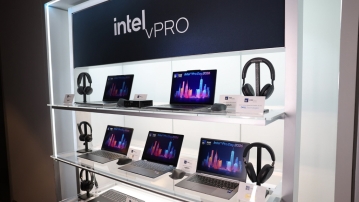
Intel has officially unveiled the "Intel Core Ultra Series 3" for next-generation enterprise PCs and the latest vPro platform, addressing a wide range of demands from enterprise notebooks to high-performance workstations.
2026.03.26by 배종인 기자
ROHM Launches ESD Protection Diode Compatible with High-Speed Interfaces of 10Gbps or Higher
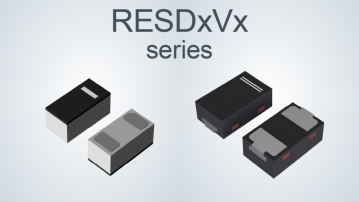
Semiconductor specialist ROHM has developed the 'RESDxVx series' of ESD (electrostatic discharge) protection diodes capable of responding to next-generation high-speed data communication environments exceeding 10Gbps, simultaneously enhancing both signal quality maintenance required in high-speed interfaces and IC protection performance.
2026.03.26by 배종인 기자
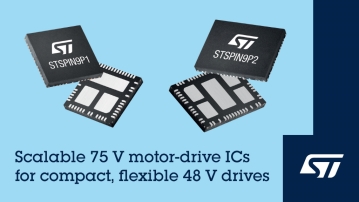
ST Launches 75V Drive IC Targeting 48V Industrial Motor Driving
ST Microelectronics has unveiled the 'STSPIN9P' series of 75V motor drive ICs tailored for 48V-class industrial drive system design. The new product family is characterized by half-bridge and full-bridge configurations that enable design scalability according to motor type and output conditions. Power supply circuits, protection functions, and current sensing circuits are integrated on-chip to simplify system configuration, and the devices are designed to support applications up to 500W maximum. The company plans to provide reference designs and demo boards to support development and evaluation in industrial automation, robotics, pumps, fans, lighting, and textile machinery.
2026.03.26by 배종인 기자











