


Arm Announces Mali Multimedia IP Family for Universalizing Powerful Visual Experiences
 Published2018.03.06 15:59
Arm has announced the Mali Multimedia Suite, which provides a powerful visual experience even on entry-level mobile devices. This enables more mobile users to enjoy advanced features that support machine learning (ML), HDR, and complex UI.
The content that smartphones must process is becoming increasingly complex. Furthermore, consumers are naturally demanding more from entry-level and low-cost devices, making richer, multi-layered user interfaces and extensive support for the latest applications and technologies essential.
Furthermore, ML is no longer a domain exclusive to premium smartphones. Arm is well aware of this trend, as over 90% of currently shipped AI-enabled devices are based on Arm architecture. All users expect to easily use applications that leverage ML, and gaming is expanding the reach of entry-level mobile devices, led by 3D games, mixed reality (MR), and 4K content, which are more widely used than ever before.
Arm announced the Mali multimedia product family, an innovative solution capable of meeting the requirements for these next-generation experiences. The new IP family, consisting of video, display, and graphics processors, enables seamless integration with existing DynamIQ-based CPUs and other Arm IP, completing Arm's next-generation solutions for entry-level mobile and DTV.
Based on the previous model, the Mali-G51, the Mali-G52 is designed to enable more complex graphics, allowing more ML functions to be implemented in entry-level mobile systems with limited power and bandwidth.
The Mali-G52 utilizes a more extensive execution engine with 8 pipelines, twice as many as the previous model which used 4 pipelines, providing more powerful graphics performance in the same semiconductor size and boasting 30% improved performance per unit area.
With 15% higher energy efficiency, it reduces device power consumption and heat generation, enabling games using battery-intensive technologies like AR to run for longer periods. With 3.6 times higher ML performance compared to the previous generation, it enables all types of devices to support next-generation ML use cases.
Computing requirements for all devices are increasing, and users expect a certain level of content quality and highly complex DTV UIs even on mid-range devices. We aim to meet these demands through the Arm Mali-G31.
The Mali-G31 is the first ultra-efficient GPU designed based on the innovative Bifrost architecture. As Arm's ultra-compact processor supporting OpenGL ES 3.2 and the latest Vulkan API, it enables developers to develop on millions of devices. It features a 20% reduction in size and a 20% improvement in performance density compared to the previous Bifrost model, Mali-G51, providing excellent energy efficiency while reducing chip area.
The Mali-D51 packs the key features of the Mali-D71, a premium display processor released in 2017, into Arm's smallest DPU. The first entry-level display processor to be released is designed based on the Komeda architecture and boasts the following performance.
The Mali-D51, optimized to work seamlessly with other IPs in the Mali multimedia family, enables HDR support even on entry-level devices when integrated with Assertive Display 5 and improves memory management efficiency across the system when used with the CoreLink MMU-600.
Ian Smythe, Senior Director of Arm’s Client Business Unit, explained, “Arm’s partners have shipped 125 billion chips to date, and we expect this figure to increase to 200 billion in 2021. This is possible because Arm is constantly striving for innovation and is committed to providing scalable CPU, GPU, video, and display architectures across a wide range of devices in the computing industry.” He added, “These principles are also clearly evident in the Mali multimedia family, which Arm announced to provide powerful visual experiences to a wider audience.”
Comments
Related news

Arm Delivers Scalable and Universal Machine Learning Computing Platform
Arm has announced 'Project Trillium.' This is a portfolio of Arm IP products that includes new processors with excellent scalability, delivering enhanced machine learning (ML) and neural network (NN) capabilities. While current technologies focus on the mobile market, they will drive a new generation of ML-enabled devices through advanced computing capabilities that include cutting-edge object recognition functionality.
2018.02.22by 김지혜 기자
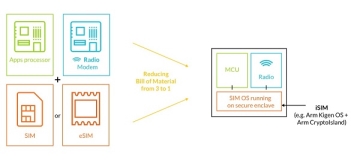
ARM Disrupts SIM Card Business with Integrated IoT SoC Architecture at MWC 2018
ARM, which designs low-power, high-efficiency semiconductor architecture, will announce ARM Kigen OS and CryptoIsland, which integrate SIM cards, at the MWC 2018 keynote. ARM's integrated SIM identity will target IoT cellular connectivity communication devices to be used in smart cities, connected rural areas, and digitalized industrial environments.
2018.02.26by 명세환 기자

Arm Announces Features of Mbed IoT Device Platform to Help Enterprises Leverage Data
Arm has announced expanded Arm Mbed IoT device platform capabilities. Through new Mbed Cloud functionality, enterprises can now manage devices in-house and connect low-performance devices to IoT. Additionally, the latest Mbed OS supports design modules and NB-IoT. Forward-thinking enterprises are exploring new approaches to data collection and analysis by leveraging IoT, and using that data to gain insights and improve operational efficiency, quality, and consumer experience. However, to translate such exploration into actual implementation, more advanced IoT device security, connectivity, and provisioning to the cloud and data centers are required.
2018.03.02by 김지혜 기자
.jpg)
SalePoint Signs Multi-Year Partnership Agreement with AWS… Promoting Identity Security that Integrates Even AI Agents
Sailpoint has entered into a multi-year strategic partnership agreement with AWS and is moving forward with establishing an integrated governance system that manages both human and non-human identities together. The plan is to consistently manage access permissions in an environment where AI agents are increasing as work execution entities, while applying the principle of least privilege and automated policy enforcement. The two companies plan to jointly expand capabilities to manage the identities of various entities, including AI agents, within a single layer in the AWS environment. This collaboration is interpreted as a move to design security and governance together in corporate environments where AI adoption is expanding.
2026.03.26by 배종인 기자
.png)
Databricks Unveils Open AI Security Monitoring 'Lakewatch'
Databricks entered the security market on March 24 by unveiling LakeWatch, an open-source agentic SIEM. The core functionality of this product is to integrate and analyze security, IT, and business data in a single environment to support AI-based threat detection and investigation. The company explained that it reduces the limitations of existing security operations centers, which have had to forgo some data due to high cost structures, and enables large-scale data analysis and automation based on open formats and ecosystems. LakeWatch is currently offered as a private preview, with Adobe and Dropbox mentioned as early customers. Databricks also announced an expanded partnership with Anthropic as well as the acquisition of Antimatter and SiftD.ai.
2026.03.26by 배종인 기자











