


Data transmission capacity quadrupled through independent development of optical transceiver components
 Published2018.03.09 13:41
Components for 5G communications networks have been developed.
The Electronics and Telecommunications Research Institute (ETRI) developed optical transmission and reception components using domestic technology. The existing transmission network was around 100G, but it was expanded by four times to 400Gbps.
ETRI has successfully demonstrated in a real environment a technology that can accommodate large-capacity data communications without additional installation of optical cables, even when traffic increases more than four times the current level for new network expansion, using components developed domestically.
There are two major optical transmission and reception components that ETRI has succeeded in developing. First, it developed a 400 Gbps optical receiver element that converts 400 Gbps optical signals into electrical signals and receives them, and a wavelength-tunable optical source element that is necessary to load electricity onto light in order to send electrical signals to optical communication networks.
The research team succeeded in developing an ultra-small component by developing the core components themselves and integrating them into an optical module. The developed coherent optical receiver is 3 cm x 1 cm in size, and the optical transmitter is 2 cm x 1 cm in size.
Accordingly, in the future, these technologies will be modularized into optical transmitters and receivers and used as repeaters for optical communications. These systems are expected to be installed in each city, especially in large cities with heavy traffic.
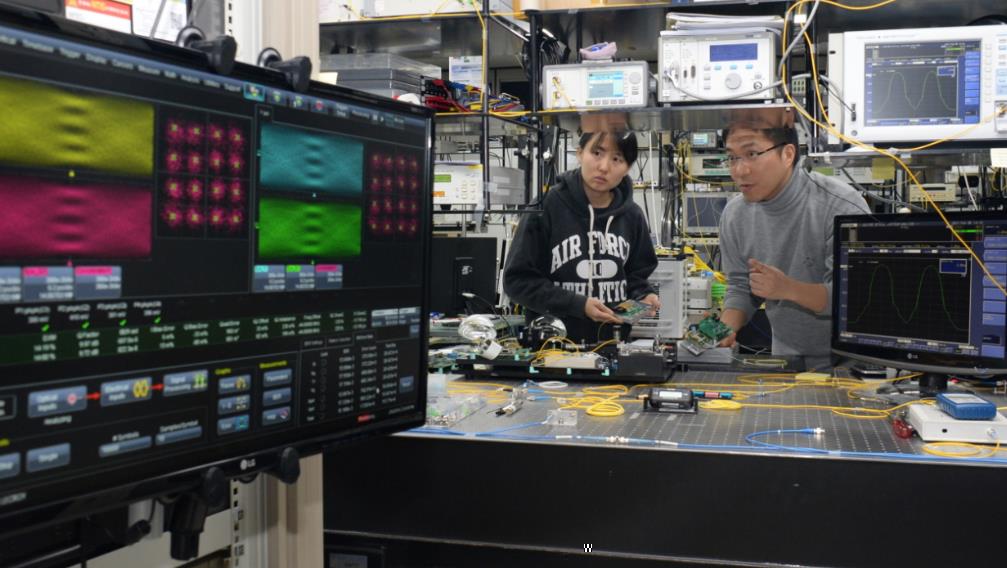
ETRI explained that these systems will be installed in the core networks or metro networks of mobile carriers in the future to effectively control traffic. In the future, this technology is expected to be implemented by optical transmission equipment manufacturers through optical transceiver manufacturers and then commercialized in earnest by telecommunications carriers.
The research team first created a 400Gbps electrical signal using a signal generator in Laboratory 4 of the ETRI Research Institute last month to confirm transmission. They successfully transmitted the created signal by putting it on light and sending it to Seoul through an optical fiber network, and then transmitting it back and forth to Daejeon.
ETRI's successful round-trip transmission test lasted a total of 510 km and used the Future Network Leading Test Network (KOREN) operated by the National Information Society Agency.
The research team said that with this technology development, existing optical communications had to be expanded by laying additional optical cables, but ETRI succeeded in developing a component technology that solves this problem by simply replacing the optical transmission and reception equipment using existing optical cables without the need for additional optical cable installation costing hundreds of billions of won. They said that this is the most effective in terms of not only economic benefits but also time and physical efficiency.
In addition, this technology is a next-generation optical network core technology that can control and manage transmission capacity, modulation method, and wavelength through software to provide communication services suitable for user needs such as transmission distance and communication quality. It has a great effect in increasing efficiency and reducing costs because there is no need to replace hardware to change transmission capacity.
Kim Jong-hoe, head of the Optical Communication Components Research Group at ETRI, said, “The optical components we developed are price competitive because they use low-cost materials such as silica and polymer, and in addition to 400 Gbps, they can also be used at various data capacities such as 100 Gbps and 200 Gbps without replacing parts, so they have the advantage of being applicable to existing optical communication networks.”
Comments
Related news
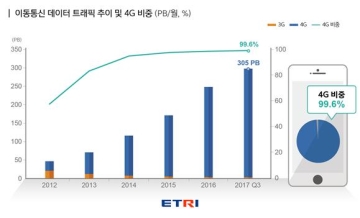
ETRI Announces Current Status of Domestic Mobile Traffic
The Electronics and Telecommunications Research Institute (ETRI) released mobile traffic status as a representative indicator of growth in the mobile communication market. This content examines domestic mobile communication subscribers, traffic trends, and traffic status by user characteristics, and presents forecasts for mobile communication subscribers and mobile communication traffic over the next six years through 2023. As of the third quarter of 2017 last year, South Korea's mobile communication penetration rate exceeded 122% of the population. The fourth-generation mobile communication (4G) subscription rate relative to mobile communication stands at approximately 78%. Mobile communication data traffic reached 305 petabytes (PB), with 4G accounting for 99.6% of the total.
2018.01.25by 김지혜 기자
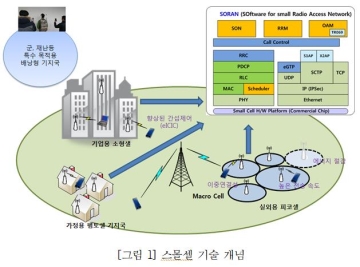
Backpack-type base station commercialization possibility opens within a radius of several hundred meters of temporary LTE network
The Electronics and Telecommunications Research Institute (ETRI) has developed advanced small cell base station software technology applicable in buildings and sports stadiums, and is preparing for commercialization. Following the successful development of LTE small cell base station software in 2016, the institute announced that it has successfully developed software technology supporting LTE-TDD technology and dual connectivity. The LTE-TDD technology developed by the research team is a technology that allows time-division usage of the ratio between uplink and downlink. In LTE, it is possible to vary the uplink/downlink link ratio in seven different ways. For example, for limited data, it is possible to adjust the uplink/downlink data speed ratio to suit the situation.
2018.02.13by 김지혜 기자
ETRI successfully demonstrates gigabit Wi-Fi transmission technology on a moving bus.
Following the provision of gigabit-class WiFi on Seoul subway lines, a successful demonstration of 5Gbps-class transmission was achieved on a moving bus. The Electronics and Telecommunications Research Institute (ETRI) announced that this technology is the result of joint fifth-generation (5G) research between Korea and the European Union (EU), and conducted demonstrations for the general public at the Gangneung ICT Promotion Center starting from the 2nd. On the 21st, ETRI announced a successful demonstration of ultra-multiview media transmission service, which enables viewing of 3D video without glasses on a moving bus by utilizing 5Gbps-class Mobile Hotspot Network (MHN)-E technology on Yulgok-ro in Gangneung.
2018.03.02by 김지혜 기자
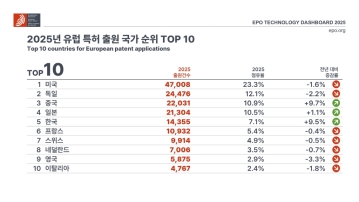
European Patent Applications Surpass 200,000 for the First Time… South Korea Maintains 5th Place, Led by Batteries and Telecommunications
According to the European Patent Office (EPO)'s 'Technology Dashboard 2025', European patent applications last year reached 201,974, surpassing 200,000 for the first time. Korean companies and inventors filed 14,355 applications, representing a 9.5% increase from the previous year and maintaining 5th place by country. Battery, digital communication, and semiconductor technologies led the growth, with Samsung ranking as the top EPO applicant for the second consecutive year and LG reaching 3rd place. The presence of major domestic cities such as Seoul, Suwon, and Yongin was also confirmed. It was also revealed that Korea's European patent strategy is expanding beyond individual technologies to span the entire industry.
2026.03.24by 명세환 기자
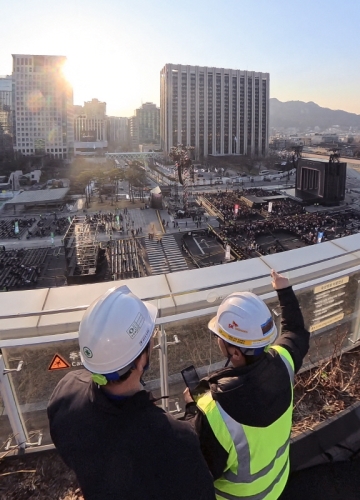
SK Telecom First Applies AI-Based Network Operations at Gwanghwamun K-Pop Concert
SK Telecom announced that it applied an AI-based network operation system for the first time at a large-scale K-pop concert held in the Gwanghwamun area of Seoul on March 21st, managing communication quality throughout the event. Mobile data usage during the three hours before and after the concert reached 12.15TB, approximately doubling compared to the same time slot the previous weekend. SK Telecom monitored traffic using the AI system 'A-One' in five-minute and 50-meter units to respond to potential overload situations, while also operating temporary communication facilities and on-site personnel in parallel. This case is interpreted as confirmation of the practical applicability of AI-based autonomous network operation in an environment where demand from dense events and foreign users increases simultaneously.
2026.03.23by 명세환 기자











