



To implement OpenCV image processing capable of 700 frames per second!
 Published2018.03.13 06:30
From the text on business cards to recognizing human faces, most forms of images can now be recognized with a mobile phone. This is done using a computer vision library called OpenCV. Developed by Intel and currently used on various platforms such as Windows and Linux, OpenCV is a library that focuses on real-time image processing. It currently consists of over 2,500 algorithms and can be used in interfaces such as C, C++, Python, and MatLab.
Thanks to the advancement of camera performance, which acts like the human eye in devices, and the improvement of chip performance that processes tens of millions of pixels in real time, object recognition functions that were previously only available in existing CPUs have become possible in the mobile phones we always carry with us. These developments are being used in a variety of ways in industrial and medical devices, including face detection and recognition, object recognition, 3D model extraction of objects, 3D coordinate generation from stereo cameras, image stitching for high-resolution image generation, image search, red-eye removal, and eye movement tracking.
Xilinx, which provides various support in the vision field, has decided to support the development of OpenCV, following Open VX and OpenCL. Jeong Woong, DSP Specialist in the Embedded Business Unit at Xilinx, explained the background of the support, saying, "The continuous increase in the number of users and the expansion of deep learning functions supported from version 3.0 are creating a larger user base for OpenCV." Additionally, it is expected that Xilinx's Zynq SoC will gain a market advantage with higher performance than existing processor-based vision platforms.
As evidence for this, when executing Harris Corner Detect, Stereo Depth Map, and Dense Optical Flow Function of OpenCV through ARM cortex-A53, it showed 2.4 FPS, 2.1 FPS, and 0.1 FPS, which are significantly lower than the general image processing requirement of 30 FPS. Also, considering the continuous increase in image resolution in the market, it was said that if the same function is supported in high definition, a performance shortage will occur, and this will require acceleration of the OpenCV function.
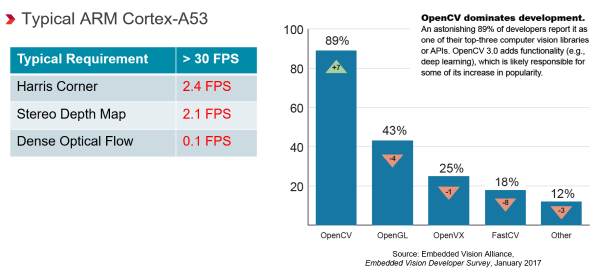
Embedded Vision Alliance OpenCV Usage and Cortex-A53 Performance Table
17x the performance of eGPU, half the power usage
When accelerating the OpenCV function using Xilinx's Zynq SoC, it shows a performance of up to 700 FPS, which is more than 17 times higher than the 43 FPS of Tegra X1 from NVIDIA, a representative graphic chip vendor, when comparing the Stereo LBM of 1080P. Moreover, the power consumption is 2.2W to 4.8W, which is nearly half of the 7.9W of Tegra X1. LK Dense Optical Flow based on 720P also showed 170 FPS, which is up to 24 times higher than 7 FPS compared to the same NVIDIA Tegra X1, and the power consumption showed the same amount as the Stereo LBM case.
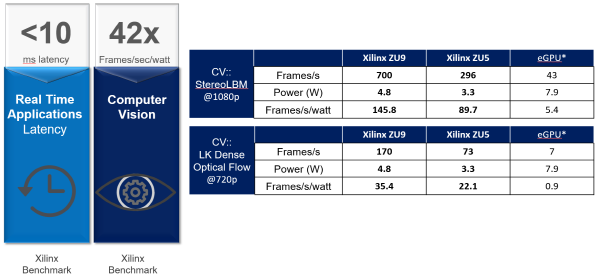
Performance comparison chart of Xilinx Zynq SoC and NVIDIA's Tegra X1
Reduce processing latency through programmable logic
Regarding the part where such high-efficiency performance is possible, Xilinx's Vice President Jeong-ung mentioned Xilinx's unique DDR operation method. The processing data flow of a typical processor or GPU is structured as a sequence block processing in which image sensor data such as a camera is first stored in DDR, each processing block uploads DDR data, processes it, and then stores the processed results back in DDR. In contrast, Xilinx's Zynq SoC implements programmable logic and processes in a streaming manner, where processing results for each pixel are available before the processing of one block is completed, and processing begins in the next processing block.
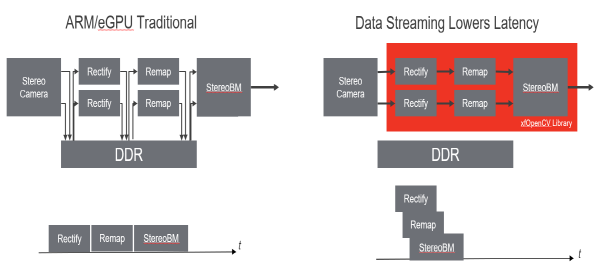
Comparison of traditional processing architecture and processing using Xilinx's xfOpenCV
Streaming is performed at the line buffer level rather than the pixel level, and can be stored using BRAM, an internal block RAM within the programmable logic, or ULTRARAM, a large-capacity BRAM. This can provide higher performance because processing can be done within the programmable logic without accessing external memory.
Vice President Jeong Woong said, "If we look at the latency when image processing blocks are processed sequentially using Xilinx programmable logic, it takes approximately 15.73 msec, or 15.73 million clocks, when only the Bilateral Filter is processed." He also said, "If the Wrap Transform is processed after the Bilateral Filter, it takes approximately 15.85 msec, and even if the Customer ISP block is processed after that, it takes approximately 15.86 msec."
Typically, for sequential block processing, the approximate latency is the sum of the latencies of each processing block, excluding DDR access times. However, in a pipeline structure, there is a slight additional latency added to the block latency, which has the highest latency.
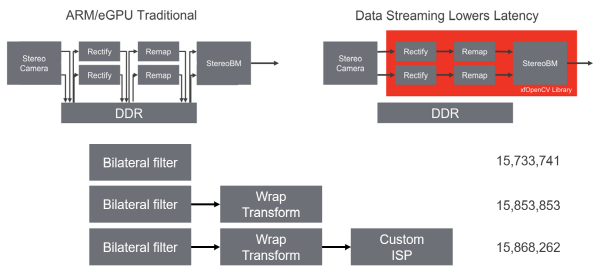
Comparison of processing steps using programmable logic
With these strengths, Xilinx's xfOpenCV library can avoid frame buffer or external memory access by automatically configuring the pipeline structure between each block in the same structure as the existing Open CV code, thereby providing high performance in terms of processing speed. In addition, it has the advantage of improving power efficiency by not using external memory access.
Provides over 50 different usable libraries
Currently, Xilinx provides more than 50 libraries for OpenCV. It is broadly divided into six main functions: basic function library, Geometric Transforms, image processing and filters, object recognition, 3D Reconstruction, motion analysis, and location tracking. All sources can be downloaded from GitHub.
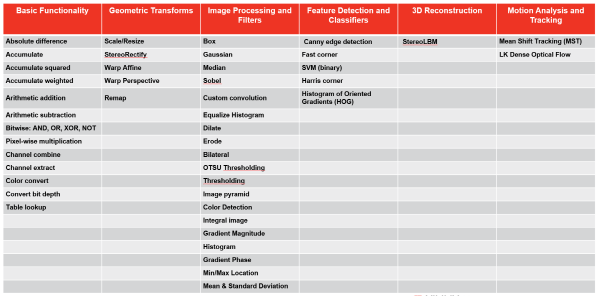
xfOpenCV: 50+ OpenCV functions provided by Xilinx
Vice President Jeong Woong explained that Xilinx's leading position in the computer vision field is due to the SoC structure that only their ZynQ has. In the case of Zynq US+, it has a Cortex A53 APU, a dual core for CG devices, and a quad core for EG/EV devices. In addition, the R5 Real-Time Processor is a dual core, enabling real-time application processing.
And it has a built-in ARM Mali GPU, so it can perform tasks like rendering images on the display, and in the case of EV devices, it has a built-in H.265 video codec. In addition, it also has cutting-edge power management and security and safety features that are critical to all embedded applications.
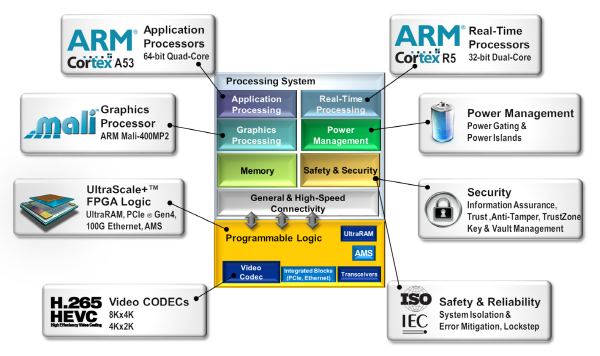
Acceleration SoC architecture for computer vision provided by Xilinx
Vice President Jeong Woong said, "Zynq SoC has various processors, but the part that is most different from other SoCs is the programmable logic that implements HW to enable parallel processing of algorithms." He added, "If you design an embedded vision system using Zynq SoC, you will be able to experience more flexible and efficient performance than existing processor-based platforms."
Xilinx will be hosting an Open CV public webinar on March 13th utilizing its ZynQ SoC, where it will answer any questions engineers may have about OpenCV in real time.

관련뉴스
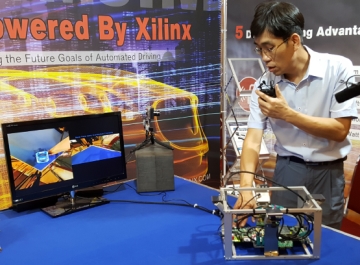
[Automotive Innovation Day] Xilinx Provides Automotive-Compatible FPGAs and All-Programmable SoCs
Xilinx, which participated in the Automotive Innovation Day (2016 Automotive Innovation Day) held on the 14th and hosted by Automotive Electronics, showcased application solutions necessary for realizing next-generation automotive electronic systems such as infotainment, driver information systems, and ADAS (Advanced Driver Assistance Systems). Xilinx supplies the broadest range of FPGA and All Programmable SoC product lines to the market that fully comply with automotive quality requirements. Xilinx launched the XA (Xilinx Automotive) program in 2004, based on various logic sizes and packages as well as extended temperature grades.
2016.07.19by 신윤오 기자
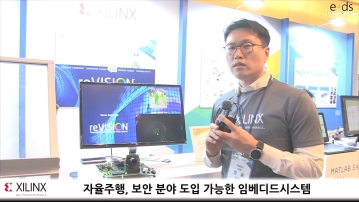
Xilinx Introduces Embedded Systems for Security and Autonomous Driving
자일링스의 DSP Specialist 정웅 부장이 매스웍스 엑스포2017에서 보안과 자율주행 시스템에 도입될 수 있는 reVISION을 소개했다. 정웅 부장은 "자일링스 SD SOC는 프로세서와 FPGA를 동시에 탑재해 오픈 프레임워크로 C와 C++로 디자인하면 자동으로 HDL코드로 변환해준다."고 했다. 데모에서는 실시간 이미지를 움직임이 많은 곳은 밝고, 적은 곳은 어둡게 보여주는 이미지 프로세싱을 선보였다. 이를 도로에 가져오면 사람과 물체를 구분하는 자율주행과 보안 분야에 이용될 수 있다.
2017.05.19by 김자영 기자
[Automotive Video Coverage] Xilinx, "All-in-One" for Machine Learning Development
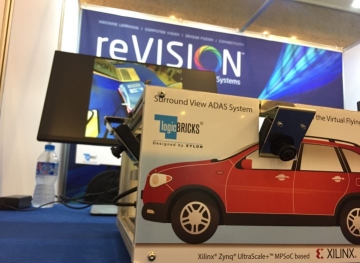
Xilinx participated in the Automotive Innovation Day 2017 held on the 5th and introduced Xilinx's automotive solutions. Xilinx showcased reVISION, which features immediate system response speed and is suited for markets requiring rapid deployment of algorithms and sensors. The reVISION stack facilitates the development of intelligent vision-based systems including machine learning, computer vision, and sensor fusion. It supports the most commonly used neural networks such as AlexNet, GoogLeNet, SqueezeNet, SSD, and FCN.
2017.07.07by 김자영 기자

ST Microelectronics and NUS Establish Joint Research Center 'HELIX' for Edge AI
ST Microelectronics and the National University of Singapore have established the 'HELIX' joint research center aimed at implementing embedded AI in edge environments. Over a four-year period, the center will conduct research across the entire technology stack from algorithms to silicon, focusing on memory-centric architecture leveraging ST's 18nm FD-SOI technology and embedded PCM. The core objective is to implement intelligence directly in physical devices such as robots and drones while minimizing energy consumption.
2026.08.28by 배종인 기자

ams, 디지털 포토닉스로 휴머노이드 로봇 감각·소통 기능 지원
ams OSRAM이 디지털 포토닉스 기술을 활용해 휴머노이드 로봇의 감각·소통 기능을 강화하는 솔루션을 공개했다. dToF 센서, 광학식 힘 센서, 구조광 이미터 등으로 주변 환경 인식과 정밀 조작을 구현하며, EVIYOS·ALIYOS 플랫폼으로 LED 기반 비언어 소통을 지원한다. 시장조사에 따르면 휴머노이드 로봇 시장은 2025년 6억 달러에서 2035년 510억 달러로 성장할 전망이며, 로봇의 감각 능력 향상이 핵심 성장 동인으로 작용할 것으로 예상된다.
2026.08.27by 배종인 기자











