



SK Telecom and Busan Transportation Corporation to Safely Use IoT Technology on Urban Railways
 Published2018.03.15 13:54
SK Telecom and Busan Transportation Corporation have decided to utilize cutting-edge IoT and big data technologies to manage urban railways more safely.
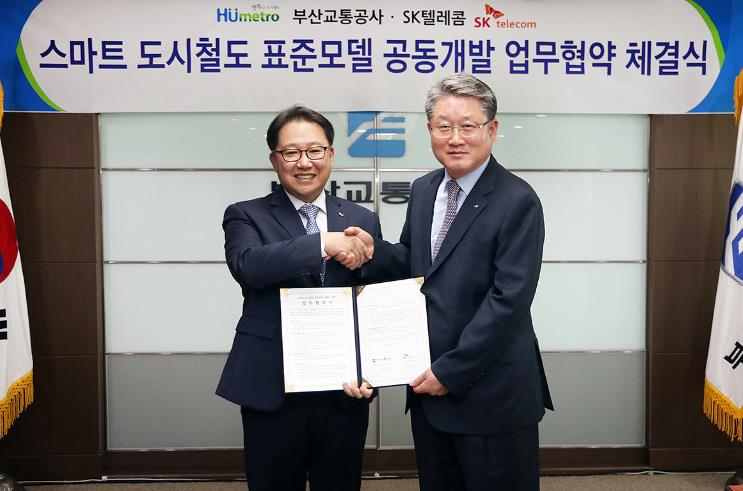
SK Telecom announced on the 15th that it signed a memorandum of understanding with Busan Transportation Corporation to promote the development and demonstration of a 'smart urban railway standard model'.
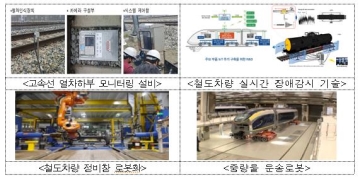
Starting in April, the two companies will install "railway IoT sensors" at Busan subway stations and other locations for approximately two years to monitor facilities in real time. Each sensor will utilize SK Telecom's LoRa network.
The main elements monitored in real time by IoT sensors are ▲temperature and humidity ▲fine dust ▲fire occurrence ▲escalator vibration within the station, and ▲rail temperature ▲trolley line tension in the above-ground section of the train.
The two companies expect that if the 'Smart Urban Railway Standard Model' is applied, railway safety and management convenience will increase.
We are also developing a real-time control system using the railway integrated wireless communication network (LTE-R), including ▲power on/off devices and ▲subway shutter control sensors. Previously, station staff manually managed the lighting and shutters according to the first and last train times.
Busan Transportation Corporation is considering introducing a 'smart urban railway standard model' to the Sasang-Hadan and Yangsan light rail lines, which are scheduled to open in 2022.
SK Telecom's Public Works Division Director Choi Il-gyu said, "SK Telecom's IoT technology will make the Busan subway significantly safer," and added, "Based on this demonstration project, we hope that IoT technology will be fully introduced to urban railways in the future."
Comments
Related news
Smart technologies like IoT and drones are improving railway safety.
Through the Internet of Things (IoT), train conditions are monitored in real-time to prevent train failures in advance, and drones are utilized to manage facilities in dangerous sections such as bridges and transmission towers. The Ministry of Land, Infrastructure and Transport has established a "Basic Plan for Building a Smart (SMART) Railway Safety Management System (2018-2027)" to proactively introduce fourth industrial revolution technologies in the railway safety field and improve the level of railway safety. Although the number of accidents and fatalities in the railway safety field has been decreasing, the rate of decrease has reached its limit, making it difficult to achieve safety improvements through conventional safety management methods alone. Accordingly, this plan has been established to improve safety management methods by utilizing advanced technologies.
2018.01.17by 김지혜 기자
SK Telecom Accelerates Early 5G Commercialization
SK Telecom is consolidating its capabilities to secure leadership in global 5G competition and commercialize it. SK Telecom announced that it has launched a "5G Company-wide Task Force" and sent out a second Request for Proposal (RFP) to develop commercial communication equipment based on global standards. The TF is composed of approximately 200 people across the company, including SK Telecom's four major business units—MNO, Media, IoT/Data, and Service Platform—as well as the ICT Infrastructure Center and Research Institute.
2018.01.23by 김학준 기자
SKT Upgrades Hybrid IoT Network with 'LTE cat.M1' Deployment
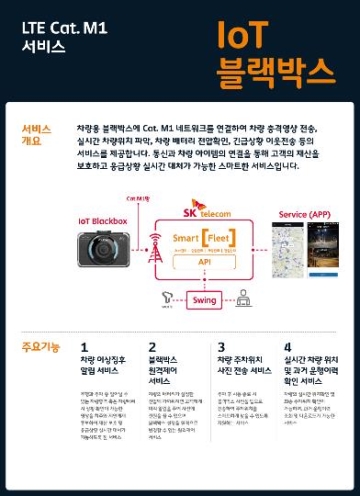
SK Telecom announced the completion of 'LTE Cat.M1' construction, a nationwide IoT network following its 'LoRa' network, and disclosed plans for commercialization in April, upgrading its existing 'hybrid IoT network'. 'LTE Cat.M1' is a technology standardized by 3GPP, the international standardization body, and offers the advantage of enabling transmission of low-capacity video and HD-grade photos and voice. With this commercialization, SK Telecom can now provide complete IoT network coverage alongside its 'LoRa' network, which is suitable for low-power and low-capacity data transmission.
2018.02.21by 김지혜 기자
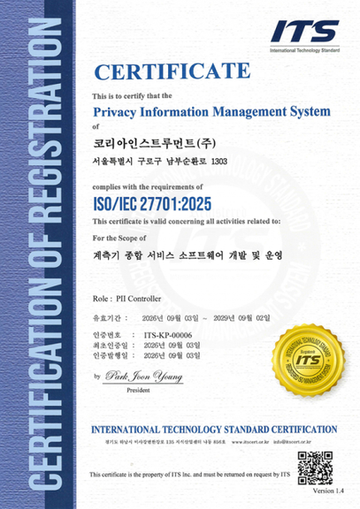
Korea Instrument, KOLAS Accredited Calibration Agency First to Simultaneously Acquire ISO/IEC 27,001·27,701
Korea Instrument has become the first among KOLAS accredited calibration agencies to simultaneously acquire ISO/IEC 27,001 and ISO/IEC 27,701 certifications. Through its proprietary platforms CWIZ Enterprise and CWIZ Partners, the company has embedded information security and personal data protection requirements across all business processes including customer information, equipment data, and calibration reports, with plans to continuously advance its management system through regular audits and security inspections.
2026.10.12by 배종인 기자
TeamViewer One, IT Incident Automation Workflow and Resolution Center Enhanced
TeamViewer has added IT incident automation capabilities and an advanced Resolution Center to its integrated digital workplace management platform 'TeamViewer ONE'. Recurrent service disruptions, configuration errors, and capacity shortages are automatically handled according to preset policies, and device status verification through script deployment can be managed in a unified interface, significantly reducing repetitive tasks for IT teams.
2026.10.12by 배종인 기자











