



We must prepare for future communications through 'THz'-based 6G research
 Published2018.03.22 17:57
“Reducing multiple sidelobes and researching challenging technologies such as ADCs and DACs must be prioritized”
Mobile communication has increased speed and reduced latency as it evolved from the first to the fourth generation. The pace of research and development transitioning to each generation has also shortened. As a result, the commercialization of 5G is on the horizon. Recently, the U.S. Defense Advanced Research Projects Agency (DARPA) and the Chinese government have begun preparing for future communications by launching the '6G Advanced Communications Research Project.' Attention is focused on this 6G research, which has begun even before 5G standards have been established.
In Korea, 1G and 2G began as voice-oriented mobile services, and with the transition to the 3G and 4G eras, mobile internet via smartphones became possible. Recently, 5G pilot projects were launched in conjunction with the PyeongChang Winter Olympics. 5G offers speeds exceeding 20Gbps with expanded bandwidth. This represents a 20-fold difference compared to 4G, which operates at 1Gbps. Furthermore, response latency is less than one-tenth of that of 4G, with response times as fast as one-thousandth of a second. Characterized by ultra-high speed and ultra-low latency, 5G is considered a key element of the Fourth Industrial Revolution based on the Internet of Things.
In January 2018, the Ministry of Science and ICT announced five major convergence fields: cities, welfare, transportation, safety, and national defense. Super-intelligence, super-realism, and super-connected information and communications are expected to accelerate applications in various fields, including these five convergence areas. 5G is serving as the foundation for each application field, and the technological requirements demanded by future industries are becoming increasingly stringent. This trend appears to be the reason why China, the United States, and others are preparing for future communications.
Such discussions have also begun in Korea. Bang Seung-chan, a researcher at the Electronics and Telecommunications Research Institute (ETRI), stated, “Researchers began taking an interest in 6th generation mobile communication after the PyeongChang Olympics,” adding, “We will expand into Massive Connectivity related to IoT and Critical Communication related to automobiles and robots.” He further noted, “5G serves as the foundation for each field, and we expect this concept to deepen further in the future.” This appears to suggest a focus on research and development to prepare for a higher level of future communication based on 5G.
Future service applications include ultra-realistic information and communication AR/VR, autonomous vehicles, holographic conferencing, and national defense. In the AR/VR field, the advancement of 6-DoF (6 Degrees of Freedom) will require transmission speeds of 0.2 to 5 Gbps in the future. The autonomous vehicle market, driven by advancements in VR and holograms, requires 1 Gbps per person and 5 to 10 Gbps per vehicle. Assuming there are roughly dozens of vehicles in a single cell, this means 100 Gbps to 1 Tbps per cell is required. Furthermore, assuming multiple holographic conferences, a single meeting location must possess speeds ranging from several Gbps to tens of Gbps.
'THz waves' are being discussed as a suitable frequency for handling such data volumes. THz is an electromagnetic wave that vibrates one trillion times per second. The candidate frequency for 5G millimeter waves is the 28GHz band, with a possible frequency bandwidth of 10GHz. To provide data speeds of 100Gbps to 1Tbps, high frequency efficiency is required. However, due to the directional nature of millimeter waves, there are limitations to multi-antenna methods, which restricts the increase in frequency efficiency. To obtain high transmission speeds, bandwidth must be increased, and 'THz' is suitable for this purpose.
Furthermore, beam width and side lobes are critical performance factors during beamforming, and side lobes are reduced by using windowing techniques on array antenna weights. While array antenna systems cannot inherently prevent side lobes, horn arrays are more advantageous for reduction than patch arrays. The advantages of horn antennas include their wide bandwidth capacity and low antenna loss. A 28GHz millimeter wave horn antenna measures 42cm, whereas a THz horn antenna measures 4.2cm, making it between one-tenth and one-hundredth the size. Large side lobes cause interference and reduce efficiency. Since THz allows for the reduction of side lobes, it is advantageous for high-capacity base station technology.

Furthermore, THz possesses advantages such as good penetration into non-metallic materials like paper, wood, and plastic, low scattering compared to ultraviolet and visible light, harmlessness to the human body unlike X-rays and gamma rays, higher spatial (imaging) distribution capability than millimeter waves and microwaves, and high data capacity, making it suitable for non-destructive testing for safety, protection, and defects, inspection of explosives and pharmaceuticals, medical imaging, and next-generation wireless communication.
A representative example based on these characteristics is expected to be a 'smart airport'. When THz technology is applied during airport security screening, it is possible to acquire higher-resolution 3D penetration images than microwaves or radio waves because it is an electromagnetic wave harmless to the human body, and it can penetrate bags, clothing, etc., allowing for the detection of metals or liquids. In addition, broadband spectroscopic search enables the detection of hazardous materials, such as some solids, liquids, and gases.
However, there are technologies that must be overcome for 6G research, development, experimentation, and commercialization. First is beamforming. While it is certainly more advantageous than millimeter wave, interference caused by multiple side lobes resulting from the formation of multiple beams is clearly a challenge that must be resolved. Next are ADCs and DACs. When bandwidths reach tens of GHz, the issue of high power consumption arises. Third, existing RF-PHY structures consume a significant amount of power, necessitating research into low-power RF-PHY structures to replace them.
"To solve the technical challenges of 6G, such as new waveforms with very short pulses, low-power RF-PHY structures, THz transceivers, ADCs, and DACs, it is necessary to prioritize the research and development of core component structural technologies," said Bang Seung-chan, a researcher at ETRI. He further explained, "THF technology is progressing alongside 5G millimeter wave, and it will be commercialized in some application fields before 2030. We anticipate cellular systems with speeds ranging from 100 Gbps to 1 Tbps by around 2030."
Comments
Related news

Stop worrying about accidents and emergencies with 5G autonomous vehicles!
SK Telecom (hereinafter SKT) Park Jin-hyo, Head of ICT Technology, said at a 5G autonomous vehicle demonstration conducted by SKT and the Korea Road Traffic Authority, "I am pleased to be able to showcase 5G technology," and "Through autonomous driving, we will prevent traffic accidents and create a world without accidents, improving quality of life." For safe and convenient autonomous vehicle operation, which SKT emphasized on this day, 5G implementation is essential. At CES 2017, Intel announced a 5G modem, signaling innovation in various fields such as wireless broadband and the Internet of Things. 5G, which is a concern for mobile carriers, the automotive industry, and various companies, has the following characteristics in autonomous vehicle operation.
2018.02.08by 김학준 기자
SK Telecom Unveils New Campaign 'THIS IS 5G'
SK Telecom has unveiled a new 5G campaign titled "THIS IS 5G." Figure skating queen Kim Yuna and skeleton emperor Yun Sung-bin will serve as models to promote SK Telecom's 5G. The campaign will roll out across various spaces including TV, social media, and baseball stadiums starting today. The "THIS IS 5G" campaign presents SK Telecom's answer to the question "What is 5G?" The core attributes of 5G—speed, stability, and security—are clearly expressed through conversations between Kim Yuna and Yun Sung-bin, as well as skeleton training scenes.
2018.03.21by 김지혜 기자

What is KT's faster-than-anyone 5G commercialization strategy?
KT held a 5G achievement presentation and commercialization strategy press briefing to announce the 5G technologies used during the 2018 PyeongChang Winter Olympics and Paralympics, as well as future strategies. Oh Seong-mok, head of KT's Network Division, stated, "After announcing at the Mobile World Congress (MWC) that KT would showcase the world's first 5G trial service at the 2018 Olympics, KT made efforts in developing various technologies and services for early 5G commercialization." During this Olympics, KT applied 5G-based technologies such as SyncView, Time Slice, and OmniView to events including figure skating, short track speed skating, and skiing. Through these technologies, KT delivered three-dimensional images capturing key moments such as aerial jumps and championship goals, as well as competition scenes from 360-degree angles to spectators and viewers. For bobsleigh, SyncView equipped on the top 10 teams was also used by US-based NBC. Additionally, approximately 3,000 people, including government officials, media executives, and telecommunications company CEOs, boarded KT's 5G Connected Bus.
2018.03.22by 김학준 기자
European Patent Applications Surpass 200,000 for the First Time… South Korea Maintains 5th Place, Led by Batteries and Telecommunications
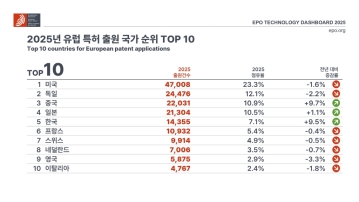
According to the European Patent Office (EPO)'s 'Technology Dashboard 2025', European patent applications last year reached 201,974, surpassing 200,000 for the first time. Korean companies and inventors filed 14,355 applications, representing a 9.5% increase from the previous year and maintaining 5th place by country. Battery, digital communication, and semiconductor technologies led the growth, with Samsung ranking as the top EPO applicant for the second consecutive year and LG reaching 3rd place. The presence of major domestic cities such as Seoul, Suwon, and Yongin was also confirmed. It was also revealed that Korea's European patent strategy is expanding beyond individual technologies to span the entire industry.
2026.03.24by 명세환 기자

SK Telecom First Applies AI-Based Network Operations at Gwanghwamun K-Pop Concert
SK Telecom announced that it applied an AI-based network operation system for the first time at a large-scale K-pop concert held in the Gwanghwamun area of Seoul on March 21st, managing communication quality throughout the event. Mobile data usage during the three hours before and after the concert reached 12.15TB, approximately doubling compared to the same time slot the previous weekend. SK Telecom monitored traffic using the AI system 'A-One' in five-minute and 50-meter units to respond to potential overload situations, while also operating temporary communication facilities and on-site personnel in parallel. This case is interpreted as confirmation of the practical applicability of AI-based autonomous network operation in an environment where demand from dense events and foreign users increases simultaneously.
2026.03.23by 명세환 기자











