



Cognex Unveils 'BD Suite' That Detects Defective Products with Human Eyes
 Published2018.03.26 17:01
Available in Cognex Blue, Red, and Green options
Cognex has released 'Cognex BD Suite', a deep learning-based machine vision software. It has improved on the defect detection in irregular patterns and pattern recognition with many variations that existing machine vision technology could not do. It announced that it will attack the domestic vision market through this.
Machine vision is a technology that recognizes and collects sophisticated patterns and features in images, and then performs precise guidance, inspection, measurement, and high-speed reading, and is necessary for increasing automation and efficiency in smart factories. During the manufacturing process, precise placement is important in the alignment stage. If accurate placement is not achieved, it can take a lot of time and money, which can increase the overall cost or the proportion of defective products.
The most important feature of machine vision is precision. It finds and confirms minute details and features down to micrometers that people cannot do. The camera captures, identifies, and measures precise parts such as line segments and edges at the front end, and corrects them if they deviate from the alignment position. This is why machine vision is necessary in automation.
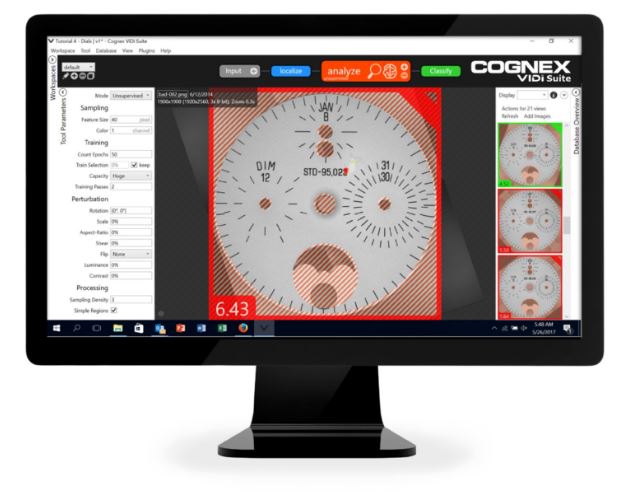
Cognex Vidi Suite Red
Existing machine vision has shown limitations in detecting defects in irregular backgrounds, detecting complex patterns with many variations, and recognizing characters. Vision has had difficulty inspecting defective patterns that people can recognize at a glance. For the above reasons, Vietnam's manufacturing market currently has more than 500,000 people involved in inspection. Although it is efficient for overall automation, it has shown weaknesses in the detailed detection required for 'customized production' in smart factories.
Machine vision enables inspection by rules created through various signal processing. It is difficult to create rules that detect irregular and highly variable patterns that people can immediately recognize. Cognex Vidi Suite goes beyond rule-based and applies human learning to deep learning to enable pattern detection that only people can solve.
“By combining existing machine vision to increase automation and new product solutions, we can increase productivity, reduce defects, and improve efficiency,” said Min-Soo Kim, Cognex Vision Solutions Manager.
IBM's Watson beat everyone else in the famous quiz show Jeopardy Show in the US and won first place. Also, IBM's Deep Blue looks at the chessboard and makes the optimal move by looking at five moves ahead based on the current move. These are all rule-based systems and have surpassed people in many aspects.
One game that I thought I couldn't win was Go. I thought it was impossible to approach it in a rule-based way because the search space was almost infinite. However, Google's AlphaGo broke this. AlphaGo judges the Go board as an image and judges each point as three values: black, white, and empty space. AlphaGo's learning ability is trained with a huge amount of data called Go records. Here, artificial intelligence plays against each other to conduct reinforcement learning.
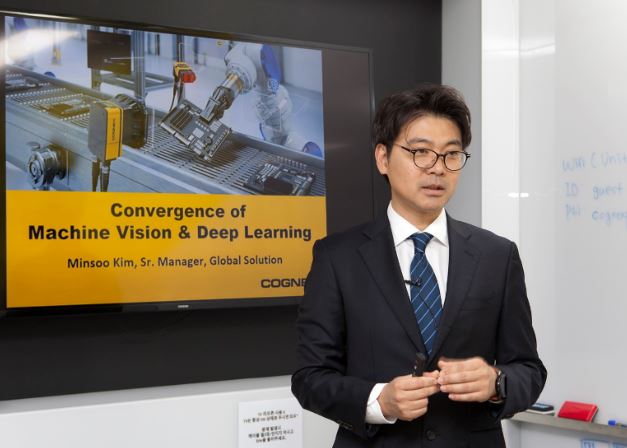
Data is important when learning a network. Facebook, Google, Amazon, etc. have big data. They create artificial intelligence and train it on a large amount of data to operate like a human. Deep learning has gradually developed due to abundant data, high-performance computing, and deep learning algorithms. However, there are several problems in utilizing this deep learning in the industry. Google and Facebook have servers to utilize a large amount of data. However, the industry does not have a large amount of data. In addition, it is difficult to apply deep learning centered on big data because they do not have servers.
In other words, it must be able to process even small amounts of data. Cognex Vidi Suite has solved this problem. Since it does not require a large amount of image processing at once, high-resolution image processing is possible with a single GPU that can process at high speed. A large number of servers are not required. In addition, it provides functions optimized for factory automation based on Vidi Suite Blue, Red, and Green tools. Unlike existing deep learning-based machine vision solutions, it can learn with image data sets of several tens to a maximum of a hundred sheets. Additionally, it is capable of optical effect processing, high-resolution color and thermal image recognition to perform inspections accurately.
Conventional machine vision only distinguishes between passes and fails and leaves the learning to deep learning, but Vidi is composed of blue, red, and green and processes various detailed features and options.
VidiBlue is used to find and localize multiple features in a single image. Even objects with complex features, such as severely deformed characters on a noisy background or multiple complex objects, can be located and identified by recognizing annotated images. To train the Blue tool, you just need to provide an image with the target features marked on it.
Bidi Red is used to detect anomalies and aesthetic defects. It learns the normal appearance of an object, including distinct but acceptable variations, and can identify numerous problems, including scratches on decorative surfaces, incomplete or improper assemblies, and the texture of fabrics.
Bidi Green can be used for object or whole scene classification. It distinguishes different classes based on a collection of labeled images, such as product identification based on packaging, classification of weld seams, and separation of acceptable and unacceptable defects. The green tool can be trained through images that are assigned and labeled according to different classes.
Cognex CEO Moon Eung-jin said, “With these three tools, even non-vision experts can easily design and use them flexibly. And since they can process small amounts of data, they can be applied to both individual consumers and industrial applications.” He continued, “Conventional deep learning has a long learning time, making it difficult to apply to industrial sites when the model changes, but Cognex is capable of fast learning because it uses less computing power and images.”
Comments
Related news
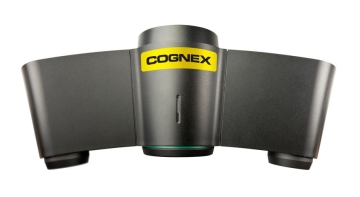
Cognex Launches 3D Camera for Fast and Accurate Inspection
Cognex has announced the launch of the 'Cognex ES-A5000 Series', a 3D camera that enables fast and accurate inspection based on 3D image capture technology. In October 2016, Cognex acquired EnShape GmbH, a company specialized in 3D machine vision technology, to strengthen its leadership in 3D vision. This new product combines Cognex's machine vision technology with EnShape's 3D sensor technology, enabling reliable component inspection, pick-and-place applications, and inline metrology through high-resolution imaging of specific areas and industry-leading 3D analysis algorithms.
2018.01.12by 김지혜 기자
SUALAB Launches Upgraded Version 'SUAKITT 2.0' with 4 Improved Features
SUALAB has achieved another leap forward. By launching version 2.0 of 'SuaKIT', the company has significantly improved upon the inconveniences of the existing version. SuaKIT version 1.0, a deep learning-based machine vision inspection software, applied case learning-based deep learning algorithms to introduce automated defect inspection across various manufacturing sectors. It has been recognized for enabling inspection in diverse areas that were difficult to inspect with conventional machine vision systems, and for substantially improving both accuracy and speed.
2018.02.28by 김지혜 기자

Cognex participates in Automation World 2018
Cognex announced that it will participate in 'Automation World 2018' held on March 28th under the theme of 'The Future of Vision'. Cognex will showcase various new products including 'Cognex Vidi Suite,' a machine vision solution utilizing deep learning technology, 'ES-A5000,' a high-performance 3D camera enabling bin-picking, 'DSMAX,' which supports high-precision high-speed dimensional inspection and surface inspection, 'Vision Guided Robot (VGR),' a high-precision assembly solution through robot guidance, 'Insight 2000-23M,' an upgraded version of the existing Insight 2000 vision sensor, and the latest ID readers. 'Cognex Vidi Suite,' newly introduced by Cognex this time, is deep learning-based image analysis and inspection software designed for industrial image analysis. Based on state-of-the-art machine learning algorithms, it enables significantly enhanced image analysis compared to conventional methods. It can solve inspection and classification problems that could not be programmed with existing methods, and is expected to be widely utilized in demanding machine vision applications in the future.
2018.03.26by 김학준 기자
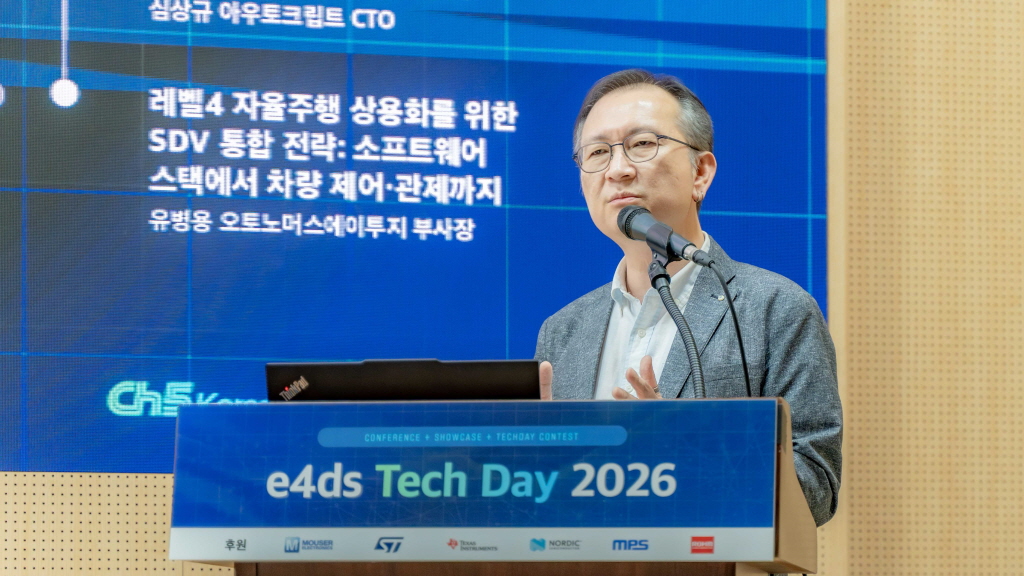
[e4ds Tech Day 2026 ⑨] Sim Sang-gyu, Autocrypt CTO: "In the Physical AI Era, Automotive Security Must Extend Beyond the Vehicle"
At e4ds Tech Day 2026, Sim Sang-gyu, CTO of Autocrypt, explained automotive cybersecurity strategies in the era of Physical AI and SDV (Software-Defined Vehicle). Automobiles are evolving as part of an ecosystem connected to AI, cloud, chargers, IoT, and robots, and he emphasized that the scope of security must expand beyond the vehicle interior to the entire connected environment. In particular, AI model tampering, adversarial attacks, OTA updates, and EV charger hacking were identified as major threats. He explained that response measures require zero trust, AI model integrity protection, intrusion detection, Security by Design and Default, and full lifecycle security management, and that proactive security system establishment beyond regulatory compliance is critical for securing future mobility competitiveness.
2026.10.12by 배종인 기자
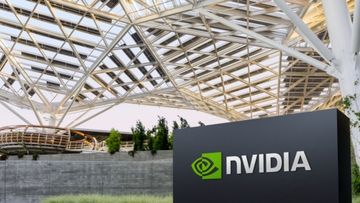
NVIDIA to Invest $1 Billion in U.S. Science Over Next Five Years
NVIDIA has announced plans to invest $1 billion over the next five years to strengthen U.S. scientific and technological competitiveness. The company will enhance cutting-edge artificial intelligence research and development capabilities in key areas including quantum computing, healthcare, and energy security, while expanding support for higher education research institutions and cloud service providers. NVIDIA is participating as a major industry partner in the White House Office of Science and Technology Policy's Genesis Mission, and is promoting supercomputer construction in collaboration with national laboratories including Argonne and Los Alamos.
2026.10.12by 배종인 기자











