


NVIDIA Unveils System to Test Self-Driving Cars Using Simulation
 Published2018.03.28 10:32
NVIDIA is introducing a cloud-based system that can test self-driving cars in realistic simulations, providing a safer, more scalable way to get self-driving cars on the road.
In his GTC 2018 keynote, NVIDIA founder and CEO Jensen Huang announced NVIDIA DRIVE Constellation, a computing platform built on two different servers.
The first server runs NVIDIA DRIVE Sim software to simulate the vehicle’s sensors, including cameras, lidar and radar. The second server’s powerful NVIDIA DRIVE Pegasus AI car computer runs the entire autonomous vehicle software stack and processes the simulated data as if it came from the sensors of a real car driving on the road.
“Deploying production self-driving cars requires solutions that can test and validate billions of miles to ensure the safety and reliability our customers demand,” said Rob Csongor, vice president and general manager of Automotive at NVIDIA. “NVIDIA DRIVE Constellation allows us to do this by combining our expertise in visual computing and data center. “Virtual simulations have allowed us to refine our algorithms by testing them over tens of miles, including custom scenarios and rare cornering cases, in a fraction of the time and cost of real-world driving,” he said.
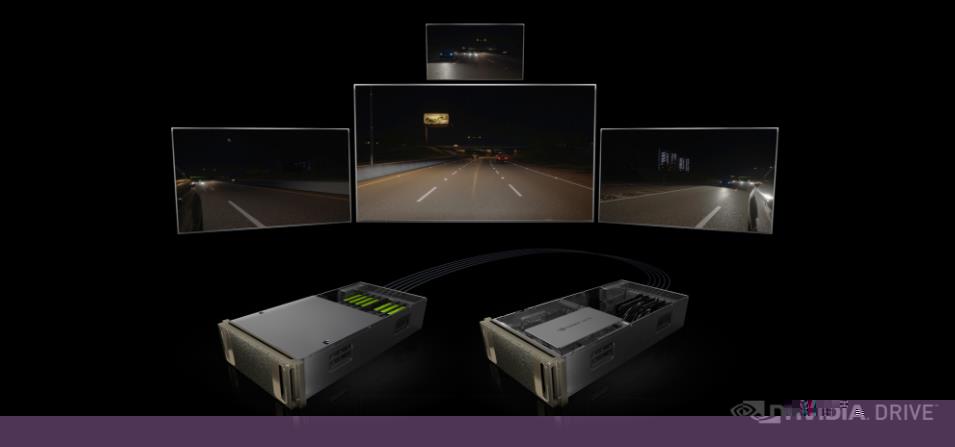
The simulation server is based on NVIDIA GPUs, and each generated simulation sensor data stream is passed to DRIVE Pegasus for processing.
Driving commands from the Pegasus are relayed back to the simulator, completing a digital feedback loop. This “hardware-in-the-loop” cycle occurs about 30 times per second and is used to verify that the algorithms and software running on the Pegasus are operating the simulated vehicle correctly.
DRIVE Sim software generates photorealistic data streams to create a variety of test environments. It can simulate a variety of weather conditions, such as storms and snowstorms, glare or limited visibility at night during different times of the day, and a variety of road surfaces and terrains. It can also simulate dangerous situations to test the ability of autonomous vehicles to respond while avoiding the risk to real drivers.
“Autonomous vehicles need to be developed as systems that can cover everything from training to testing to real driving,” said Luca De Ambroggi, research and analyst director at IHS Markit. “NVIDIA’s end-to-end platform is the right approach. “With Drive Constellation for virtual testing and validation, we will get one step closer to production autonomous vehicles,” he said.
Comments
Related news
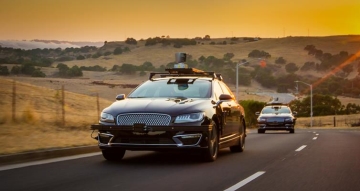
NVIDIA: "Xavier, the culmination of complex technology for future autonomous vehicles, will be the starting point"
Nvidia CEO Jensen Huang affirmed at the CES 2018 press briefing that the company will solidify its leadership position in the competition to develop autonomous driving safety solutions. The Nvidia Xavier autonomous driving machine processor, which plays a key role in autonomous driving sector collaboration, is the most complex system-on-chip (SoC) developed to date. Jensen Huang stated that more than a year has passed since the Xavier launch, and the company will deliver samples to several customers in the first quarter. CEO Jensen Huang remarked to an audience of media, partners, and stakeholders from the global automotive and consumer electronics industries: "Future automobiles are the embodiment of highly complex and sophisticated technology. Xavier, which processes deep learning, computer vision, and high-performance computing with advanced efficiency, stands at the starting point of this."
2018.01.12by 김지혜 기자
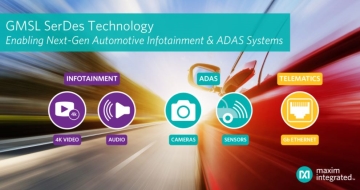
Maxim Supports NVIDIA Autonomous Driving Platform Functional Safety
Maxim Integrated announced its collaboration with NVIDIA to support NVIDIA's industry-first Level 5 fully autonomous driving platform 'DRIVE Pegasus' and 'DRIVE Xavier' for Level 4 autonomous driving. Maxim's ASIL (Automotive Safety Integrity Level) related solutions and high-performance analog integration technology include next-generation Gigabit Multimedia Serial Link (GMSL) parallel-to-serial transceiver (SerDes) technology and power system monitoring solutions. Through these, Maxim supports functional safety for NVIDIA's autonomous driving platforms.
2018.01.17by 김지혜 기자
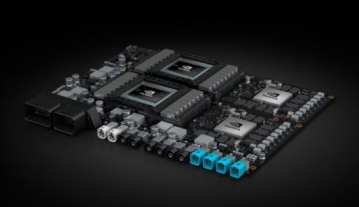
NVIDIA Accelerates Autonomous Driving Technology with Xavier SoC
Nvidia has announced that it is moving closer to realizing autonomous vehicles through its Xavier System-on-a-Chip (SoC). Current autonomous vehicle technology is at a level where it can operate independently on congested highways during rush hours or during parallel parking, but it is not yet capable of executing autonomously in all situations. Nvidia unveiled Drive Xavier, a System-on-a-Chip (SoC), at CES 2018.
2018.01.29by 김학준 기자
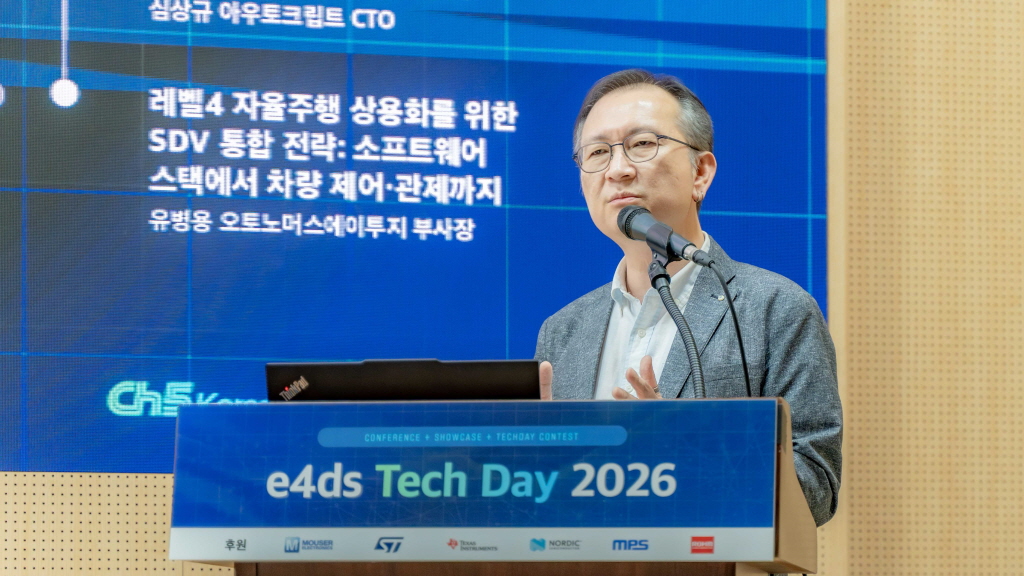
[e4ds Tech Day 2026 ⑨] Sim Sang-gyu, Autocrypt CTO: "In the Physical AI Era, Automotive Security Must Extend Beyond the Vehicle"
At e4ds Tech Day 2026, Sim Sang-gyu, CTO of Autocrypt, explained automotive cybersecurity strategies in the era of Physical AI and SDV (Software-Defined Vehicle). Automobiles are evolving as part of an ecosystem connected to AI, cloud, chargers, IoT, and robots, and he emphasized that the scope of security must expand beyond the vehicle interior to the entire connected environment. In particular, AI model tampering, adversarial attacks, OTA updates, and EV charger hacking were identified as major threats. He explained that response measures require zero trust, AI model integrity protection, intrusion detection, Security by Design and Default, and full lifecycle security management, and that proactive security system establishment beyond regulatory compliance is critical for securing future mobility competitiveness.
2026.10.12by 배종인 기자

Practical HIL Construction Strategy for Automotive and Off-Highway Controller Validation
As vehicle E/E architecture transitions to zonal structures and shifts to software-defined vehicles (SDV), the number of controllers (ECUs) requiring validation and software complexity are surging dramatically. Meanwhile, real vehicle testing cannot provide repeated verification under identical conditions and entails lead time and safety concerns. This white paper explains the principles of HIL (Hardware-in-the-Loop) validation and the structure of the NI platform composed of PXI, SLSC, and VeriStand, and through two actual implementation cases—Camera Record & Replay HIL for In-Cabin Monitoring Controller (ICMU) and Forklift Controller (VCU) HILS—describes how controller-level regression testing becomes possible. Additionally, it explicitly states application boundaries and limitations, such as lack of A2B support.
2026.10.12by 편집부











