



Siemens Unveils Simulation Solution to Accelerate Commercialization of Autonomous Vehicles
 Published2018.04.03 10:10
Siemens PLM Software unveiled a groundbreaking solution for the development of autonomous driving systems at the Siemens US Innovation Day event held in Chicago.
This solution, part of the Simcenter portfolio, significantly reduces the test drive time required to prove the safety of autonomous vehicles and minimizes the need for extensive physical prototyping.
Siemens PLM Software's new solution is designed to help automotive manufacturers and their suppliers solve these industry challenges using advanced physics-based simulation and innovative sensor data processing technology, thereby reducing the time required for the development, verification, and certification of autonomous vehicles by more than several years.
The new Simcenter solution integrates autonomous driving technology from Mentor Graphics, recently acquired by Siemens, and TASS International, a global supplier of simulation software. Looking at how Simcenter works, the simulation environment based on PreScan, TASS International’s advanced safety automotive simulation solution, generates simulations of highly realistic physics-based raw sensor data for infinite potential driving scenarios, traffic conditions, and other parameters.
TASS’s FreeScan inputs data generated from LiDAR and camera sensors—the core "eyes" of autonomous driving—into Mentor Graphics’ DRS360 simulation platform for autonomous driving. There, the data is fused in real-time to generate a high-resolution model of the vehicle's environment and driving conditions. By utilizing this, customers can test and improve proprietary algorithms for critical tasks, such as object recognition and driving policies, using the DRS360 platform’s superior perception resolution and high-performance processing capabilities.
Dr. Jan Leuridan, Senior Vice President of Simulation and Test Solutions at Siemens PLM Software, stated, “Automakers recognize that physical prototypes and road tests alone cannot address all the complex driving scenarios that autonomous vehicles will encounter. In fact, many of the most critical scenarios are impossible to reproduce, and others are too dangerous to recreate, making pre-testing impossible for ethical reasons. Whether the commercialization of fully autonomous vehicles can be achieved in the short term depends on the advancement of advanced physics-based simulation technology.” "Siemens is a global leader in the field of automotive design simulation," he emphasized.
Siemens PLM Software is developing physically based 3D simulation versions of specific sensor modules in collaboration with numerous leading global manufacturers of LiDAR, radar, and vision sensing products to provide the most comprehensive and accurate solutions. Compatible with the new Siemens toolchain, these simulation versions of sensors are tuned to utilize detailed design information from sensor suppliers and are certified using real-world measurement data, thereby achieving optimal accuracy. One of the key sensor partners, Cepton Technologies, is an innovative Silicon Valley-based company renowned for developing small-profile, long-range LiDAR sensors. Announcements regarding additional sensor partners are scheduled to be made later this year.
Comments
Related news
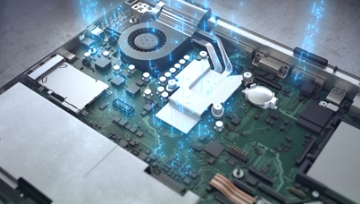
Siemens Launches Integrated Electronic Product Development Management Solution with ALM and PLM Technologies
Siemens has launched an integrated product development management solution for the electronics field with integrated ALM and PLM technology. The newly released product allows engineers to use their preferred and familiar development tools while being connected in real-time to an integrated workflow, enabling them to enjoy the same user experience. When software components are created and tested on the ALM side, they can be published to the BOM (Bill of Material), enabling the creation of a fully integrated BOM from mechanical, electrical, and software perspectives. Through this, enterprises can improve visibility across the entire product development domain. Additionally, real-time collaboration becomes possible, allowing for rapid identification of defects in complex systems, understanding their impact, and resolving issues.
2018.02.08by 명세환 기자
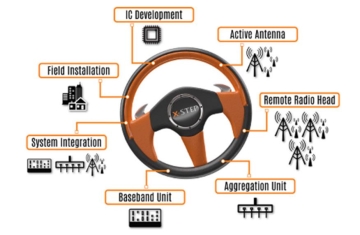
Siemens Focuses on IC Industry with Acquisition of Sarokal Test Systems
Siemens announced that it will acquire Sarokal Test Systems Oy, a company providing test solutions for fronthaul networks. Fronthaul is a wired network that transmits voice or data received from individual base stations to a server, connecting central and distributed devices. Sarokal's products are used by chipset vendors, fronthaul equipment manufacturers, and telecom operators to develop and test 4G/5G network devices through initial design phases, implementation, and field testing.
2018.02.20by 김지혜 기자
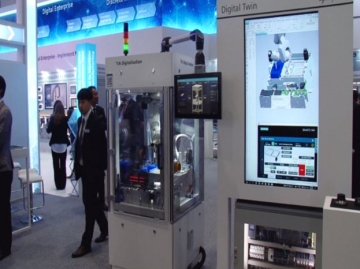
Siemens' 'digital twin' simulation prevents risks in advance
Siemens Korea (hereinafter Siemens) exhibited a variety of smart factory solutions and products at 'Automation World 2018,' held at COEX from March 28 to 30. Siemens introduced its high-performance products for increased productivity and automation, including Digital Twin, MindSphere, and Digital Enterprise TIA. Through these, it is possible to implement features such as automated connection and execution of engineering tasks, product lifecycle management, virtual commissioning, and machine and plant security. Among the various products and solutions, Siemens highlighted Digital Twin as its flagship product. This is a smart factory simulation system that reduces risk factors that may occur in actual operations through commissioning in a virtual environment and prevents losses caused by equipment or material shortages in advance, thereby supporting smooth operation.
2018.04.02by 김학준 기자
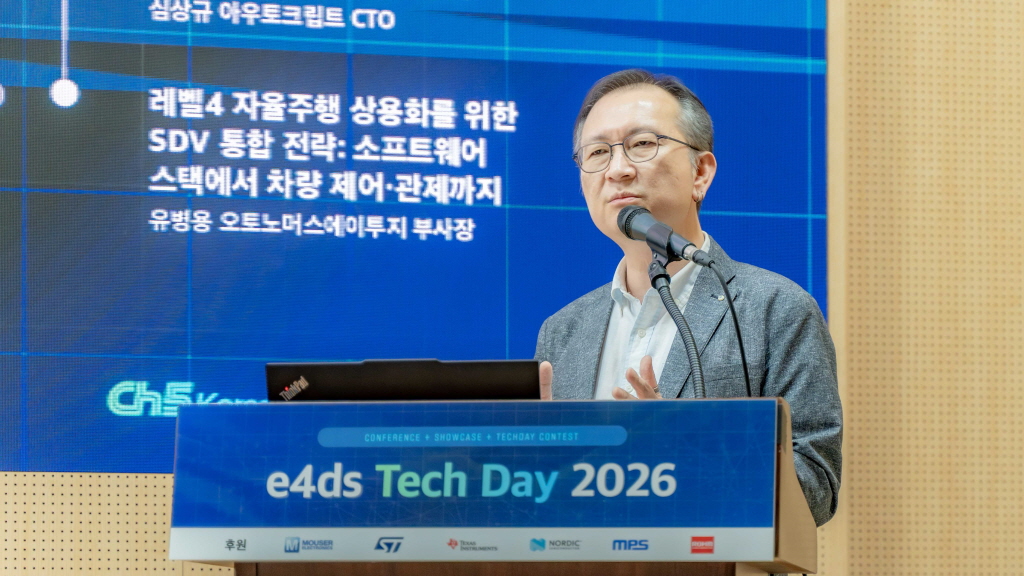
[e4ds Tech Day 2026 ⑨] Sim Sang-gyu, Autocrypt CTO: "In the Physical AI Era, Automotive Security Must Extend Beyond the Vehicle"
At e4ds Tech Day 2026, Sim Sang-gyu, CTO of Autocrypt, explained automotive cybersecurity strategies in the era of Physical AI and SDV (Software-Defined Vehicle). Automobiles are evolving as part of an ecosystem connected to AI, cloud, chargers, IoT, and robots, and he emphasized that the scope of security must expand beyond the vehicle interior to the entire connected environment. In particular, AI model tampering, adversarial attacks, OTA updates, and EV charger hacking were identified as major threats. He explained that response measures require zero trust, AI model integrity protection, intrusion detection, Security by Design and Default, and full lifecycle security management, and that proactive security system establishment beyond regulatory compliance is critical for securing future mobility competitiveness.
2026.10.12by 배종인 기자

Practical HIL Construction Strategy for Automotive and Off-Highway Controller Validation
As vehicle E/E architecture transitions to zonal structures and shifts to software-defined vehicles (SDV), the number of controllers (ECUs) requiring validation and software complexity are surging dramatically. Meanwhile, real vehicle testing cannot provide repeated verification under identical conditions and entails lead time and safety concerns. This white paper explains the principles of HIL (Hardware-in-the-Loop) validation and the structure of the NI platform composed of PXI, SLSC, and VeriStand, and through two actual implementation cases—Camera Record & Replay HIL for In-Cabin Monitoring Controller (ICMU) and Forklift Controller (VCU) HILS—describes how controller-level regression testing becomes possible. Additionally, it explicitly states application boundaries and limitations, such as lack of A2B support.
2026.10.12by 편집부











