



Resolving Optical Communication Network Traffic with SDN Optical Switches
 Published2018.04.06 11:13
We developed a core component for ROADM, an optical switching system, to accommodate large amounts of data and enable intelligent control of optical communication networks.
Until now, optical network equipment varied by manufacturer, requiring separate software management for each piece of equipment, making operation difficult and costly.
Accordingly, the Electronics and Telecommunications Research Institute (ETRI) developed core components controllable by software to create equipment and configure a network for the development of an efficient optical switching system. They explained that this has enabled its utilization in smarter Software Defined Networks (SDN).
ETRI stated that the development of this optical switch enables efficient network operation and management by providing centralized software-based control of the optical switching system. This is also expected to lead to cost savings.
It was announced that with this technology development, the total amount of data that can be processed per existing Rotem device can increase by approximately three times, from the existing 8T (tera)bps to 23Tbps.
In conventional optical communication networks, a fixed bandwidth was allocated per wavelength regardless of transmission speed. Consequently, channels communicating at low speeds relatively wasted resources. However, ETRI technology allows for the free adjustment of wavelength bandwidth according to communication speed, significantly increasing network capacity.
In addition, it was previously impossible to process optical signals of the same wavelength coming from telephone exchanges in multiple directions at a single telephone exchange or base station in a network, but this was made possible, thereby increasing network efficiency.

The research team revealed that the core of this technology is 'SDN-based flexible optical node technology.' In the future, the upgraded optical switch developed by the team will be embedded within the optical node. Once the technology is commercialized, it is expected to be installed in optical communication network base stations that connect transmission networks.
ETRI explained that the components successfully developed this time are a 'multicast switch' and a 'flexible grid optical monitor'.
First, the multicast switch is a key component in optical switch systems that determines the direction of data even for signals entering with the same wavelength. Previously, signal processing was difficult due to collisions when signals of the same wavelength entered, but this effectively resolves that issue.
As a result, the channel width can be freely adjusted, and it is expected that the difficulty of sending large amounts of data due to narrow bandwidth will disappear in the future.
In addition, the flexible grid optical monitor solved the problem of having to determine what kind of data and how much was coming in, as the width of existing data channels was uniformly fixed. This is because the channel width can flexibly shrink and expand as data comes in.
The research team successfully developed the components, and Kowiver Co., Ltd., a domestic optical communication equipment company, manufactured them into line cards to form an optical switch device. Through this joint research, the team also demonstrated that the optical switch system can be controlled and managed via software.
Moving forward, this technology is expected to be integrated into optical switch system equipment manufacturers via domestic optical device manufacturers, followed by full-scale commercialization by telecommunications operators. By utilizing planar waveguide integration technology based on low-cost materials such as silica and polymers, and enabling mass production, this technology possesses price competitiveness, raising expectations for future market entry.
Baek Yong-soon, Head of the Optical and Wireless Convergence Research Division at ETRI, stated, “The successful development of core optical components and optical switching devices to increase network capacity and efficiency has secured the global technological capabilities and competitiveness of domestic optical components in high-capacity transmission networks.”
Comments
Related news
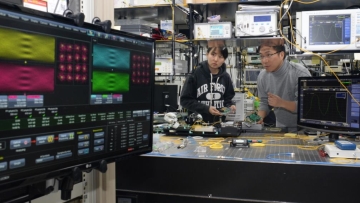
Data transmission capacity quadrupled through independent development of optical transceiver components
Components for 5G communications networks have been developed. The Electronics and Telecommunications Research Institute (ETRI) has developed optical transceiver components using domestically independent technology. The existing transmission network operated at approximately 100G, but this has been expanded four-fold to 400Gbps. ETRI has successfully demonstrated the technology in a real-world environment using domestically developed independent components that enable high-capacity data communication without additional optical cable installation, even if traffic increases more than four-fold compared to current levels, for new network expansion.
2018.03.09by 김지혜 기자

KT Reduces Gigabit Internet Deployment Time with SDN Technology
KT announced that it has developed and will commercialize an 'Internet Access Network Automation Solution' that remotely and automatically controls network equipment based on SDN. Using this solution significantly reduces the time required for gigabit internet construction and service activation. Until now, configuring gigabit internet access networks has been done manually by numerous personnel, requiring considerable time. However, by leveraging the Internet Access Network Automation Solution, gigabit ethernet switches are automatically detected remotely and all network settings required for internet service are completed automatically, thereby reducing network configuration time. Additionally, to provide gigabit internet, the process of migrating hundreds of internet users connected to existing optical access equipment to high-performance optical access equipment (large-capacity OLT: Optical Line Terminal) is also automatically applied. Upon completion of commercialization, the time required for gigabit switch installation and subscriber accommodation change operations can be reduced by over 80%.
2018.04.03by 김학준 기자

Intel Unveils Next-Generation 'Core Ultra Series 3' and vPro Platform for Enterprise PCs
Intel has officially unveiled the "Intel Core Ultra Series 3" for next-generation enterprise PCs and the latest vPro platform, addressing a wide range of demands from enterprise notebooks to high-performance workstations.
2026.03.26by 배종인 기자

ROHM Launches ESD Protection Diode Compatible with High-Speed Interfaces of 10Gbps or Higher
Semiconductor specialist ROHM has developed the 'RESDxVx series' of ESD (electrostatic discharge) protection diodes capable of responding to next-generation high-speed data communication environments exceeding 10Gbps, simultaneously enhancing both signal quality maintenance required in high-speed interfaces and IC protection performance.
2026.03.26by 배종인 기자
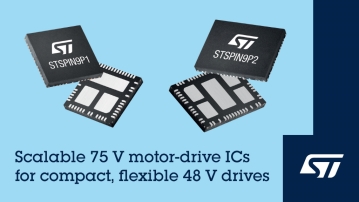
ST Launches 75V Drive IC Targeting 48V Industrial Motor Driving
ST Microelectronics has unveiled the 'STSPIN9P' series of 75V motor drive ICs tailored for 48V-class industrial drive system design. The new product family is characterized by half-bridge and full-bridge configurations that enable design scalability according to motor type and output conditions. Power supply circuits, protection functions, and current sensing circuits are integrated on-chip to simplify system configuration, and the devices are designed to support applications up to 500W maximum. The company plans to provide reference designs and demo boards to support development and evaluation in industrial automation, robotics, pumps, fans, lighting, and textile machinery.
2026.03.26by 배종인 기자











