



ETRI succeeds in transmitting wireless quantum cryptography over a distance of 100 meters.
 Published2018.04.13 10:27
A domestic research team has developed and systematized core integrated components for wireless quantum cryptography using its own technology, successfully transmitting and restoring quantum signals in real-world environments.
The Electronics and Telecommunications Research Institute (ETRI) announced that it has succeeded in transmitting and restoring quantum signals (photons) from a distance of more than 100 meters above the rooftop of Building 1 of the research institute, not only during the night but also during the day, using wireless quantum cryptography technology, a next-generation secure communication technology that can fundamentally block hacking.
The wireless quantum cryptography system technology recently developed by ETRI encodes information into photons, which are particles of light, and transmits and decodes them to generate encryption keys. If a third party intercepts the data, the quantum information is altered, making hacking or eavesdropping fundamentally impossible.
ETRI has successfully maintained an excellent quantum bit error rate (QBER) of 1% at night and 3% during the day at transmission distances exceeding 100 meters. The research team has secured technology capable of generating cryptographic keys at a rate of over 200,000 bits per second at 200 kbps.
.jpg)
The quantum bit error rate, which generally indicates the rate at which quantum signals are transmitted incorrectly, is 11% or less, and quantum cryptographic keys can be generated. The lower the error rate, the faster the encryption key can be generated, and a quantum bit error rate of 3% is very good performance.
Additionally, the research team explained that since the encryption key generated through quantum cryptography is used to encrypt high-speed data using a low-speed encryption key, the encryption key speed secured this time can be sufficiently utilized for data transmission at the level of tens of Gbps.
This announcement is significant in that it successfully restored quantum signals even during daylight, when sunlight is much stronger than the quantum signal. The ETRI researchers explained that by developing and applying ultra-noise reduction technology, they achieved excellent results, achieving a quantum bit error rate of less than 3% even during daylight.
In addition, ETRI is evaluated to have moved closer to commercialization by applying core components for integrated quantum cryptography communication, which it developed on its own at the level of several centimeters, to its system at the end of last year.
Miniaturization of core components of wireless quantum cryptography is an essential core technology for quantum cryptography to be applied in various fields in the future, such as drone-based systems and small terminal systems.
The wireless quantum key distribution system developed by ETRI has secured a significant portion of the technology required for operation in a real environment, and it is expected that the transfer of core technologies is possible at the current stage and that commercialization will be brought closer within one to two years. In the future, this technology can be used for communication within close range, such as between smartphones and bank ATMs, he explained.
However, the research team said that in order for wireless quantum cryptography systems to be commercialized in various fields such as long-distance as well as short-distance communication, additional research is needed on long-distance quantum signal transmission, mobile quantum communication technology, and development of convergence technology with modern cryptography, including encryption and decryption.
Furthermore, the research team first demonstrated the potential for hacking of a quantum cryptography system utilizing multiple lasers in a wireless quantum cryptography communication system. Furthermore, their method for preventing hacking and securing performance was published in Photonics Research, and was featured on the cover of the March issue.
Dr. Cheon-Ju Yoon, head of ETRI's wireless quantum cryptography research, said, "We will continue to research and develop ultra-small wireless quantum cryptography transmission and reception components that integrate a light source for wireless quantum communication, a polarization encoding module, a polarization decoding module, and a single photon detector, and to develop research technologies for small terminals and short-distance services."
Additionally, the research team explained that they plan to develop a wireless quantum cryptography communication system that can be used in mobile devices such as automobiles and drones, as well as a technology that can further increase transmission distance by utilizing small wireless quantum cryptography communication transceiver components.
Comments
Related news
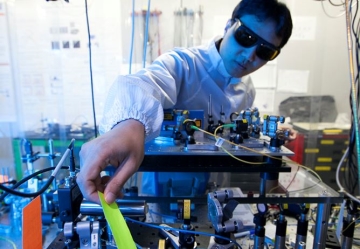
[Reporter's Notebook] What is the relationship between quantum communication and Mozi?
China's choice of the name "Micius" for its quantum communication satellite launched last year is believed to carry meanings of opposition to war and peace. This Micius satellite is China's first independently developed quantum satellite, which was launched into space aboard a rocket called "Chang Zheng 2-D." The fact that the preparation period alone took over 8 years demonstrates how much effort China invested in this project.
2017.07.24by 신윤오 기자
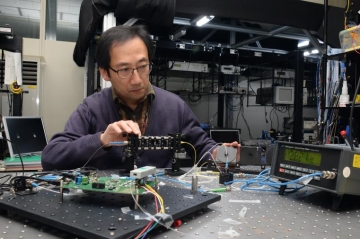
Development of core quantum cryptography components to block hacking and eavesdropping
A core technology for wireless quantum key distribution has been developed in Korea for the first time. The Electronics and Telecommunications Research Institute (ETRI) has developed key component technology required for wireless transmission of encryption keys in quantum key distribution communications. Previously, bulk optical components occupying meter-scale areas were used, but through application of a new integration method, the institute successfully miniaturized components to centimeter-scale or smaller—1/100 the size of existing systems. Quantum key distribution works by reducing the intensity of photons from a laser light source to single-photon level and transmitting them to the receiver to generate encryption keys. The principle involves generating, transmitting, and detecting the polarization and phase quantum states of photons to create encrypted keys for both sender and receiver. Therefore, if hacking or eavesdropping occurs in transit, the quantum state changes, making hacking and eavesdropping theoretically impossible.
2018.01.04by 김지혜 기자
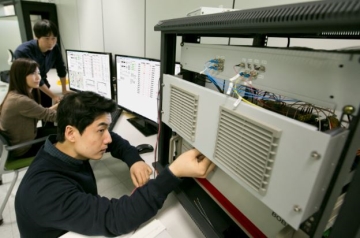
Strengthening competitiveness in core security technologies of the Fourth Industrial Revolution through successful quantum communication
KT announced that it has successfully built a one-to-many quantum key distribution (hereinafter quantum communication) test network in collaboration with KIST (Korea Institute of Science and Technology). Quantum communication is a communication technology that utilizes the non-clonability property of quantum states, allowing the sender and receiver to detect any attempt by a third party to intercept communication information midway, thereby making it unhackable. The test network was configured in KT's commercial network environment with one server and multiple clients simultaneously exchanging quantum cryptographic keys. Unlike existing methods, the network demonstrated quantum communication between multiple locations with a single piece of equipment, showing the feasibility of cost-effective network construction.
2018.02.19by 김학준 기자
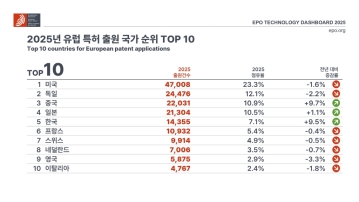
European Patent Applications Surpass 200,000 for the First Time… South Korea Maintains 5th Place, Led by Batteries and Telecommunications
According to the European Patent Office (EPO)'s 'Technology Dashboard 2025', European patent applications last year reached 201,974, surpassing 200,000 for the first time. Korean companies and inventors filed 14,355 applications, representing a 9.5% increase from the previous year and maintaining 5th place by country. Battery, digital communication, and semiconductor technologies led the growth, with Samsung ranking as the top EPO applicant for the second consecutive year and LG reaching 3rd place. The presence of major domestic cities such as Seoul, Suwon, and Yongin was also confirmed. It was also revealed that Korea's European patent strategy is expanding beyond individual technologies to span the entire industry.
2026.03.24by 명세환 기자

SK Telecom First Applies AI-Based Network Operations at Gwanghwamun K-Pop Concert
SK Telecom announced that it applied an AI-based network operation system for the first time at a large-scale K-pop concert held in the Gwanghwamun area of Seoul on March 21st, managing communication quality throughout the event. Mobile data usage during the three hours before and after the concert reached 12.15TB, approximately doubling compared to the same time slot the previous weekend. SK Telecom monitored traffic using the AI system 'A-One' in five-minute and 50-meter units to respond to potential overload situations, while also operating temporary communication facilities and on-site personnel in parallel. This case is interpreted as confirmation of the practical applicability of AI-based autonomous network operation in an environment where demand from dense events and foreign users increases simultaneously.
2026.03.23by 명세환 기자











