


KETI Develops Customized Slicer Software for Tooth Output
 Published2018.04.13 10:40
The Korea Electronics Technology Institute (KETI) announced the development of a customized slicer software, a core technology in 3D printing. The software is optimized for dental printing using DLP 3D printing.
3D printing is a layered process, requiring preliminary work, such as creating supports to support parts that float in midair. Slicer software performs preliminary work, such as rotating the 3D model and placing supports, and generates output data by dividing the 3D model into horizontal layers. This software performs a key function in 3D printing.
Until now, domestic DLP 3D printer manufacturers have been less competitive in price as they have been equipped with general-purpose foreign slicer SW priced at 1.5 to 3 million won. In addition, it was difficult to compete with foreign 3D printers regardless of the excellence of the equipment itself, as it not only caused inconvenience to the dental labs who were the users due to unnecessarily complex functions, but also could not reflect the equipment's unique output know-how, such as fine adjustment of curing time or light amount for each output material.
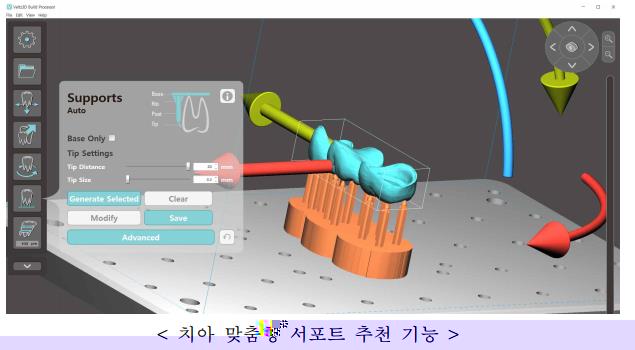
Considering the reality of the 3D printing equipment industry, KETI has focused on developing customized functions specialized for dental laboratories, such as an automatic placement function for printing multiple teeth simultaneously, a tooth support recommendation function, a rotation function for minimizing post-processing, and a slicing and stacked cross-sectional image generation function, along with a simple UI. It is expected that the domestic production of slicer SW will secure the price competitiveness of 3D printers.
Shin Hwa-seon, a senior researcher at KETI's Intelligent Image Processing Research Center who oversaw the technology development, said, "This slicer SW is based on a slicing engine developed with government support, and by additionally integrating a 3D rendering engine, it is a SW that can be specialized to meet corporate needs in the future," adding, "We plan to continuously add new functions such as automatic support generation in the future."
In addition, he said, “The slicing engine technology developed by KETI can be utilized in various 3D printing fields such as not only dental but also automobiles, aviation, and shipbuilding, and we expect that it will contribute to securing global competitiveness in the 3D printer equipment field for domestic small and medium-sized enterprises.”
The core technology of KETI's '3D printing slicing engine' was developed as a project for 'development of a smart slicer customized for domestic popular 3D printers' supported by the Ministry of Science and ICT, and this dental customized slicer SW was developed as a corporate consignment project of Hephzibah and is currently being bundled with Hephzibah equipment..
Comments
Related news

KETI-SIMT Collaboration Establishes Korea-China Certification Infrastructure for Air Appliances
The Korea Electronics Technology Institute (KETI) announced that it has signed a memorandum of understanding with the Shanghai Institute of Measurement and Testing (SIMT) at the China Beijing Zhaoyuandai to achieve mutual recognition of analysis testing and product certification for air appliances. With this agreement, domestic companies in the air appliances sector are expected to reduce the time and costs required for China's Compulsory Certification (CCC) and voluntary certification (CQC) when entering the Chinese market in the future.
2017.12.22by 김지혜 기자

KETI and Smart Factory Activation Partnership on Testing and Certification Technologies
The Electronics and Telecommunications Research Institute (KETI) announced that it has signed a memorandum of understanding with the Public-Private Joint Smart Factory Promotion Group (KOSF) and TÜV SÜD Korea at the Korea Chamber of Commerce and Industry for technical cooperation in smart factory testing and certification. The government has been making efforts to supply and disseminate smart factories since 2014. Currently there are approximately 5,000 smart factories, with plans to increase this to 20,000 by 2022. The goal is to elevate the current level, which is limited to production history tracking and management of specific processes or partial automation, to an advanced smart factory level capable of customized flexible production. Testing and certification is the starting point for industry activation. This is because test results on interoperability and compatibility among various products—including equipment, networks, energy, security, and other components that implement smart factories—serve as a credential enabling related companies to smoothly enter the market. However, since smart factory-related technologies are diverse and standardization efforts are underway with international standards in mind (IEC, ISO, IIC, etc.), the reality is that responding to global certification is challenging not only for SMEs but even for large enterprises.
2017.12.28by 김지혜 기자
KETI Develops Environment-Adaptive Wrap-Around View Monitoring Platform
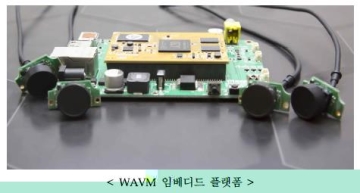
The Korea Electronics Technology Institute (KETI) has announced the development of a WAVM (Wrap-Around View Monitoring) platform that combines multiple camera feeds in real-time to generate customized omnidirectional video according to environmental conditions. WAVM is a technology that mounts cameras on the front, rear, left, and right of a vehicle to create video from a bird's-eye view perspective, as if someone is looking down at the vehicle from above. It is easy to understand by imagining the perspective when playing a driving game—not from the viewpoint of being inside the vehicle, but from a perspective where you can see both the vehicle and surrounding roads while driving. Because blind spots are eliminated, it is a core technology already equipped as standard on high-end vehicles.
2018.04.06by 김지혜 기자
.jpg)
SalePoint Signs Multi-Year Partnership Agreement with AWS… Promoting Identity Security that Integrates Even AI Agents
Sailpoint has entered into a multi-year strategic partnership agreement with AWS and is moving forward with establishing an integrated governance system that manages both human and non-human identities together. The plan is to consistently manage access permissions in an environment where AI agents are increasing as work execution entities, while applying the principle of least privilege and automated policy enforcement. The two companies plan to jointly expand capabilities to manage the identities of various entities, including AI agents, within a single layer in the AWS environment. This collaboration is interpreted as a move to design security and governance together in corporate environments where AI adoption is expanding.
2026.03.26by 배종인 기자
.png)
Databricks Unveils Open AI Security Monitoring 'Lakewatch'
Databricks entered the security market on March 24 by unveiling LakeWatch, an open-source agentic SIEM. The core functionality of this product is to integrate and analyze security, IT, and business data in a single environment to support AI-based threat detection and investigation. The company explained that it reduces the limitations of existing security operations centers, which have had to forgo some data due to high cost structures, and enables large-scale data analysis and automation based on open formats and ecosystems. LakeWatch is currently offered as a private preview, with Adobe and Dropbox mentioned as early customers. Databricks also announced an expanded partnership with Anthropic as well as the acquisition of Antimatter and SiftD.ai.
2026.03.26by 배종인 기자











