


Limelight Networks Releases CDN Implementation Checklist
 Published2018.04.17 16:24
Limelight Networks has released a checklist of things to consider when implementing a CDN.
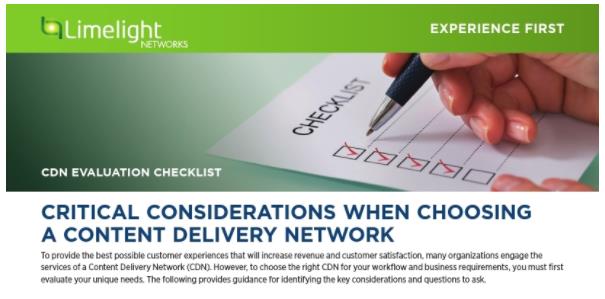
Key points of the "CDN Implementation Checklist" include: Establish an implementation policy by specifying various requirements tailored to the organization's circumstances; Develop an operational plan tailored to the goals of the CDN system, including new and additional implementations; and Ensure professional services and consulting support are available to ensure stable operation and expansion after CDN implementation.
1. Establish an adoption policy by specifying the various requirements specific to your organization's circumstances: Every application may present unique challenges when delivering online. When adopting a CDN, it's important to understand the characteristics required to address these unique challenges and the key metrics that describe these characteristics. While not exhaustive, the following are common content delivery applications and considerations.
First, you need to check your geographical coverage, which can be global, regional, or local. To ensure fast and reliable content delivery, it's crucial to select a CDN with network points of presence (PoPs) in your customer's area. Each PoP must have sufficient transmission capacity to ensure customers receive the fastest service possible. Additionally, to eliminate "last-mile" bottlenecks across the entire connection from the CDN to the user's internet, you should choose a CDN that has robust service agreements with the last-mile networks and local Internet Service Providers (ISPs) that serve your customers.
CDN adopters must also consider the storage location of content, both on-premises and within the cloud. When a user requests content not stored in the cache (temporary storage), the CDN must be able to retrieve it from "origin storage," a high-performance cloud-based storage service, regardless of its storage location. To ensure the fastest content delivery in the event of a cache miss, select a CDN that supports storage replication across multiple regions and bypasses internet congestion that delays content retrieval.
You should also carefully consider whether it has the capabilities to support the types of content you need to deliver, such as web content, file distribution, and live and on-demand video (VoD).
With security issues becoming a hot topic, it's important to consider whether your content security requirements, including TLS/SSL encryption, DDoS attack protection, Web Application Firewall (WAF) protection, and video Digital Rights Management (DRM), can be met. For example, to prevent content interception during transmission, choose a CDN that supports full TLS/SSL encryption across the entire network. A CDN that incorporates DDoS protection on the same network used to deliver traffic should offer the fastest performance in the event of an attack. Additionally, if you are delivering video content, you should adopt a CDN that integrates DRM and content protection features.
You should also consider video content delivery capabilities, including online video platforms that manage video content, live video streaming, and VoD transcoding and packaging. If you require video content management capabilities within an online video platform (OVP), choose a CDN with OVP capabilities, eliminating the complexity of utilizing a separate system to manage and deliver video content. To maximize viewership and easily produce content in multiple streaming formats, choose a CDN with integrated transcoding/transmuxing capabilities, which allows you to use a single input file and generate multiple output formats and bitrates as needed.
2. Develop an operational plan tailored to the goals of your CDN system, including new and additional implementations: Whether you're implementing a CDN for the first time, migrating to a new CDN, or implementing a multi-CDN strategy, a successful implementation requires strategic planning.
For businesses new to CDNs, content delivery via a CDN presents many challenges, and the learning curve can be steep. Finding a CDN partner that supports the development of a suitable solution and a phased implementation strategy is crucial. Therefore, a shortlist of content and regional requirements should be developed to focus on the basics, followed by a longer-term plan that guides the decision-making process. CDN candidates should then be evaluated based on expertise, service and support solutions, and technical capabilities. The optimal CDN should be able to execute your vision and support a smooth transition from your current approach. A CDN provider should offer expert support and turnkey solutions on an ongoing basis, and should be able to design, build, and maintain custom solutions leveraging existing internal resources.
When replacing or adding a CDN, implementing load balancing across multiple CDNs can yield various business benefits. When migrating from one CDN to another, the new CDN should scale up and the old CDN should scale down seamlessly to ensure service continuity. When deploying a multi-CDN, consider a load balancing strategy and decide whether to allocate traffic to multiple CDNs at a fixed rate, balance based on performance, or adjust based on factors such as region. Furthermore, when deploying a new CDN, consider the impact on existing services, such as origin storage, DNS, and other key components. Choose a method to maintain existing components and successfully migrate to the new one without disrupting existing operations.
3. Check for professional services and consulting support to ensure stable operation and expansion after implementing a CDN: After starting content delivery, it's crucial to choose a CDN partner that provides ongoing support and services. This ensures maximum uptime and efficient traffic operation, and allows you to respond to ever-changing business requirements.
First, to prevent downtime and respond quickly to incidents, you should carefully review the CDN provider's 24/7 real-time support, the provider's support costs, whether support is provided in multiple regions and languages, whether the provider has a 24/7 CDN network operations center that ensures efficient traffic delivery, and whether the CDN provider provides an appropriate customer notification system for planned maintenance and service incidents.
You should also check whether the CDN provider provides a set of APIs that support 'self-provisioning', which automatically configures and allocates IT resources when needed for efficient operation, and whether it provides a web-based GUI for setup and management.
Additionally, it's important to check whether the CDN provider offers professional services and consulting support when implementing new features to meet evolving business needs. For example, you should consider whether the CDN provider's professional services team can help you optimize your initial deployment, provide specialized support for major events, and offer workflow consulting and best practice implementation assistance, as well as problem-solving solutions based on case studies from other customers.
Park Dae-seong, Country Manager of Limelight Networks Korea, explains, "Choosing the optimal CDN begins with identifying the most critical features for a specific workflow and determining the vendor best suited to meet your needs. An implementation plan must be developed to ensure efficient and timely deployment while minimizing operational impact. "Support and implementation services are critical components of the decision-making process and crucial to continued success. By considering all these factors during your vendor selection process, you will be able to find the optimal partner for long-term success."
Comments
Related news

Limelight Networks Sets Out to Target Domestic CDN Market
Limelight Networks announced that it successfully held the "Limelight Seminar for Next-Generation Business Leaders" at the Maple Room of the Grand Intercontinental Hotel in Samseong-dong, with the participation of CxOs and key executives from corporations and public institutions. At the "Limelight Seminar for Next-Generation Business Leaders," Limelight stated that it will strengthen its strategy to capture the video streaming market by providing robust cloud security services and offering customized services based on high-definition, low-latency global CDN private networks, while expanding its market presence by pursuing the domestic CDN market. The seminar introduced innovative Limelight services for next-generation business leaders, "cloud security" as an essential element for successful business, and successful business cases both domestically and internationally.
2018.03.29by 김지혜 기자

Limelight Releases '2018 Global Online Gaming Status' Report
# Key Findings from '2018 Online Gaming Status Report' As video game and esports websites continue to proliferate, the rate of viewers watching other players engage in video games is also increasing. Globally, young gamers aged 18-25 are watching other players' gaming sessions for an average of 3 hours and 25 minutes per week. This is approximately 1 hour more than the 2 hours and 33 minutes spent watching traditional sports. Korean gaming users allocate nearly half (48%) of their weekly time—over 2 hours—to watching other players' video game content, representing the highest ratio globally. Globally, gaming users cited 'fast load times' and 'quick performance' as the most important factors in gameplay experience; however, over three-quarters (77%) of respondents reported dissatisfaction during the video game download process. Additionally, more than half of gaming users (57%) stated they would not engage in online gaming or make purchases on websites that have previously experienced security breaches, establishing security as a critical consideration. Security concerns were particularly pronounced in Korea and France, with Korea recording the highest refusal rate at 71.2% and France following at 68% when asked whether they would visit gaming websites that have experienced security incidents.
2018.04.02by 김학준 기자
Limelight Unveils Ultra-Low Latency Live Streaming Solution with Sub-Second Latency
Limelight Networks announced that it will showcase enhanced capabilities of its 'Limelight Video Platform and Video Delivery Service' and a new 'Live Streaming Solution' based on WebRTC (Web Real-time Communication) that implements sub-second (under 1 second) latency at 'NAB 2018,' the world's largest broadcast equipment exhibition. The WebRTC-based Live Streaming Solution implements sub-second latency based on scalable open technology supported by standard web browsers without requiring additional special plugins, and enables video streaming from anywhere in the world to any region. With WebRTC streaming technology integrated into the Limelight Orchestrate Platform, content distributors can implement live video streaming workflows such as sports broadcasting, gambling, gaming, and live auctions that require low latency. Steve Miller-Jones, Senior Director of Product Management at Limelight Networks, stated, "Limelight enables customers to deliver large-scale live and VOD content at broadcast-quality levels across all devices," and added, "WebRTC-based low-latency live streaming implements sub-second latency without additional plugin installation, and for the first time in the industry, enables seamless delivery of global live video natively supported across all major browsers."
2018.04.09by 김학준 기자
.jpg)
SalePoint Signs Multi-Year Partnership Agreement with AWS… Promoting Identity Security that Integrates Even AI Agents
Sailpoint has entered into a multi-year strategic partnership agreement with AWS and is moving forward with establishing an integrated governance system that manages both human and non-human identities together. The plan is to consistently manage access permissions in an environment where AI agents are increasing as work execution entities, while applying the principle of least privilege and automated policy enforcement. The two companies plan to jointly expand capabilities to manage the identities of various entities, including AI agents, within a single layer in the AWS environment. This collaboration is interpreted as a move to design security and governance together in corporate environments where AI adoption is expanding.
2026.03.26by 배종인 기자
.png)
Databricks Unveils Open AI Security Monitoring 'Lakewatch'
Databricks entered the security market on March 24 by unveiling LakeWatch, an open-source agentic SIEM. The core functionality of this product is to integrate and analyze security, IT, and business data in a single environment to support AI-based threat detection and investigation. The company explained that it reduces the limitations of existing security operations centers, which have had to forgo some data due to high cost structures, and enables large-scale data analysis and automation based on open formats and ecosystems. LakeWatch is currently offered as a private preview, with Adobe and Dropbox mentioned as early customers. Databricks also announced an expanded partnership with Anthropic as well as the acquisition of Antimatter and SiftD.ai.
2026.03.26by 배종인 기자











