



ETRI Develops Core Technology for E-Books for the Visually Impaired
 Published2018.04.19 12:34
Create a standardized way to convey content such as formulas, tables, graphs, and pictures.
The Electronics and Telecommunications Research Institute (ETRI) announced that it has developed a core source technology that allows the visually impaired to freely listen to general e-books based on EPUB, an international standard technology, through the Ministry of Culture, Sports and Tourism's (MCST) 'Development of E-book Service Platform Technology for Accessibility for the Disabled' project.
This technology is currently being trademarked under the name "SEA Platform" and is in the process of commercialization. The research team is also planning a pilot service for the visually impaired this year, with the support of the National Library for the Disabled.
Until now, the only ways for the visually impaired to access books have been Braille, audio books, and DAISY, a specially designed book for the visually impaired. However, providing content through these methods required separate reprocessing, limiting the annual availability to only 4-10% of new books.
The research team confirmed that although visually impaired people can understand some text information by using the screen reader function on their smartphones that conveys the content on the screen through voice, there is no standardized method for conveying content such as formulas, tables, graphs, and pictures. To solve this problem, the research team created pronunciation rules specialized for Korean to express learning content such as formulas and tables.
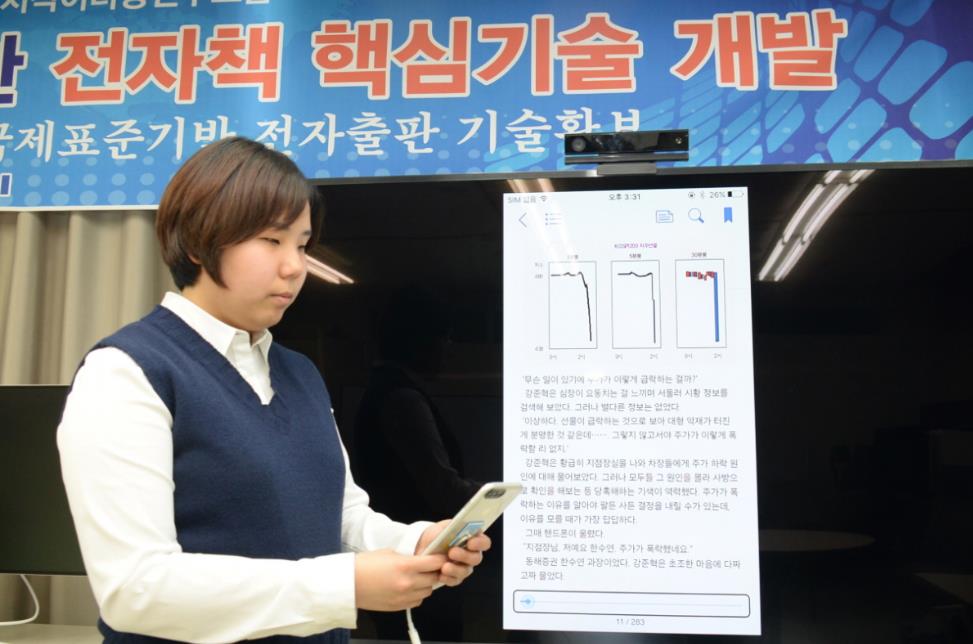
Therefore, tables, figures, and formulas in books, which had been considered difficult problems, were made available to visually impaired people through voice.
ETRI explained that this technology consists of four core technologies: converter, author, reader, and service platform technology.
A 'conversion tool' is a technology that converts existing books into standard e-book formats that can be understood by the visually impaired. Additionally, the 'authoring tool' allows e-book creators to create e-books that comply with standard accessibility guidelines from the initial authoring stage.
'Reader' is an e-book viewer that not only provides the functions necessary for non-disabled people to read e-books, but also allows visually impaired people to use the same functions by using touch input and text-to-speech (TTS) output functions to navigate e-books and provide functions such as paused reading or continuous reading.
A 'service platform' is a concept of an e-book providing server that allows users to search for, download, and read e-books.
With this, ETRI announced that it has developed ▲a text reading function through TTS ▲an e-book viewer based on interaction for the disabled ▲an authoring tool and conversion tool that can easily author and convert e-books to support accessibility for the disabled, in order to provide the visually impaired with equal access to information and the right to education.
Ultimately, in order to make it easier for visually impaired people to access books, the entire platform was created by creating a standard protocol based on e-books so that visually impaired people can easily access and listen to them.
ETRI stated that it has currently developed technology to convey middle school-level formulas and tables, but that significant effort is needed to convey more complex and challenging formulas, tables, graphs, and complex diagrams verbally, even in professional textbooks. They also added that it will take time for visually impaired people to adapt to this new technology, moving beyond the methods they have been using.
ETRI's Gil Yeon-hee, the principal researcher responsible for this project, said, "Companies distributing e-books do not have their own reader terminals that can be used by people with disabilities for reading, so people with disabilities are having difficulty reading. “General companies also need to pay more attention to e-book accessibility for the welfare of people with disabilities,” he said.
Comments
Related news
Transparent and flexible electrodes made with graphene
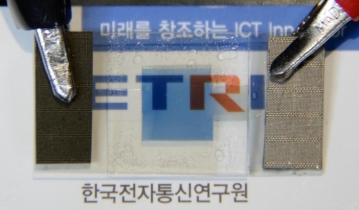
The Korea Electronics and Telecommunications Research Institute (ETRI) has successfully developed flexible and transparent electrodes, which have been cited as the greatest challenge in manufacturing flexible wearable devices. ETRI has developed an electrochromic device that changes color in just 0.5 seconds by stacking graphene material in four layers. This is expected to accelerate the wearable implementation of various display devices. ETRI also developed electrochromic technology in 2013 and created smart windows. The technology has since been transferred and is currently in preparation for commercialization. It is expected to be applied to rearview mirrors to prevent glare from headlights of trailing vehicles during driving.
2018.04.06by 김지혜 기자
.jpg)
ETRI Showcases Latest Broadcasting Equipment Technology at NAB
Domestic researchers have developed ultra-high definition (UHD) transmission technology that led to international standardization, and this technology is now being transferred and commercialized in TVs. The Electronics and Telecommunications Research Institute (ETRI) participated in the 'National Association of Broadcasters (NAB) 2018,' the world's largest broadcasting equipment exhibition held at the Las Vegas Convention Center in the United States from the 9th for four days, and showcased the latest broadcasting technologies. ETRI first presented ATSC 3.0-based single frequency network (SFN) technology as a new broadcasting and telecommunications media technology that is garnering global market attention. This technology is for constructing broadcasting networks. The transmission and reception equipment has been commercialized and is being used worldwide.
2018.04.09by 김지혜 기자
.jpg)
ETRI succeeds in transmitting wireless quantum cryptography over a distance of 100 meters.
Domestic researchers have successfully developed and systematized key integrated components for wireless quantum key distribution using proprietary technology, demonstrating the transmission and recovery of quantum signals in real-world environments. The Electronics and Telecommunications Research Institute (ETRI) announced that it has successfully transmitted and recovered quantum signals (photons) over a distance of more than 100 meters between the rooftop of Building 1 of the institute, not only at night but also during daytime, using wireless quantum key distribution technology, a next-generation secure communication technology that can fundamentally block hacking.
2018.04.13by 김지혜 기자
.jpg)
SalePoint Signs Multi-Year Partnership Agreement with AWS… Promoting Identity Security that Integrates Even AI Agents
Sailpoint has entered into a multi-year strategic partnership agreement with AWS and is moving forward with establishing an integrated governance system that manages both human and non-human identities together. The plan is to consistently manage access permissions in an environment where AI agents are increasing as work execution entities, while applying the principle of least privilege and automated policy enforcement. The two companies plan to jointly expand capabilities to manage the identities of various entities, including AI agents, within a single layer in the AWS environment. This collaboration is interpreted as a move to design security and governance together in corporate environments where AI adoption is expanding.
2026.03.26by 배종인 기자
.png)
Databricks Unveils Open AI Security Monitoring 'Lakewatch'
Databricks entered the security market on March 24 by unveiling LakeWatch, an open-source agentic SIEM. The core functionality of this product is to integrate and analyze security, IT, and business data in a single environment to support AI-based threat detection and investigation. The company explained that it reduces the limitations of existing security operations centers, which have had to forgo some data due to high cost structures, and enables large-scale data analysis and automation based on open formats and ecosystems. LakeWatch is currently offered as a private preview, with Adobe and Dropbox mentioned as early customers. Databricks also announced an expanded partnership with Anthropic as well as the acquisition of Antimatter and SiftD.ai.
2026.03.26by 배종인 기자











