



Why is the domestic LBE market growing larger than the home VR market?
 Published2018.04.23 17:39
The LBE VR experience will eventually extend to the home VR market.
Last month, KT opened a VR game room called 'Bright' in Sinchon. GPM also expanded its 'Monster VR' store at COEX, following its location in Songdo. VR gaming is evolving beyond simple VR experiences to include wireless walking attraction games, expanding into the form of theme parks.
Moon Seong-hyeon, Director of Brotin, explained, “The number of VR rooms, which was around 150 at the end of 2017, increased to about 250 in just the first quarter of this year,” adding, “The number of people enjoying the game is increasing despite the hourly billing. VR rooms can be operated on a small scale in the form of pop-up stores, or on a large scale with many rooms.”
Why is the market shifting toward LBE (location-based entertainment) rather than the home VR market?
Choi Jeong-hwan, Vice President of Skonec Entertainment, stated, “In the early stages of VR, the hardware market developed first. However, the price was a burden for individual users to purchase devices, and there was a lack of usable content.” He added, “Although there were many content developers, they struggled to operate stores due to a lack of performance.” Consequently, he said, the company prioritized targeting LBE VR to enable customers to experience VR.
Park Sung-joon, CEO of GPM, also stated that they did not start with the commercial viability of the offline market in mind from the beginning. It became an opportunity to run large shopping malls and theme parks amidst the limitations of revenue from online content.
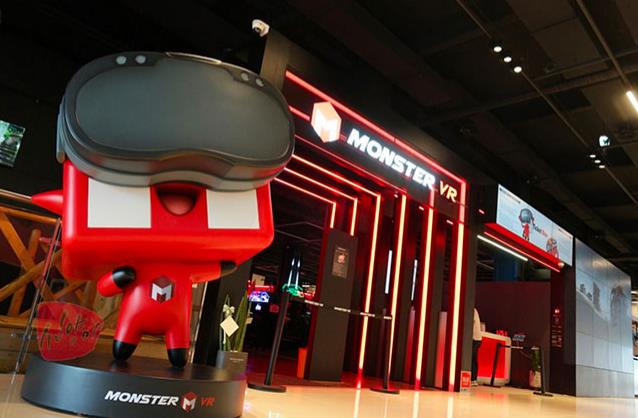
As large shopping malls and outlets continued to face similar competition, they stepped forward to utilize VR as cultural content to attract online customers back to offline spaces. CEO Park Seong-jun stated, "The difficult issue we faced while running the VR experience zone business was real estate."
VR experience zones require a lot of space and high installation costs. On the other hand, it is a business with a fixed maximum number of daily visitors and revenue. He added, “We opened at Triple Street in Songdo, Incheon, and this time we opened on the first basement floor of COEX. The commercial areas of the two locations are completely different.”
The point is that in established neighborhood commercial districts, repeat visits by families influence revenue, whereas in high-traffic areas like COEX, this impact is less significant. CEO Park emphasized, "Currently, access is available in the form of an all-access pass. As a result, the influence of the commercial district where the store is located cannot be ignored."
VR rooms are relatively expensive compared to services such as PC cafes, karaoke rooms, and escape room cafes. Regarding this, Vice President Choi Jeong-hwan explained, "Investment costs are higher than for past services. Consequently, usage fees are inevitably higher." He added, "Currently, we are in a situation where labor costs are unavoidable regarding safety and how consumers can use VR devices without guidance." He added that prices would drop as hardware devices become wireless and consumers become accustomed to VR content.
Although the number of places to enjoy VR offline has increased, accessibility is still not easy. Regarding future market changes, Vice President Choi stated, “I think the home VR market and the LBE VR market will grow sequentially.” He added, “Since few people own VR devices yet, they have no choice but to enjoy it offline, and it is important to expand experiences in this way. Once devices become more widely available and multiplayer capabilities are established, the market will expand to include home use.”
CEO Park also predicted, “Urban theme parks will grow due to their easy accessibility, diverse content, and the advantage of being enjoyable for the whole family,” adding, “Although the experience provided by LBE VR and home VR are different, they will influence each other and grow together.”
Comments
Related news
KT and Dragonfly Unveil "Special Force VR," a Fully Wireless VR Game Using 5G Technology at MWC 2018
KT and Dragonfly announced that they will showcase 'Special Force VR: UNIVERSAL WAR (hereinafter 'Special Force VR')', the world's first multiplayer VR game incorporating 5G technology, at 'MWC 2018'. 'Special Force', a first-person shooter (FPS) game developed by Dragonfly, is the world's first and globally representative online FPS game that marked a turning point in gaming history. 'Special Force' has achieved mega hits not only in Korea but worldwide, becoming the standard for online FPS games, and is currently providing service to over 100 countries across the globe.
2018.02.21by 김지혜 기자
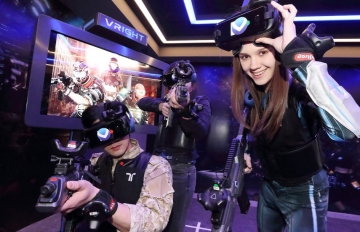
Now enjoy a VR theme park in Seoul
KT and GS Retail held the opening ceremony for 'VRIGHT,' an urban VR theme park, on March 6th and officially opened the Shinchon location. At VRIGHT, visitors can experience approximately 50 types of VR content including 'Special Force VR: UNIVERSAL WAR,' which reimagines the first-person shooter game 'Special Force' as a VR game, and 'Flying Jet,' among others. VRIGHT, where KT and GS Retail held the official opening event, is running a 30% discount promotion on weekdays throughout March as an opening commemoration. For more details, please visit the website (www.VRIGHT.com).
2018.03.06by 김지혜 기자
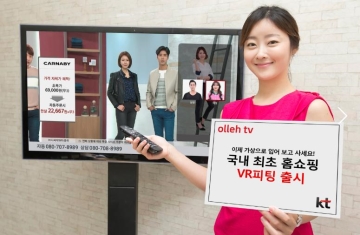
KT Introduces 'VR Fitting Service' for Home Shopping Apparel Try-On
KT announced that it will debut Korea's first 'Home Shopping VR Fitting Service' in partnership with Hyundai Home Shopping and Shinsegae TV Shopping through its IPTV service 'Olleh tv'. The 'Home Shopping VR Fitting Service' is an immersive T-Commerce service that allows customers to virtually try on clothing products being broadcast live on home shopping channels through 3D models and avatars using only remote control. KT will introduce the service as a pilot program on Shinsegae Shopping (Channel 2) and Hyundai Home Shopping+Shop (Channel 36) to customers using the 'Olleh tv Live' reception method among 'GigaGeni' and 'Olleh tv UHD' product offerings.
2018.03.27by 김지혜 기자
ESP32 Development Environment Selection and GPS Application Implementation
The ESP32 is a microcontroller that integrates Wi-Fi, Bluetooth, 12-bit ADC, capacitive touch, PWM, DAC, and UART in a single SoC. However, the abundance of features does not by itself solve the designer's problems. The real challenges lie in selecting the appropriate development environment, determining which pins can be used and which must be avoided, and converting raw data from modules into usable information. This document addresses ESP32 peripheral constraints (ADC2 and Wi-Fi coexistence limitation, UART1 occupancy, ADC non-linear regions), the trade-offs between Arduino IDE and ESP-IDF, and the process from connecting NEO-6M/NEO-M8N GPS modules to UART2, parsing NMEA sentences, and visualizing routes in Google Earth, all organized based on documented references.
2026.10.12by 편집부

MIPI CSI-2, DSI-2, C-PHY, D-PHY Test Solution Technical White Paper
The MIPI interface adopts a burst mode that transitions between low-power (LP) and high-speed (HS) states for low-power consumption, and in return, strict timing rules are imposed on state transitions. Additionally, the high-speed section operates as a packet-based protocol with headers, ECC, and CRC, so verification engineers must handle waveforms and protocols simultaneously. Traditional configurations combining general-purpose oscilloscopes and AWGs reveal limitations in setup complexity, measurement uncertainty, and lack of reproducibility when faced with these requirements. This white paper, based on webinar materials, organizes the structure of this problem and describes how the SV5C-DPTXCPTX generator for receiver testing and SV5C-DPRXCPRX analyzer for transmitter testing integrate state transition testing, stressed eye testing, and protocol analysis into a single bench, along with their application boundaries.
2026.10.12by 편집부











