


ETRI Resolves Traffic Issues with 4x Faster Network Technology
 Published2018.04.27 11:34
The Electronics and Telecommunications Research Institute (ETRI) announced that it has succeeded in developing a fingernail-sized (1.3cm × 1.1cm) 400Gbps optical receiver module applicable to switching systems in large-capacity, mega data centers, and has transferred the technology to a related company.
This receiver is plugged into an optical transceiver to enable optical transmission, mounted on a line card, and embedded within a switching system, and is scheduled to be utilized in data centers.
To address traffic issues caused by the data big bang, ETRI has quadrupled the data transmission capacity per unit module from the existing 100Gbps to 400Gbps. Instead of the existing NRZ (No Modulation Zone) method, which sends 1 bit at a time, it adopted PAM-4 (4-level High-order Modulation), a next-generation high-efficiency transmission method that sends 2 bits at a time. This effectively makes the transmission speed four times faster.
With this, the research team reduced the number of components by half, decreased the footprint by more than 40%, and reduced power consumption by more than 25%. They also expect to reduce module costs by half.
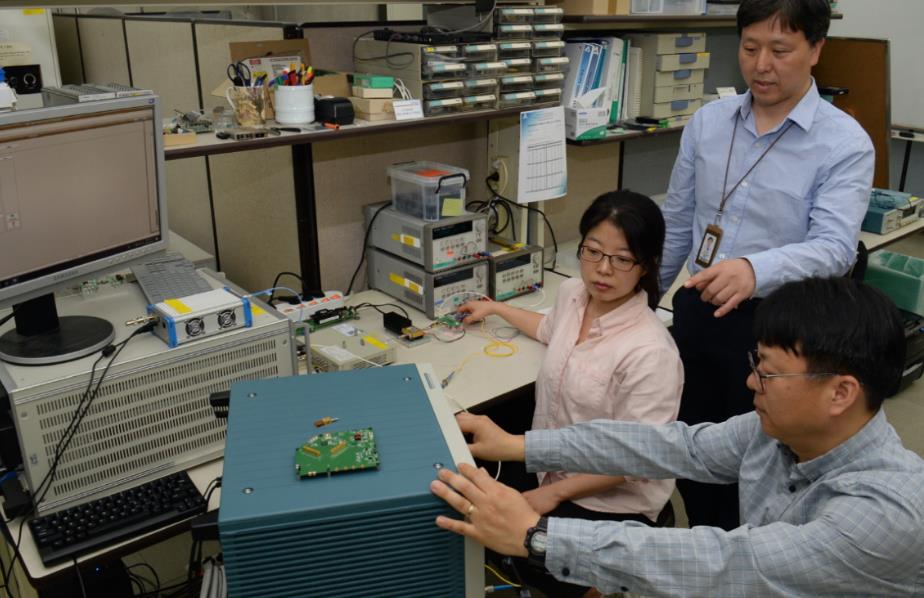
The optical receiver module developed by the research team consists of an optical input, an optical multiplexer, a photodiode, and an electrical signal amplifier. They explained that the core of the optical receiver module technology lies in optical coupling technology and high-speed electrical signal interface technology.
Optical coupling technology refers to a technology that enhances optical performance during the process from the optical input to the photodiode. It reduces optical signal loss and minimizes inter-channel noise. ETRI announced that it has succeeded in localizing key components, such as parallel beam generators and lenses within optical receivers, in cooperation with domestic small and medium-sized enterprises.
High-speed electrical signal interface technology is a technique that amplifies the output signal of a photodiode and connects it to the outside while minimizing signal loss and distortion; therefore, ensuring linearity to maintain a uniform signal amplitude as the PAM-4 signal propagates is crucial.
Along with a 400Gbps optical receiver module, the research team simultaneously developed PAM-4 signal processing technology that generates and restores PAM-4 electrical signals. The technology was transferred to OISolution Co., Ltd.
ETRI announced that companies that received technology transfers are already receiving offers from overseas, and that plans for foreign exports are expected to materialize in the second half of this year.
During the development of this technology, the research team filed six key patents domestically and internationally regarding technologies to improve optical coupling efficiency and the practical application of PAM-4 modulation transmission and reception technology. They stated that they plan to further develop a 400Gbps optical transmitter this year to secure technology at the level of global leading companies and drive domestic small and medium-sized enterprises.
In addition, global data center IP traffic is projected to increase approximately threefold from 6.8 zettabytes (ZB) annually in 2016 to 20.6 ZB annually in 2021, at an average annual rate of 24.7%. Furthermore, the global data center optical transceiver market is predicted to grow at an average annual rate of 10%.
Yang Seon-hee, Head of the Network Research Division at ETRI, explained, “We expect the 400Gbps PAM-4 optical transceiver market to open up within the next two to three years. Securing 400Gbps PAM-4 optical receiver technology will be a new opportunity to create high added value.”
Comments
Related news
.jpg)
ETRI Showcases Latest Broadcasting Equipment Technology at NAB
Domestic researchers have developed ultra-high definition (UHD) transmission technology that led to international standardization, and this technology is now being transferred and commercialized in TVs. The Electronics and Telecommunications Research Institute (ETRI) participated in the 'National Association of Broadcasters (NAB) 2018,' the world's largest broadcasting equipment exhibition held at the Las Vegas Convention Center in the United States from the 9th for four days, and showcased the latest broadcasting technologies. ETRI first presented ATSC 3.0-based single frequency network (SFN) technology as a new broadcasting and telecommunications media technology that is garnering global market attention. This technology is for constructing broadcasting networks. The transmission and reception equipment has been commercialized and is being used worldwide.
2018.04.09by 김지혜 기자
.jpg)
ETRI succeeds in transmitting wireless quantum cryptography over a distance of 100 meters.
Domestic researchers have successfully developed and systematized key integrated components for wireless quantum key distribution using proprietary technology, demonstrating the transmission and recovery of quantum signals in real-world environments. The Electronics and Telecommunications Research Institute (ETRI) announced that it has successfully transmitted and recovered quantum signals (photons) over a distance of more than 100 meters between the rooftop of Building 1 of the institute, not only at night but also during daytime, using wireless quantum key distribution technology, a next-generation secure communication technology that can fundamentally block hacking.
2018.04.13by 김지혜 기자

ETRI Develops Core Technology for E-Books for the Visually Impaired
The Electronics and Telecommunications Research Institute (ETRI) announced that it has developed core foundational technology that enables visually impaired individuals to freely listen to general e-books based on EPUB (the international standard technology) through a project sponsored by the Ministry of Culture, Sports and Tourism (MCST) titled "Development of Electronic Book Service Platform Technology for Accessibility of People with Disabilities." Currently, this technology is in the process of trademark registration under the name "SEA Platform" and is preparing for commercialization. With the support of the National Library for the Disabled this year, the research team is also planning to conduct pilot services targeting visually impaired individuals.
2018.04.19by 김지혜 기자
European Patent Applications Surpass 200,000 for the First Time… South Korea Maintains 5th Place, Led by Batteries and Telecommunications
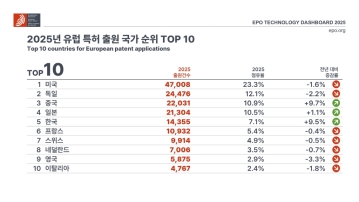
According to the European Patent Office (EPO)'s 'Technology Dashboard 2025', European patent applications last year reached 201,974, surpassing 200,000 for the first time. Korean companies and inventors filed 14,355 applications, representing a 9.5% increase from the previous year and maintaining 5th place by country. Battery, digital communication, and semiconductor technologies led the growth, with Samsung ranking as the top EPO applicant for the second consecutive year and LG reaching 3rd place. The presence of major domestic cities such as Seoul, Suwon, and Yongin was also confirmed. It was also revealed that Korea's European patent strategy is expanding beyond individual technologies to span the entire industry.
2026.03.24by 명세환 기자

SK Telecom First Applies AI-Based Network Operations at Gwanghwamun K-Pop Concert
SK Telecom announced that it applied an AI-based network operation system for the first time at a large-scale K-pop concert held in the Gwanghwamun area of Seoul on March 21st, managing communication quality throughout the event. Mobile data usage during the three hours before and after the concert reached 12.15TB, approximately doubling compared to the same time slot the previous weekend. SK Telecom monitored traffic using the AI system 'A-One' in five-minute and 50-meter units to respond to potential overload situations, while also operating temporary communication facilities and on-site personnel in parallel. This case is interpreted as confirmation of the practical applicability of AI-based autonomous network operation in an environment where demand from dense events and foreign users increases simultaneously.
2026.03.23by 명세환 기자











