



Arm Announces IP Solution to Protect IoT Devices from Physical Threats
 Published2018.05.08 10:19
Arm has announced IP design technology capable of protecting systems from physical attack threats. Now, all Arm IPs incorporating this technology are tagged with a 'P', signifying physical security.
Along with the Cortex-M35P, a high-performance processor that enables embedded security developers to prevent physical tampering and enhance security authentication levels, Arm unveiled the Arm CryptoCell-312P and Arm CryptoIsland-300P, which add physical attack defense capabilities to existing security IP solutions.
IoT security is a multifaceted challenge involving billions of devices, requiring system-wide security measures to protect such a vast number of devices. The diversity of this field is a challenge even for Arm's partners. In response, Arm has announced a new product that enables SoC designers to integrate higher levels of security to provide a core layer of system protection, amidst a growing number of applications requiring protection against physical attack threats.
With the emergence of new use cases, the need has arisen to integrate protection features not only into payment and identity verification applications but also into smart lighting, connected door locks, smart meters, and automotive applications.
Physical attacks target vulnerabilities in the physical implementation of the chip rather than in the software or design phases. These physical attacks are divided into two categories. One is an invasive attack that requires chip depackaging, and the other is a non-invasive attack such as a proximity side-channel attack (SCA). This obtains information through unintended side-channels generated during chip execution.
All of Arm's security IP designed to defend against physical attacks is tagged with 'P', which stands for physical security. The Cortex-M35P is a powerful, high-performance processor that enables embedded security developers to prevent physical tampering and enhance security authentication levels.
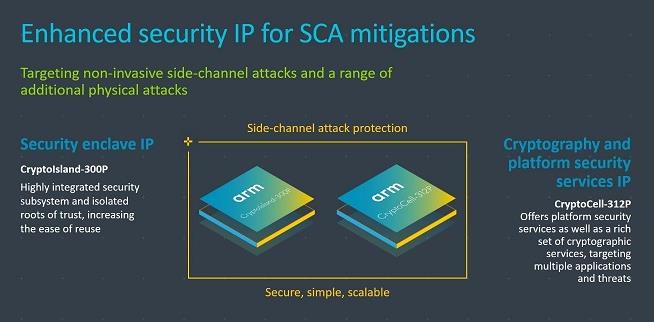
Arm announced that it has applied protection technologies against various Side-Channel Attacks (SCA), including power and electromagnetic field analysis, to its two major existing security IP families, CryptoCell and CryptoIsland. Consequently, partners can now license more secure IP within Arm's security portfolio. The CryptoCell and CryptoIsland solutions have already met the security requirements of various stakeholders in the value chain. With the addition of the newly announced physical attack defense capabilities, these solutions are now capable of addressing a broader range of attack surfaces required by some IoT applications.
Arm has a unique approach to SCA protection, such as adding physical security features to existing products. By reducing information leakage from the source rather than hiding or disguising leaked information, additional safeguards have been established to defend against the advanced methods and analysis tools that hackers use to overcome existing 'information hiding' tactics. Arm's mitigation method is not affected by the fundamental characteristics of the protected target, enabling expansion into new markets.
The design of the Cortex-M35P follows the PSA principle that specific use cases of IoT devices must be analyzed first when defining device security requirements. This enables the assessment of relevant assets and values targeted by attacks before defining the range of various attack methods that could threaten new devices. Through this, designers can determine a multi-layered approach to implementing appropriate levels of security and threat mitigation technologies.
Paul Williamson, Vice President and General Manager of Arm’s IoT Device IP business unit, stated, “The new IP announced by Arm expands Arm’s robust security portfolio and provides partners with more building blocks and flexibility to build security solutions tailored to their applications and markets. This enables the industry to introduce protection solutions for existing and new use cases requiring physical resilience in critical areas.”
Comments
Related news
Arm Presents Universal Industry Framework for Secure IoT
Arm has released Threat Models and Security Analyses (TMSA) documentation and announced Trusted Firmware-M, the first open-source reference implementation firmware compliant with PSA specifications. Through this initiative, Arm provides guidelines to enterprises seeking to define security requirements for public IoT devices and has established the foundation to securely protect the connected devices that will reach one trillion units in the future. In October 2017, Arm announced the Platform Security Architecture (PSA), a universal industry framework that enables all stakeholders in the IoT ecosystem to adopt stronger and expanded security measures and proceed with greater confidence.
2018.03.09by 김지혜 기자

Arm Announces SoC Solution for Developing Secure IoT Devices
Arm has announced the Arm SDK-700 System Design Kit, a new IoT solution that supports fast and secure SoC design and time-to-market. The solution is built on the principles of Platform Security Architecture (PSA) and provides a secure SoC framework foundation for Microsoft Azure Sphere. PSA is built on four core principles comprised of device identity, trusted boot process, secure OTA updates, and certificate-based authentication, and has already gained significant momentum with support from several industry leaders. However, SoC design remains complex, and addressing this can take years. This is a challenge that impedes IoT growth, which can only be achieved when designers are able to bring products to market quickly and securely.
2018.04.17by 김지혜 기자

Arm integrates GlobalSign with Mbed for flexible secure authentication of IoT devices
To realize Arm's vision of a world with one trillion connected devices, the industry needs more than just designing the most efficient and secure semiconductors. It must make it easier to safely develop, deploy, and manage IoT devices throughout their lifecycle. This enables enterprises to leverage the opportunities that IoT data provides and combine it with business data to create valuable business outcomes. Additionally, an ecosystem that continues to grow with participation from approximately 80 partners, including IBM which connects Mbed Cloud with IBM Watson IoT Platform, also supports the Mbed platform. Today, we have integrated Mbed Cloud with Cybertrust and GlobalSign to provide more flexible secure authentication for IoT devices.
2018.04.24by 김지혜 기자
.jpg)
SalePoint Signs Multi-Year Partnership Agreement with AWS… Promoting Identity Security that Integrates Even AI Agents
Sailpoint has entered into a multi-year strategic partnership agreement with AWS and is moving forward with establishing an integrated governance system that manages both human and non-human identities together. The plan is to consistently manage access permissions in an environment where AI agents are increasing as work execution entities, while applying the principle of least privilege and automated policy enforcement. The two companies plan to jointly expand capabilities to manage the identities of various entities, including AI agents, within a single layer in the AWS environment. This collaboration is interpreted as a move to design security and governance together in corporate environments where AI adoption is expanding.
2026.03.26by 배종인 기자
.png)
Databricks Unveils Open AI Security Monitoring 'Lakewatch'
Databricks entered the security market on March 24 by unveiling LakeWatch, an open-source agentic SIEM. The core functionality of this product is to integrate and analyze security, IT, and business data in a single environment to support AI-based threat detection and investigation. The company explained that it reduces the limitations of existing security operations centers, which have had to forgo some data due to high cost structures, and enables large-scale data analysis and automation based on open formats and ecosystems. LakeWatch is currently offered as a private preview, with Adobe and Dropbox mentioned as early customers. Databricks also announced an expanded partnership with Anthropic as well as the acquisition of Antimatter and SiftD.ai.
2026.03.26by 배종인 기자











