



Can the 'Blockchain Promotion Act' revitalize the industry?
 Published2018.05.11 15:52
For the first time in the country, a blockchain-related bill has been proposed.
The Korea Blockchain Industry Promotion Association held a grand forum with the Korea International Trade Association to promote the blockchain industry and proposed the enactment of the 'Framework Act on the Promotion of the Blockchain Industry'.
Representative Hong Eui-rak, who is preparing to propose the Framework Act on the Promotion of the Blockchain Industry, said, “Although blockchain is a core foundational technology of the Fourth Industrial Revolution, the government’s bifurcated policy direction is causing confusion,” adding, “Instead of avoiding the short-term crisis, we must concentrate resources on infrastructure and foster it as a new growth engine.”
The Framework Act on the Promotion of the Blockchain Industry stipulates matters concerning the development of the industry and the promotion of the use of technology. It also defines blockchain as a technology that can be utilized in various fields, such as contracts, authentication, notarization, electronic voting, and distributed storage of personal information, based on concepts such as smart contracts and DAOs, as well as funding using virtual currency.
In addition, the non-financial sector and the financial sector were distinguished. It is stipulated that the Minister of Science and ICT shall be the competent authority for the non-financial sector, and the Chairman of the Financial Services Commission shall be the competent authority for the financial sector. It includes provisions to establish a Blockchain Industry Strategy Committee composed of about 20 members to deliberate and decide on related policies and to monitor and evaluate implementation progress.
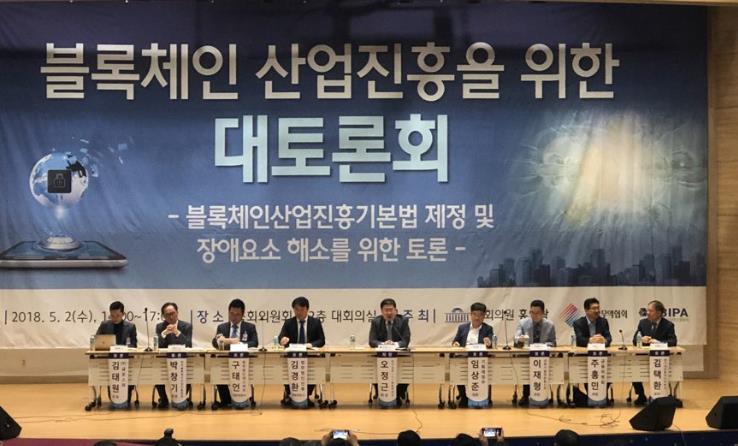
Attorney Koo Tae-eon of Tech & Law pointed out, “Looking at the Promotion Act, digital tokens are given significance as a legal basis, but the level of recognition seems insufficient.” He added, “It is necessary to resolve the relationship with other laws while positively allowing specific systems for issuance and distribution. With only confirmatory provisions, authority is reserved to the executive branch based on legal interpretation, leaving room for disputes.”
Kim Tae-won, CEO of Glosper, argued that expediency must be added to the bill. He stated, “Discussions on the blockchain bill have been delayed due to regulations on cryptocurrencies. To secure global technological competitiveness through blockchain, we must act swiftly.” He added, “The bill contains many items for review, but there is no deadline for the review. Under these circumstances, startups end up waiting indefinitely despite possessing the technology. Expediency must be considered when the bill is proposed.”
Lee Jae-hyung, a division head at the Ministry of Science and ICT, explained, “Since blockchain is a new technology, there are regulations that hinder the spread of its products and services in the market. However, compared to other general industrial promotion sectors, it is still necessary to review whether it is desirable to handle blockchain technology through separate legislation or to treat it with other technologies through comprehensive legislation.”
Following this, Joo Hong-min, a section chief at the Financial Services Commission, was also skeptical about the government taking the lead in handling blockchain technology legislation. He expressed the view that the division into non-financial and financial sectors is also a dichotomy.
Attorney Kim Kyung-hwan of Minhu Law Firm, who was in charge of drafting the bill, explained, “There is still no law regarding big data. This is because there are controversial aspects and social consensus is required. The Framework Act on the Promotion of the Blockchain Industry also took reality into account. Currently, it is impossible to open an account if the terms ‘blockchain’ or ‘cryptocurrency’ are included. I believe the Framework Act can resolve these issues.” He added, “Regarding digital tokens, I saw that standardized laws could be a stumbling block. Since it is impossible to predict what kind of tokens will emerge, we tried to include them comprehensively. The Promotion Act is almost identical to global standards. We focused on passing the bill, believing that including too many new elements would only exacerbate controversy.” He concluded by stating that once enacted, amending it would not be difficult.
Comments 1
1 Comments:
Related news

Ministry of Science and ICT to Discover Excellent Blockchain Use Cases
The Ministry of Science and ICT and the Korea Internet & Security Agency announced that they will pursue pilot projects to discover excellent use cases for blockchain, a core technology of the Fourth Industrial Revolution. Blockchain is a promising future technology that implements the Fourth Industrial Revolution by enhancing data security and transaction efficiency across various industrial sectors. The Ministry of Science and ICT has been conducting pilot projects since 2017 to promote the adoption of blockchain technology across all industries.
2018.03.09by 김지혜 기자
Samsung SDS-EY Han Young Join Hands to Innovate Business-to-Business Transactions in Manufacturing/Logistics/Finance
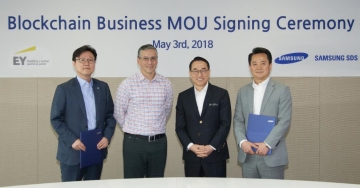
Samsung SDS has established a strategic partnership with EY Han Young, a global accounting and consulting firm, to strengthen its blockchain business that revolutionizes inter-company transactions in the manufacturing, logistics, and financial sectors. EY is a global leader in blockchain consulting and is spearheading business innovation by leveraging blockchain to advance SCM (supply chain management)/ERP (enterprise resource planning) systems and drive enterprise operations transformation based on MES (manufacturing execution) integrated with IoT.
2018.05.03by 김지혜 기자
'IOST', a blockchain platform with fast processing speeds, enters the Korean market
"Based on blockchain technology with information processing speeds enhanced by hundreds of times or more compared to existing systems, we will build a 'Web 3.0 internet' ecosystem that is safe from personal information leaks and hacking." Blockchain specialist company IOS has announced its Korea market entry with IOST (IOST), a blockchain platform based on rapid information processing speeds. IOST is a platform similar to Ethereum that aims to swiftly replace everyday internet services with blockchain-based alternatives to enhance security, personal information protection, and reliability. The project plans to progressively replace internet services such as games, social networks (SNS), and messaging applications with blockchain-based services to upgrade previously vulnerable security and personal information protection.
2018.05.09by 김지혜 기자
Nvidia invests $5 billion in Intel
NVIDIA and Intel, leaders in global AI computing technology, are now forging ahead in providing cutting-edge solutions through NVLink-based architecture integration. NVIDIA and Intel have officially announced a strategic partnership and stated that they will jointly develop customized data center and personal computing products to accelerate diverse applications and workloads ranging from hyperscale to enterprise and consumer markets, thereby laying the foundation for the next generation computing era.
2025.09.22by 배종인 기자
.jpg)
Applied Materials Launches Environmental Protection Campaign to Mark World Cleanup Day
Applied Materials Korea (CEO Park Kwang-seon) is carrying out environmental cleanup activities with employees and their families around the Dongtan Sinricheon area on the occasion of World Cleanup Day, evolving into a company that engages with the local community beyond technological innovation.
2025.09.22by 명세환 기자












좋은 정보 감사합니다.