


From increased productivity to epidemic detection, "smart poultry farms" are on the horizon.
 Published2018.05.23 15:32
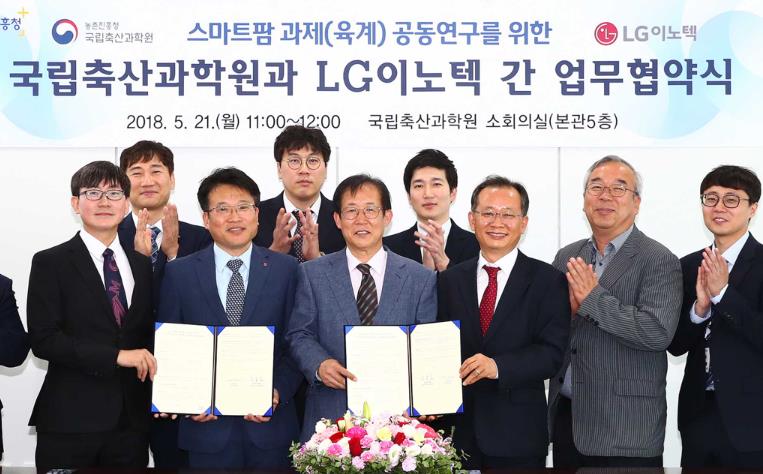
LG Innotek announced that it will collaborate with the National Institute of Animal Science (Rural Development Administration) to develop "AI-powered smart farm technology" to automate poultry farming environments. Both companies agreed that efficient and specialized breeding systems are necessary to enhance the competitiveness of the poultry industry and improve farm welfare.
The two sides signed a memorandum of understanding (MOU) on joint research on the development of smart poultry farm technology at the National Institute of Animal Science in Iseo-myeon, Wanju-gun, Jeollabuk-do, with LG Innotek CTO Kwon Il-geun, National Institute of Animal Science President Yang Chang-beom, and Poultry Research Institute Director Moon Hong-gil in attendance.
Development of "unmanned feed management technology" to revolutionize poultry productivity
LG Innotek and the National Institute of Animal Science are developing AI-powered smart farm technology aimed at improving poultry productivity through unmanned livestock management. This effort will integrate deep learning technology utilizing poultry big data and camera sensing technology.
Once this smart farm technology is developed, cameras and various sensors will automatically analyze the condition of tens of thousands of chickens and environmental changes, including weather. Artificial intelligence will then automatically control the temperature and humidity in the chicken farm. Furthermore, analysis of the chickens' developmental status will enable the prediction of shipping times.
To this end, the National Institute of Animal Science is responsible for research on behavioral analysis of chickens at each growth stage, which serves as an identification standard, and development of related standards. LG Innotek is developing a deep learning algorithm that identifies symptoms of suspected diseases based on a measurement system comprised of cameras and temperature and humidity sensors, as well as standardized information provided by the National Institute of Animal Science.
LG Innotek plans to perfect its technology to a level that can be applied to poultry farms by 2020. It currently has secured basic technologies, including object recognition technology using network cameras and an algorithm for detecting abnormal chicken movement.
Early quarantine is expected to minimize damage from poultry epidemics.
This AI-powered smart farm technology can also be used to reduce the impact of infectious diseases on poultry farms. If chickens managed on a smart farm show signs of infection, the farmer is immediately notified of the chicken's condition and location, enabling rapid quarantine measures.
Large-scale poultry farms house tens of thousands of birds, making them highly vulnerable to infectious diseases like highly pathogenic avian influenza (HPAI). Visually detecting even one or two suspected infected birds is extremely difficult, and until the farm reports the situation, there are no effective response measures.
In fact, the highly pathogenic avian influenza outbreak in November 2016 led to the culling of a total of 33.14 million chickens, ducks, and other animals from 821 farms across Korea within just three months. The damage to poultry farms and related industries, including direct and indirect costs, was estimated at 1 trillion won.
CTO Kwon Il-geun said, “Our goal is to make our lives safer and more convenient through innovative technologies,” and added, “AI smart farm technology will be a solution that will revolutionize our country’s agricultural and livestock industry and improve the welfare of farmers.”
Comments
Related news
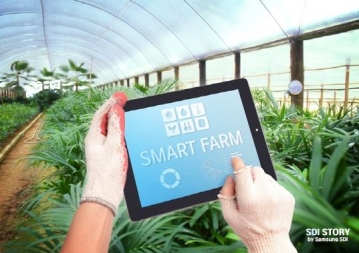
[Smart Farm] "We will make farming a happy experience for those returning to the countryside" through agricultural standardization.
There is a joke that goes, "If there are 4.5 million farmers, there are 4.5 million farming methods." This speaks to how different each individual farmer's approach is. This is also why urban farmers dreaming of returning to agricultural life often face 'discrimination' when settling in rural areas. Park Heun-dong, director of research at FarmCloud, stated, "Through standardization of farming methods, we will enable those returning to farming to establish themselves without difficulty." This was at a conference held on the 19th by the Ministry of Science and ICT regarding the IoT open platform-based development verification support infrastructure construction project. The ICT convergence Korean-style smart farm development strategy currently presented by the Rural Development Administration consists of three generations. ▲The first generation links sensors and smartphones to allow viewing of greenhouses from outside. It displays sensors and controllers through video. ▲The second generation adds big data analysis to first-generation farm technology to provide intelligent prescriptions. It applies complex environmental control to measure the atmospheric environment inside and outside the greenhouse and applies intelligent control algorithms, supporting decision-making through cloud services. ▲The third stage involves standardizing components through complex energy management and robot introduction, reaching a level where the platform can enter the global market.
2017.09.20by 김자영 기자
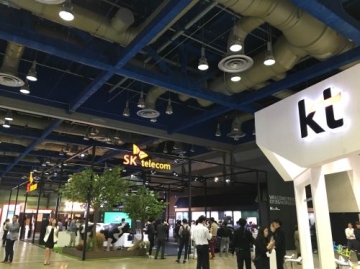
[Photo News] Meet the smart world at the 'IoT International Exhibition'
The Internet of Things International Exhibition, where you can see at a glance the various application fields of the Internet of Things such as smart cities, smart farms, smart metering, smart factories, smart cars, and smart homes, was held at COEX for three days starting on the 11th.
2017.10.11by 김자영 기자
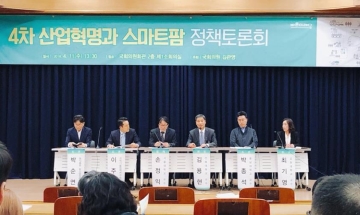
In the era of smart farms, what issues need to be resolved to activate them?
As ICT technology advances, various industrial fields from autonomous vehicles to smart cities are being integrated with this technology, and we are entering the era of the Fourth Industrial Revolution. Agriculture is also experiencing a 'smart' trend. In response, we held a discussion identifying issues for activating smart farms. As rural areas in our country face aging populations, the agricultural population is declining, and new interests such as urban agriculture and returning to farming are emerging. Smart agriculture refers to intelligizing, networking, quantifying, and automating agriculture by adopting big data, IoT, and other technologies. A smart farm is a farm that implements ICT in fields such as greenhouses and livestock facilities to measure the growth environment of crops, livestock, and fish in real-time remotely and manage them efficiently according to specific objectives.
2018.04.16by 김지혜 기자
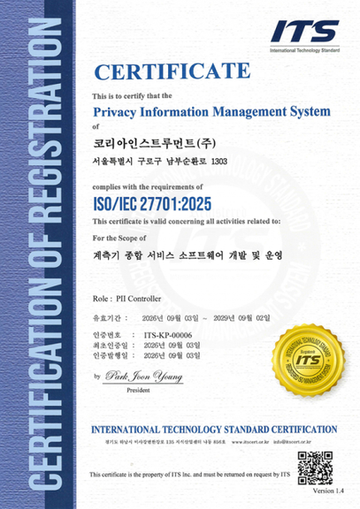
Korea Instrument, KOLAS Accredited Calibration Agency First to Simultaneously Acquire ISO/IEC 27,001·27,701
Korea Instrument has become the first among KOLAS accredited calibration agencies to simultaneously acquire ISO/IEC 27,001 and ISO/IEC 27,701 certifications. Through its proprietary platforms CWIZ Enterprise and CWIZ Partners, the company has embedded information security and personal data protection requirements across all business processes including customer information, equipment data, and calibration reports, with plans to continuously advance its management system through regular audits and security inspections.
2026.10.12by 배종인 기자
TeamViewer One, IT Incident Automation Workflow and Resolution Center Enhanced
TeamViewer has added IT incident automation capabilities and an advanced Resolution Center to its integrated digital workplace management platform 'TeamViewer ONE'. Recurrent service disruptions, configuration errors, and capacity shortages are automatically handled according to preset policies, and device status verification through script deployment can be managed in a unified interface, significantly reducing repetitive tasks for IT teams.
2026.10.12by 배종인 기자











