



PHM technology that predicts failures through real-time monitoring
 Published2018.07.12 10:26
센서 변화 값을 측정하는 측정 하드웨어 역할 중요
기계 결함에 제때 대처하지 못하면 갑작스런 고장으로 큰 사고가 발생할 수 있다. 그래서 산업현장에서 인명피해와 재산피해를 막기 위한 정기적인 산업설비 예방정비가 실시되고 있지만 비용이 만만치 않다. 결함 부품 뿐만 아니라 문제없는 부품까지 같이 교체하는 바람에 낭비가 심한 탓이다. 또한 정기적으로만 실시되어 갑작스러운 고장예방에도 한계가 있다. 이러한 이유로 고장예지 및 건전성 관리(Prognostics and health management, PHM) 기술이 거의 모든 산업분야에서 정기적 예방정비의 대안으로 떠오르고 있다.

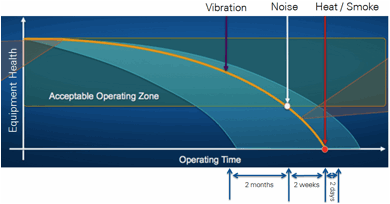
진동 센서가 이상을 감지하는 시점
PHM 기술은 기계 상태를 실시간으로 감시한다. 마모, 비정렬, 오염 등 기계 이상을 조기에 감지하고 미래에 발생할 고장을 예측한다. 가령 진동 센서는 고장 발생 약 2달 전에 고장 조짐을 감지할 수 있다. 이로써 적절한 조치를 미리 취할 수 있어 불필요한 유지보수 비용을 줄일 수 있고 안정성과 신뢰성을 높일 수 있다.
PHM 기술은 1980년대 영국 민간항공국(CAA)에서 항공기보다 30배 높은 헬기 사고율을 줄이기 위해 처음 연구가 시작됐다. CAA는 1990년대 들어 헬기의 건전성을 관찰하는 HUMS(Health & Usage Monitoring System)를 개발했다. 실제 헬기에 장착하여 운용한 결과 사고율이 종전의 절반 이하로 줄었다. 이후 PHM 기술 연구가 본격적으로 시작되었고, 우리나라에서도 한국PHM학회가 지난 2월 출범하여 벌써 두번의 심포지엄을 개최했다.
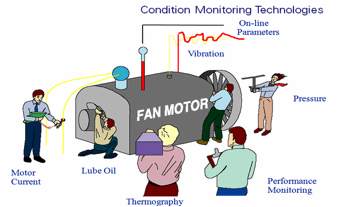
기계 이상을 감지하는 다양한 센서들
PHM 기술의 핵심은 센서다. 기계에 설치된 각 센서는 장비의 진동, 속도, 모터 전류, 온도, 압력 등의 변화를 감지한다. 그리고 그 센서를 뒷받침하는 것이 측정 하드웨어다. 측정 하드웨어는 센서가 감지한 변화를 측정한다. 측정 하드웨어가 측정한 센서 출력을 분석하고 활용할 줄 알아야 기계 고장을 예측할 수 있다.
측정 하드웨어를 고를 땐 주파수 범위, 전압 범위, 신호 컨디셔닝 요구 등 센서의 특징을 고려해야 한다. 내쇼날 인스트루먼트(NI)는 다양한 센서의 특징을 아우를 수 있는 컨디션 모니터링 시스템 측정 모듈을 출시했다.
NI의 NI 9232는 가속도계, 속도, 변형, 속도센서, 동적 입력 등의 센서 출력을 디지털화하는 범용 다이나믹 모듈로서, 24비트 델타-시그마 ADC를 분해능으로 갖고 있으며 전압 범위는 ±30V이고 샘플링 속도는 102.4kHz이다. EPE 구동은 4Ma, 24V이며 ON/OFF 설정이 가능하고 AC 커플링 컷오프는 0.1Hz이며 역시 ON/OFF 설정이 가능하다 채널은 3개고 나사 터미널은 3X 2핀 COMBICON이다.
NI의 CMS-9068 디바이스 노드에 여러 개의 NI 9232 모듈을 탑재하면 섀시당 최대 24개의 채널을 얻을 수 있다. CMS-9068용 NI 측정 모듈은 NI 9232 모듈을 포함해 14개다. NI 9207 모듈은 8개의 ±10V 입력과 8개의 -21mA~20mA 입력을 제공하며, 50/60Hz 노이즈 제거 옵션을 포함한다. NI 9205는 ±10V의 16개 차동 입력을 제공한다. NI 9208은 ±21mA의 16개 입력을 제공한다.
Comments
Related news
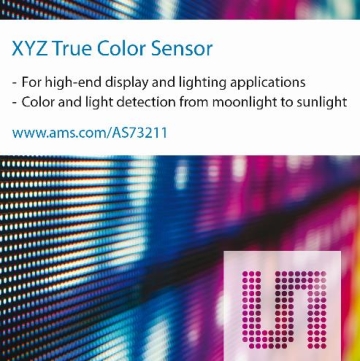
ams Launches New XYZ Color Sensors with Enhanced Dynamic Range and Sensitivity
ams announced the launch of the AS73211, a new XYZ '3-stimulus' color sensor product. The new product is characterized by superior sensitivity compared to any other product of this type and a wider range of conversion time options suitable for various operating conditions. The AS73211 extends ams's existing portfolio of TCS3430 and AS7261 true color sensor products and addresses color sensor requirements for high-end displays, spotlights, and colorimeters.
2018.05.08by 김지혜 기자
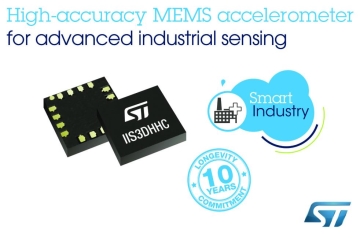
STMicroelectronics Launches High-Precision MEMS Sensor with 10-Year Warranty for Cutting-Edge Industrial Sensing
ST Microelectronics (ST) is launching a new high-reliability MEMS sensor product line with a 10-year product warranty, targeting the advanced automation and Industrial Internet of Things (IIoT) markets. The new sensor line will begin sales within 2018, with the IIS3DHHC 3-axis accelerometer being the first product, optimized for high measurement resolution and reliability that guarantees precision even with changes in time and temperature. The IIS3DHHC is suited for precision inclinometers for antenna positioning mechanisms in communication systems, structural health monitoring (SHM) equipment for building and bridge safety, stabilization devices and levels for various industrial platforms. The product's long-term accuracy and robustness make it ideal for image stabilization in advanced digital cameras, as well as high-sensitivity tilt detection and security sensors.
2018.05.15by 김지혜 기자
Keysight Launches E-Mobility Test and Measurement Solutions
elevate the advancement potential of new solutions, cell and battery technologies used in hybrid, electric vehicles and related energy storage devices, and electric powertrain components and subsystems
2018.06.14by 명세환 기자

ESP32 Development Environment Selection and GPS Application Implementation
The ESP32 is a microcontroller that integrates Wi-Fi, Bluetooth, 12-bit ADC, capacitive touch, PWM, DAC, and UART in a single SoC. However, the abundance of features does not by itself solve the designer's problems. The real challenges lie in selecting the appropriate development environment, determining which pins can be used and which must be avoided, and converting raw data from modules into usable information. This document addresses ESP32 peripheral constraints (ADC2 and Wi-Fi coexistence limitation, UART1 occupancy, ADC non-linear regions), the trade-offs between Arduino IDE and ESP-IDF, and the process from connecting NEO-6M/NEO-M8N GPS modules to UART2, parsing NMEA sentences, and visualizing routes in Google Earth, all organized based on documented references.
2026.10.12by 편집부
MIPI CSI-2, DSI-2, C-PHY, D-PHY Test Solution Technical White Paper
The MIPI interface adopts a burst mode that transitions between low-power (LP) and high-speed (HS) states for low-power consumption, and in return, strict timing rules are imposed on state transitions. Additionally, the high-speed section operates as a packet-based protocol with headers, ECC, and CRC, so verification engineers must handle waveforms and protocols simultaneously. Traditional configurations combining general-purpose oscilloscopes and AWGs reveal limitations in setup complexity, measurement uncertainty, and lack of reproducibility when faced with these requirements. This white paper, based on webinar materials, organizes the structure of this problem and describes how the SV5C-DPTXCPTX generator for receiver testing and SV5C-DPRXCPRX analyzer for transmitter testing integrate state transition testing, stressed eye testing, and protocol analysis into a single bench, along with their application boundaries.
2026.10.12by 편집부











