


WD Unveils Future Data Infrastructure 'OpenFlex'
 Published2018.08.08 09:28
SCI Management Open API Kingfish
Support for vendor-neutral solutions
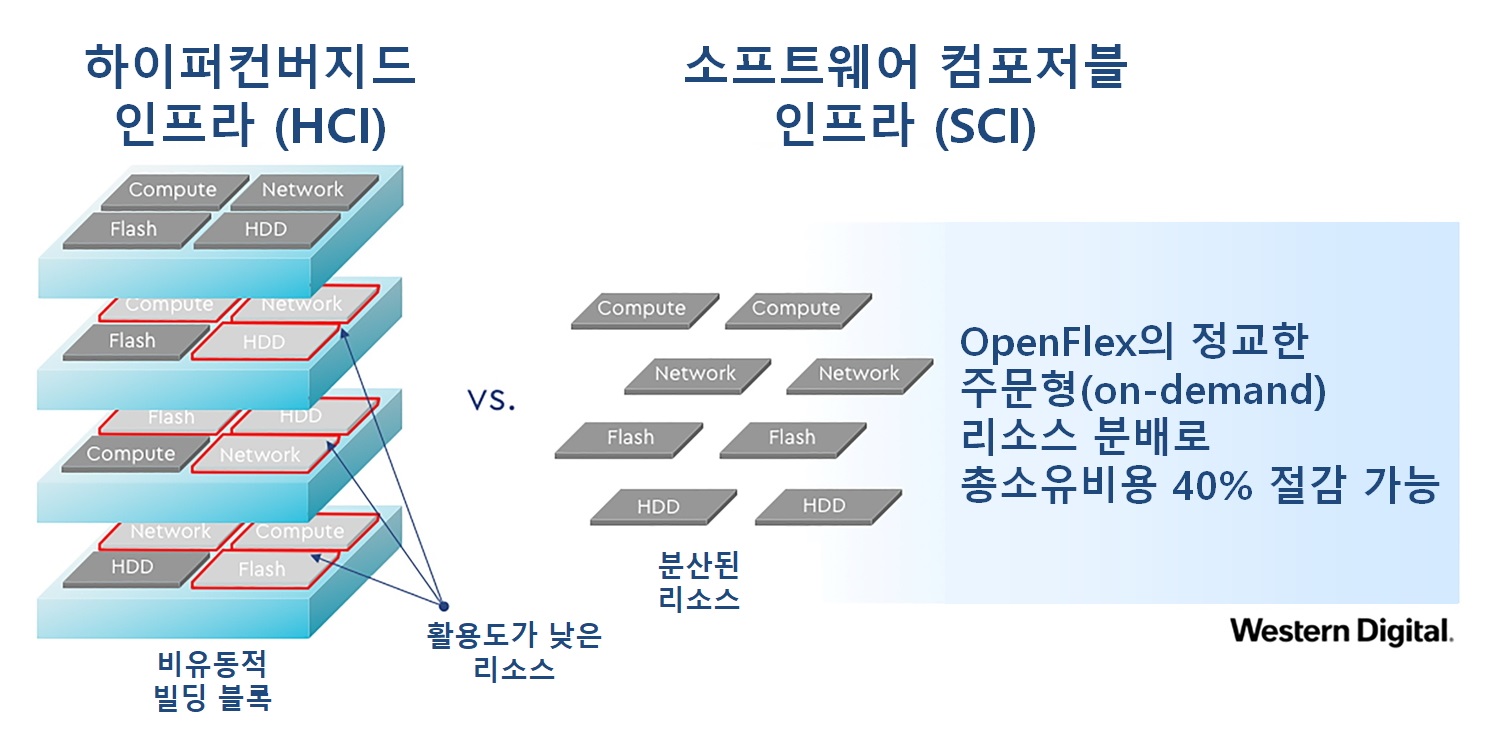
Western Digital unveiled open standards, architectures, and new products to meet the demand for high-scale private and public cloud data centers.
Western Digital unveiled its new 'OpenFlex' architecture and product family at the 'Flash Memory Summit 2018,' held in Santa Clara, California, from August 7 to 9 (local time). Along with this, the company announced plans to complete the foundation for an open Software Composable Infrastructure (SCI) by releasing Application Programming Interfaces (APIs) and key product specifications to the open community. SCI supports the independent and rapid scaling and coordination of computing, storage, and network resources, delivering a new level of scalability, efficiency, agility, and performance.
With the explosion of data, not only are new big data and fast data applications increasing, but the ways in which data is captured, preserved, accessed, and transformed are also becoming very complex. Massive data sets are being shared across various applications over longer lifecycles, and the dynamics of such demanding high-scale workloads are already exceeding the limitations of traditional data infrastructure.
Western Digital's OpenFlex architecture is designed based on the industry-standard NVMf technology to build flash and disk pools that are independently scalable and connect to computing resources via common network technologies such as Ethernet. The Kingfish API enables the flash and disk pools built via OpenFlex to be easily and rapidly implemented as SCI, which can be scaled into logical application servers. Compared to Hyperconverged Infrastructure (HCI), where computing, storage, and network ratios are fixed, the OpenFlex architecture and products can reduce Total Cost of Ownership (TCO) by up to 40% by eliminating unused resources. Additionally, sophisticated scalability can reduce initial infrastructure investment costs by approximately 50%. Furthermore, because OpenFlex directly connects distributed resources, logical servers are less sensitive to "noisy neighbor" workloads—where servers compete for the same resources and data paths—making application performance more predictable.
Phil Bullinger, Senior Vice President and General Manager of Data Center Systems (DCS) at Western Digital, stated, “Data centers require a more efficient approach to meet the requirements of complex and dynamic application and data workflows.” “Therefore, data center operators need open solutions that allow them to choose best-in-class vendor-neutral options,” he said. “Western Digital’s OpenFlex architecture and products, along with its contributions to the open community, satisfy these needs while also achieving improvements in cost and agility. Western Digital will lead the future of data infrastructure based on its proven leadership in disk, flash, and NVMe storage products.”
According to a recent survey by market research firm IDC, mid-to-large enterprise IT users are utilizing less than half of their available computing and storage resources. When asked about dynamic workload demands, 70% of users cited the time inefficiency involved in providing computing and storage resources. Ashish Nadkarni, Vice President of the Infrastructure Systems, Platforms, and Technology Group at IDC, explained, “Western Digital’s OpenFlex architecture not only provides flexible configurations that maximize resource utilization with high scalability but also resolves the issue of storage isolation. Furthermore, by adopting an open architecture, it paves the way for building a broader ecosystem without the lock-in issues associated with proprietary infrastructure.”
As part of its contribution to open architecture, Western Digital is releasing Kingfish APIs and product specifications to the community, providing vendor-neutral and compatible solutions. The broad data center hardware and software ecosystem utilized by the OpenFlex architecture includes, as of the time of announcement, Apache Hadoop, Apache Spark, Apache Kafka, Apache Cassandra, Apache Mesos, Broadcom, Ceph, DriveScale, Hewlett Packard Enterprise (HPE), Inspur, Kaminario, Kubernetes, Marvell, Mellanox Technologies, Microsoft SQL Server, Percona, Super Micro Computer, and others.
Western Digital's OpenFlex fabric-attached product family is available in various performance and capacity levels, enabling data center designers and IT managers to build scalable and flexible data centers tailored to their specific needs.
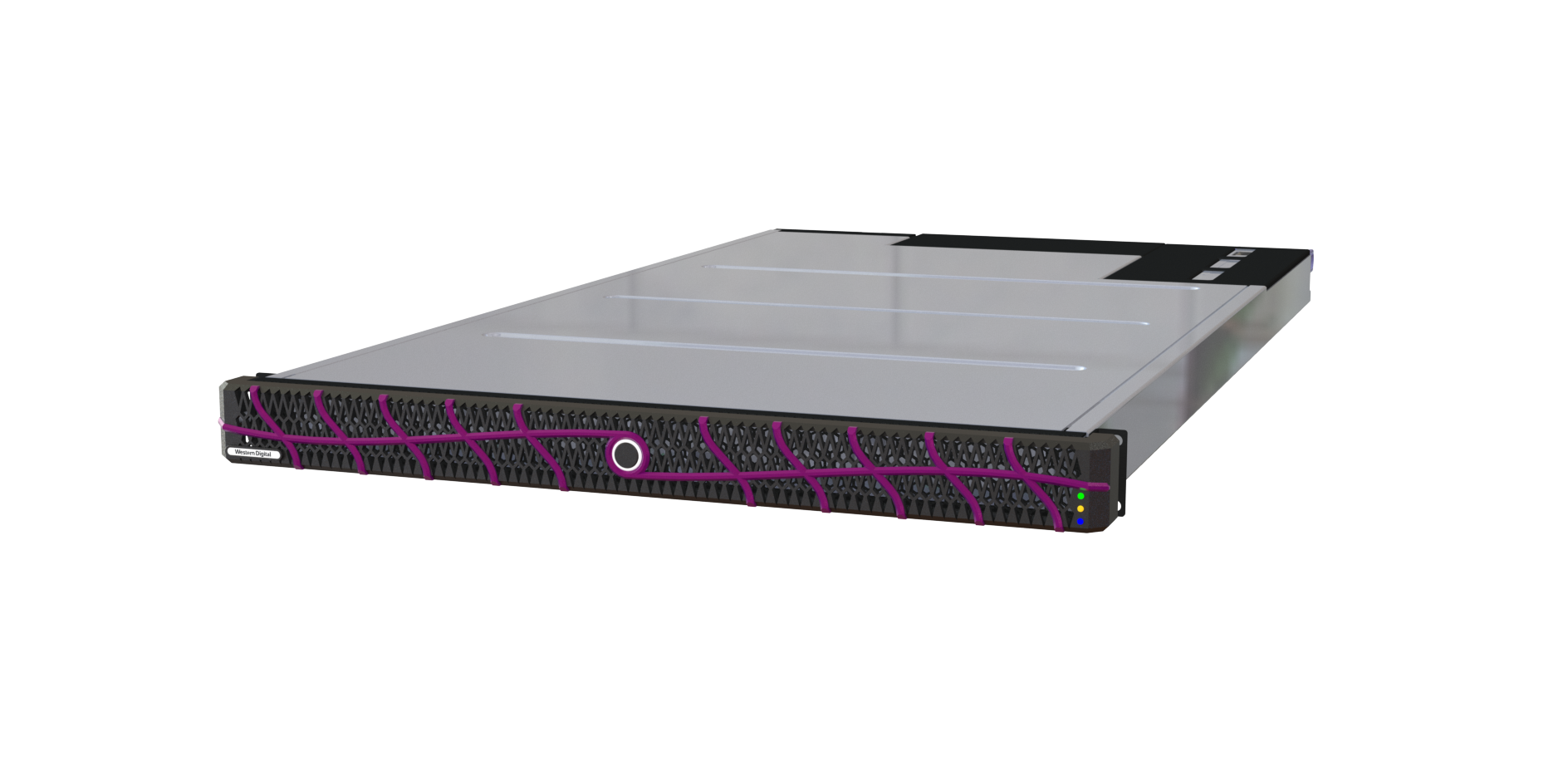
Openflex F3000 Fabric Device .png)
Openflex F300 Fabric Enclosure
Openflex F3000 Series Fabric The OpenFlex F3000 Series Fabric Device is designed for performance-intensive fast data applications and is available in capacities up to 61TB. It delivers low-latency NVMe flash performance via two 50Gb Ethernet ports. The OpenFlex E3000 Series Fabric Enclosure is a 3U enclosure capable of housing up to 10 hot-swap supported F3000 fabric devices. The OpenFlex D3000 Series Fabric Device is a 1U device designed for capacity-intensive big data applications, providing up to 168TB of hard disk capacity via two 25Gb Ethernet ports.
The OpenFlex F3000 fabric device and OpenFlex E3000 enclosure are scheduled for release in late 2018, and the OpenFlex D3000 fabric device in 2019.
Comments
Related news

Western Digital Begins Domestic Sales of New 'SanDisk Extreme Portable SSD'
Western Digital is introducing the SanDisk Extreme Portable SSD, a new concept latest external SSD designed for professional photographers requiring high-speed and large-capacity storage, to the domestic market and is commencing full-scale sales.
2018.06.14by 명세환 기자
96-layer 3D NAND technology with 1.33 terabit
Western Digital announced the development of a 96-layer 3D NAND technology based on second-generation QLC architecture and is beginning full-scale sample shipments.
2018.08.04by 이수민 기자
Dell EMC Expands Disk Array Supply to Nara Jangteo
Dell EMC has additionally registered eight types of mid-range storage and enclosures under the "disk array" category on the National Procurement Service's Nara Jangter Comprehensive Shopping Mall.
2018.08.05by 이수민 기자
.jpg)
SalePoint Signs Multi-Year Partnership Agreement with AWS… Promoting Identity Security that Integrates Even AI Agents
Sailpoint has entered into a multi-year strategic partnership agreement with AWS and is moving forward with establishing an integrated governance system that manages both human and non-human identities together. The plan is to consistently manage access permissions in an environment where AI agents are increasing as work execution entities, while applying the principle of least privilege and automated policy enforcement. The two companies plan to jointly expand capabilities to manage the identities of various entities, including AI agents, within a single layer in the AWS environment. This collaboration is interpreted as a move to design security and governance together in corporate environments where AI adoption is expanding.
2026.03.26by 배종인 기자
.png)
Databricks Unveils Open AI Security Monitoring 'Lakewatch'
Databricks entered the security market on March 24 by unveiling LakeWatch, an open-source agentic SIEM. The core functionality of this product is to integrate and analyze security, IT, and business data in a single environment to support AI-based threat detection and investigation. The company explained that it reduces the limitations of existing security operations centers, which have had to forgo some data due to high cost structures, and enables large-scale data analysis and automation based on open formats and ecosystems. LakeWatch is currently offered as a private preview, with Adobe and Dropbox mentioned as early customers. Databricks also announced an expanded partnership with Anthropic as well as the acquisition of Antimatter and SiftD.ai.
2026.03.26by 배종인 기자











