


Schneider Takes an In-house Look at Sustainability
 Published2018.08.10 11:50
Exceeded targets in 8 out of a total of 21 indicators
Schneider Electric announced the results for the second quarter of 2018 of the 'Schneider Sustainability Impact 2018-2020' assessment.
Schneider publishes the '2018–2020 Schneider Sustainability Impact' every quarter. This replaces the 'Planet & Society Barometer,' which Schneider has built in-house since 2005 to measure its performance in achieving its sustainability goals.
Schneider’s sustainability impact includes a total of 21 indicators across fields such as climate, circular economy, health equity, ethics, and development. Schneider exceeded its quarterly target by 4 out of 10, recording 4.55 out of 10 as of the end of July 2018. The goal for the end of 2018 was set at 5 out of 10.
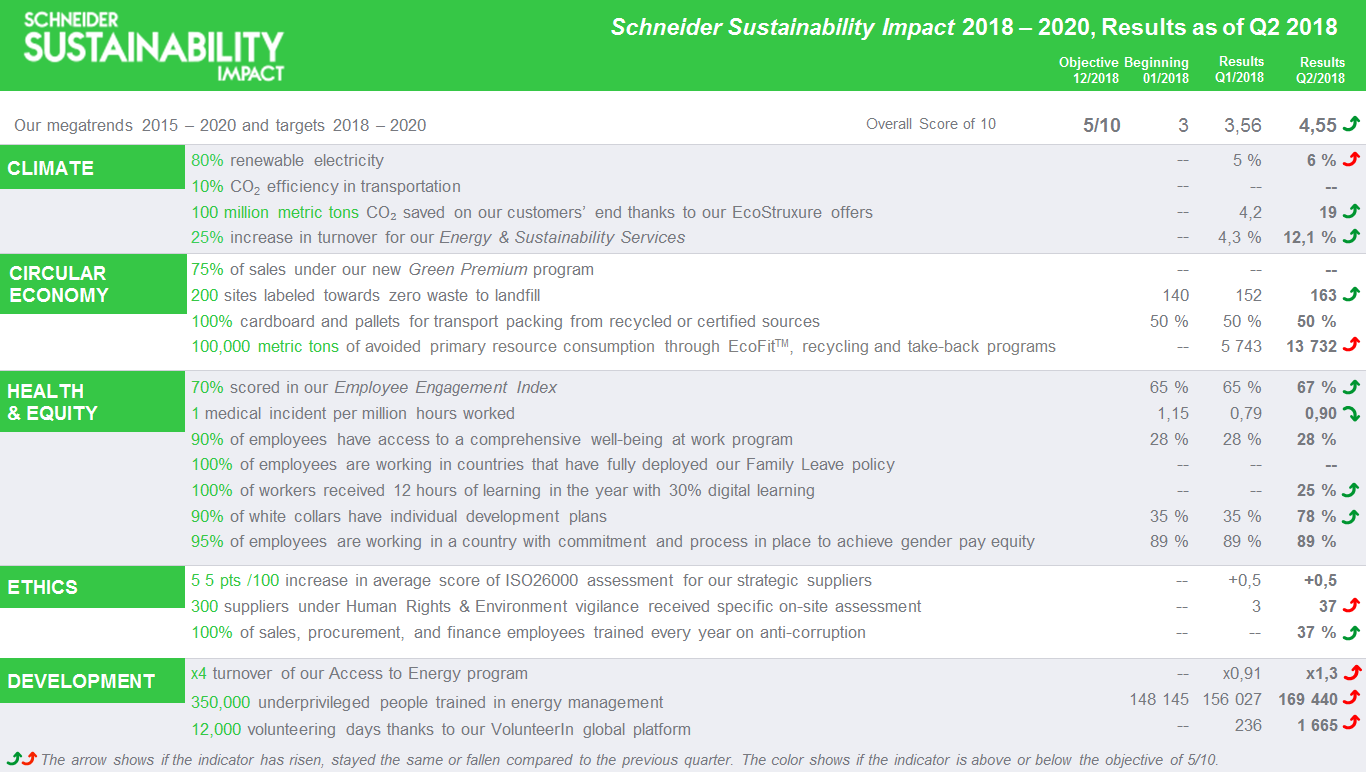
Schneider Electric's 'Schneider Sustainability Impact Assessment' Q2 2018 Results
The key results for each sector are as follows.
In the 'Climate' sector, the "80% renewable electricity" indicator grew by 6% in the second quarter. Schneider's energy requirements are continuously being optimized by leveraging the group's expertise and the integrated architecture solution, EcoStruxure. Global branches have already achieved a 20% reduction in energy since 2012. Schneider joined the international renewable energy initiative RE100 in late 2017 and aims to supply 80% of its total electricity consumption from renewable energy sources by 2020. Three new solar systems have been installed at facilities in India, Thailand, and China, and long-term renewable energy purchase agreements are currently being discussed in several countries.
In the 'Circular Economy' sector, the "Zero Landfill Waste" labeling indicator has now been expanded to 163 sites across 200 locations. This result demonstrates that Schneider recycled and reused an amount of metal equivalent to four Eiffel Towers during the first half of 2018. Additionally, it prevented non-metallic waste equivalent to over 3,400 garbage trucks from being dumped into landfills. This indicator aims not only to improve performance across various sites but also to foster mature innovation. By leveraging bold ideas such as on-site returnable and reusable packaging and digitalization solutions to go beyond recycling, it is possible to drive circular economy solutions within the supply chain. This completely eliminates waste generation and integrates business and environmental values.
In the 'healthcare equity' sector, the 'employee engagement index recorded 70%' indicator increased to 67%, up 2 points from the end of 2017. This indicator is at an appropriate level compared to the market average and has been rising for six consecutive years with the goal of achieving 70% by 2020.
In the 'Ethics' category, the indicator 'Specific on-site evaluation of 300 suppliers under human rights and environmental monitoring' recorded audits of a total of 37 suppliers in the second quarter of 2018. This indicator relates to the management of human rights and the environment and involves auditing a group of 300 suppliers over a three-year period. In the first quarter of 2018, with processes, teams, and governance established, the first three audits were conducted. The audits focus on identifying areas where suppliers require improvement and action plans, and finding ways to provide group-level support by ensuring they adhere to the industry best practice, the Responsible Business Alliance (RBA) Code of Conduct.
In the 'Development' sector, the '12,000 days of volunteer work on the VolunteerIn global platform' metric showed better-than-expected results in the second quarter. Currently, 7,258 days of volunteer work have been completed, compared to 1,665 days completed in the first quarter. The Schneider Electric Foundation plans to launch a new level of effort to encourage partner participation by introducing the new 'VolunteerIn' digital platform.
Gilles Vermot Desroches, Head of Sustainability at Schneider, stated, "We are proud that Jean-Pascal Tricoire, Chairman and CEO of Schneider Electric, has been appointed to the UN Global Compact. We are committed to promoting human rights and international labor standards, protecting the environment, and combating corruption, while constantly striving to ensure that all members embrace the Sustainable Development Goals (SDGs). This appointment also demonstrates Schneider Electric's continued commitment to sustainable development. These efforts are embodied in the Schneider Sustainability Impact indicators for 2018–2020. In late July 2018, the Group achieved a total score of 4.55, exceeding its target score by 4 points out of 10. This is another achievement confirming that Schneider Sustainability Impact is on a solid trajectory."
Comments
Related news
LG Electronics and LG Chem Extend a Helping Hand to Social Economy Enterprises in the Eco-friendly Sector
LG Electronics, together with LG Chem, fulfills corporate social responsibility by supporting the growth of social economy enterprises in the eco-friendly sector. From the 22nd of this month through the 18th of next month, social economy enterprises in the eco-friendly field will be recruited. Companies wishing to apply can obtain the application form from the LG Social Campus website and submit it via email. Following document screening, on-site review, and interviews, 'LG Social Fellows' will be finally selected at the end of April after evaluating social value, sustainability, and support validity. Selected companies will receive support including ▲up to 50 million won in free grants and up to 100 million won in interest-free loans ▲customized training programs for individual companies such as productivity improvement consulting ▲opportunities to visit overseas social economy enterprises ▲independent office space at LG Social Campus within Korea University.
2018.02.23by 김학준 기자
Schneider Takes on Solving Cyber Security Threats in the Smart Factory Era
Schneider Electric has designated cybersecurity as a core corporate issue in response to hyperconnectivity in the smart factory era. Schneider is strengthening cybersecurity within its integrated architecture platform EcoStruxure.
2018.07.11by 이수민 기자
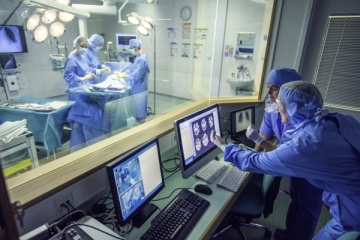
Schneider Electric Announces Solution for Building Future 'Smart Hospitals'
High power consumption, and the potential for life-threatening accidents in the event of power outages or failures of electrical facilities necessitate stable energy supply. Expanding the 'EcoStruxure™ for Healthcare' solution, which enables integrated management of medical facility equipment and energy based on Internet of Things (IoT) technology, into the Korean market.
2018.07.19by 명세환 기자
Nvidia invests $5 billion in Intel
NVIDIA and Intel, leaders in global AI computing technology, are now forging ahead in providing cutting-edge solutions through NVLink-based architecture integration. NVIDIA and Intel have officially announced a strategic partnership and stated that they will jointly develop customized data center and personal computing products to accelerate diverse applications and workloads ranging from hyperscale to enterprise and consumer markets, thereby laying the foundation for the next generation computing era.
2025.09.22by 배종인 기자
.jpg)
Applied Materials Launches Environmental Protection Campaign to Mark World Cleanup Day
Applied Materials Korea (CEO Park Kwang-seon) is carrying out environmental cleanup activities with employees and their families around the Dongtan Sinricheon area on the occasion of World Cleanup Day, evolving into a company that engages with the local community beyond technological innovation.
2025.09.22by 명세환 기자











