



ETRI succeeds in developing satellite frequency interference cancellation technology.
 Published2018.08.16 08:00
Satellite communication frequency band forward/reverse link sharing technology
Twice the efficiency compared to existing models, enabling more channels.
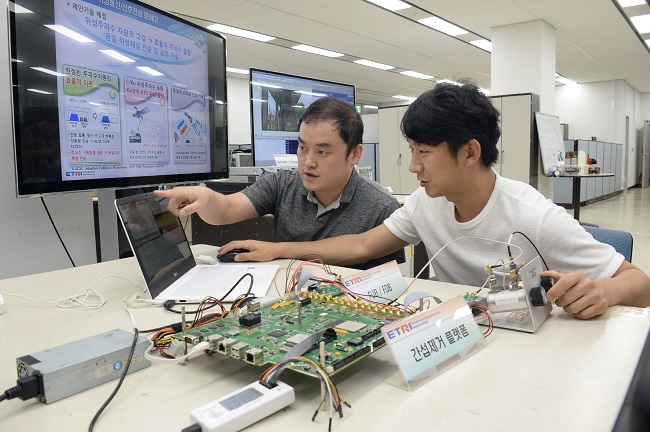
The Electronics and Telecommunications Research Institute (ETRI) announced that it has successfully developed a satellite communication frequency self-interference cancellation technology that can improve frequency usage efficiency by up to two times.
Late last month, ETRI completed verification of satellite communication frequency overlapping transmission technology that shares transmit and receive frequencies through a central station interference cancellation test using a small terminal modem (VSAT) equipment based on international satellite broadcasting standards and the Ka-band Cheonlian satellite. In the case of existing satellite communication, the frequency band (spectrum) used when sending a signal from a central base station that transmits data is different from the spectrum used by the terminal when responding to the central station. This is because the signal transmitted forward from the central station is stronger than the signal transmitted backward from the terminal, so if the same spectrum is used, the signal from the terminal cannot be received because the frequencies overlap.
ETRI researchers have developed a "self-interference cancellation technology" that can extract terminal signals even when the central station and terminals use the same frequency and their signals overlap. The overlapping signal received by the central station is a mixture of the signal previously transmitted by the central station in the forward direction and the signal transmitted by the terminal in the reverse direction. This technology separates the previously transmitted signal from this overlapping signal, thereby extracting only the signal transmitted by the terminal.
Currently, central station interference cancellation technology is a technology possessed only by world-class satellite technology companies. Domestic satellite equipment manufacturers, lacking proprietary technology, have struggled to enter the market. The technology developed by ETRI has been proven to support world-class self-interference cancellation rates and transmission speeds, enabling stable detection of desired signals from interference caused by frequency overlap. This allows for twice the number of additional channels to be allocated compared to existing satellite communication systems that use different uplink and downlink frequencies, thereby halving the cost of satellite communication repeaters.
Additionally, by securing additional channels, it becomes possible to transmit and receive large amounts of data and high-quality data using limited frequencies. Furthermore, because this technology uses overlapping transmission and reception frequencies, systems without "self-interference cancellation technology" cannot communicate. Therefore, it could be useful for defense communications, where communication security is essential.
ETRI's Oh Deok-gil, PL of the Satellite Technology Research Group, explained, "In the domestic satellite equipment manufacturing market, which is highly dependent on imported equipment, this is very significant in that we have succeeded in securing core technologies that can significantly improve the frequency usage efficiency of satellite communication systems through our own technological prowess and in localizing related equipment."
This technology development was conducted over a three-year period, beginning in 2016, as part of the Ministry of Science and ICT's "Development of Same Satellite Channel Transmission and Frequency Sharing Technology." The research team published 10 academic papers, transferred one technology, and applied for seven domestic and international patents based on this technology. ETRI plans to further transfer this technology to military communications and satellite communications equipment manufacturers, with the goal of commercialization in the second half of this year.
Meanwhile, the development and verification of core technologies such as satellite communication overlapping transmission technology were possible because the government made full use of the Cheonsae communication satellites it owned. However, in the case of Cheonsae-1, the design life of the satellite is almost over, and the launch of a follow-up satellite is urgent for the continued provision of public services, technology development, and commercialization.
Comments
Related news

ETRI Unveils 21 Cutting-Edge ICT Technologies with Potential for Commercialization
The Electronics and Telecommunications Research Institute (ETRI) will participate in the '2018 ICT Technology Commercialization Festival' held at Seoul COEX for four days starting on the 23rd, showcasing commercialization achievements and cutting-edge ICT technologies that will lead the future together with SMEs partnering for commercialization. At this festival, ETRI will display 21 latest technologies ready for immediate commercialization, including ▲Zero UI automatic interpretation ▲mobile base station based on small cells ▲deep learning-based identity recognition capable of multi-angle recognition ▲video AI analysis and protection technology.
2018.05.25by 김지혜 기자
KT Completes 3GPP 5G Standard, Ready for 5G Commercialization
The 28 GHz band, one of Korea's domestic 5G frequency bands, has been officially recognized as the world's first 5G millimeter wave standard band, with plans to showcase the world's first 5G commercial service in March 2019.
2018.06.15by 명세환 기자
Self-driving cars that come and go automatically according to smartphone instructions
The Electronics and Telecommunications Research Institute (ETRI) has developed autonomous vehicle technology that enables vehicle boarding through mobile call-up and successfully demonstrated it.
2018.08.03by 이수민 기자
European Patent Applications Surpass 200,000 for the First Time… South Korea Maintains 5th Place, Led by Batteries and Telecommunications
According to the European Patent Office (EPO)'s 'Technology Dashboard 2025', European patent applications last year reached 201,974, surpassing 200,000 for the first time. Korean companies and inventors filed 14,355 applications, representing a 9.5% increase from the previous year and maintaining 5th place by country. Battery, digital communication, and semiconductor technologies led the growth, with Samsung ranking as the top EPO applicant for the second consecutive year and LG reaching 3rd place. The presence of major domestic cities such as Seoul, Suwon, and Yongin was also confirmed. It was also revealed that Korea's European patent strategy is expanding beyond individual technologies to span the entire industry.
2026.03.24by 명세환 기자

SK Telecom First Applies AI-Based Network Operations at Gwanghwamun K-Pop Concert
SK Telecom announced that it applied an AI-based network operation system for the first time at a large-scale K-pop concert held in the Gwanghwamun area of Seoul on March 21st, managing communication quality throughout the event. Mobile data usage during the three hours before and after the concert reached 12.15TB, approximately doubling compared to the same time slot the previous weekend. SK Telecom monitored traffic using the AI system 'A-One' in five-minute and 50-meter units to respond to potential overload situations, while also operating temporary communication facilities and on-site personnel in parallel. This case is interpreted as confirmation of the practical applicability of AI-based autonomous network operation in an environment where demand from dense events and foreign users increases simultaneously.
2026.03.23by 명세환 기자











